3HSK | pdb_00003hsk

Crystal Structure of Aspartate Semialdehyde Dehydrogenase with NADP from Candida albicans


Experimental Data Snapshot

  • Method: X-RAY DIFFRACTION
  • Resolution: 2.20 Å
  • R-Value Free: 
    0.279 (Depositor), 0.275 (DCC) 
  • R-Value Work: 
    0.225 (Depositor), 0.220 (DCC) 
  • R-Value Observed: 
    0.227 (Depositor) 

Starting Model: experimental
View more details

wwPDB Validation 3D Report Full Report

Validation slider image for 3HSK

Ligand Structure Quality Assessment 


This is version 1.4 of the entry. See complete history

Literature

Expansion of the aspartate beta-semialdehyde dehydrogenase family: the first structure of a fungal ortholog.

Arachea, B.T.Liu, X.Pavlovsky, A.G.Viola, R.E.

(2010) Acta Crystallogr D Biol Crystallogr 66: 205-212

  • DOI: https://doi.org/10.1107/S0907444909052834
  • Primary Citation Related Structures: 
    3HSK

  • PubMed Abstract: 

    The enzyme aspartate semialdehyde dehydrogenase (ASADH) catalyzes a critical transformation that produces the first branch-point intermediate in an essential microbial amino-acid biosynthetic pathway. The first structure of an ASADH isolated from a fungal species (Candida albicans) has been determined as a complex with its pyridine nucleotide cofactor. This enzyme is a functional dimer, with a similar overall fold and domain organization to the structurally characterized bacterial ASADHs. However, there are differences in the secondary-structural elements and in cofactor binding that are likely to cause the lower catalytic efficiency of this fungal enzyme. Alterations in the dimer interface, through deletion of a helical subdomain and replacement of amino acids that participate in a hydrogen-bonding network, interrupt the intersubunit-communication channels required to support an alternating-site catalytic mechanism. The detailed functional information derived from this new structure will allow an assessment of ASADH as a possible target for antifungal drug development.


  • Organizational Affiliation
    • Department of Chemistry, University of Toledo, Toledo, Ohio 43606, USA.

Macromolecule Content 

  • Total Structure Weight: 82.91 kDa 
  • Atom Count: 5,538 
  • Modeled Residue Count: 716 
  • Deposited Residue Count: 762 
  • Unique protein chains: 1

Macromolecules

Find similar proteins by:|  3D Structure
Entity ID: 1
MoleculeChains  Sequence LengthOrganismDetailsImage
Aspartate-semialdehyde dehydrogenase
A, B
381Candida albicansMutation(s): 0 
Gene Names: CaO19.1559CaO19.9132HOM2
EC: 1.2.1.11
UniProt
Find proteins for Q5ALM0 (Candida albicans (strain SC5314 / ATCC MYA-2876))
Explore Q5ALM0 
Go to UniProtKB:  Q5ALM0
Entity Groups
Sequence Clusters30% Identity50% Identity70% Identity90% Identity95% Identity100% Identity
UniProt GroupQ5ALM0
Sequence Annotations
Expand
Reference Sequence

Small Molecules

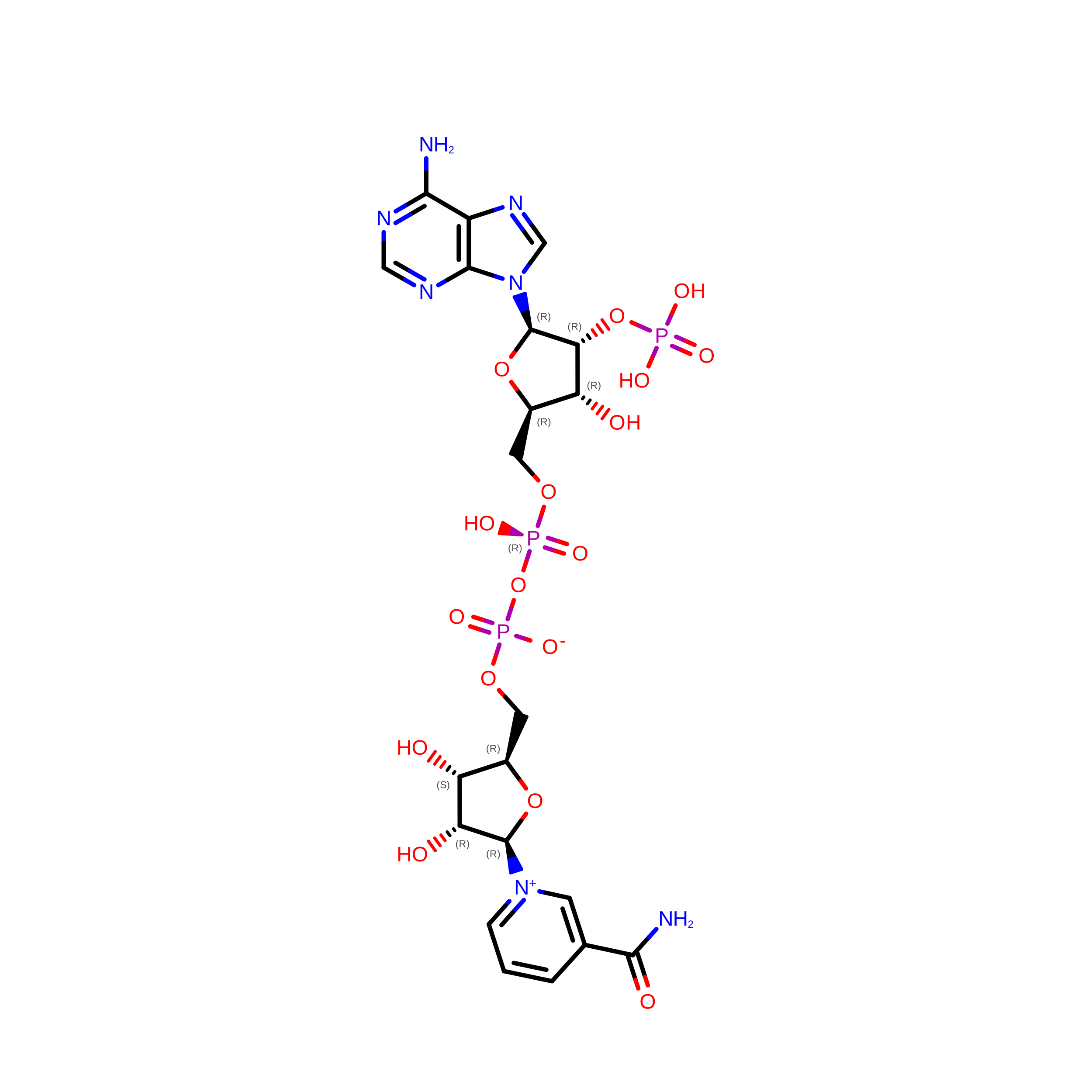
Ligands 1 Unique
IDChains Name / Formula / InChI Key2D Diagram3D Interactions
NAP

Query on NAP


Download:Ideal Coordinates CCD File
C [auth A]NADP NICOTINAMIDE-ADENINE-DINUCLEOTIDE PHOSPHATE
C21 H28 N7 O17 P3
XJLXINKUBYWONI-NNYOXOHSSA-N

Experimental Data & Validation

Experimental Data

  • Method: X-RAY DIFFRACTION
  • Resolution: 2.20 Å
  • R-Value Free:  0.279 (Depositor), 0.275 (DCC) 
  • R-Value Work:  0.225 (Depositor), 0.220 (DCC) 
  • R-Value Observed: 0.227 (Depositor) 
Space Group: C 2 2 21
Unit Cell:
Length ( Å )Angle ( ˚ )
a = 93.412α = 90
b = 152.18β = 90
c = 97.762γ = 90
Software Package:
Software NamePurpose
DENZOdata reduction
SCALEPACKdata scaling
PHASERphasing
REFMACrefinement
PDB_EXTRACTdata extraction
HKL-2000data collection
HKL-2000data reduction

Structure Validation

View Full Validation Report


Ligand Structure Quality Assessment 


Entry History 

Deposition Data

Revision History  (Full details and data files)

  • Version 1.0: 2010-02-02
    Type: Initial release
  • Version 1.1: 2011-07-13
    Changes: Version format compliance
  • Version 1.2: 2013-03-27
    Changes: Database references
  • Version 1.3: 2017-11-01
    Changes: Advisory, Refinement description
  • Version 1.4: 2023-09-06
    Changes: Advisory, Data collection, Database references, Derived calculations, Refinement description