6UAS | pdb_00006uas

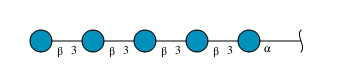
Crystal structure of a GH128 (subgroup I) endo-beta-1,3-glucanase (E199A mutant) from Amycolatopsis mediterranei (AmGH128_I) in complex with laminaripentaose


Experimental Data Snapshot

  • Method: X-RAY DIFFRACTION
  • Resolution: 1.91 Å
  • R-Value Free: 
    0.198 (Depositor) 
  • R-Value Work: 
    0.157 (Depositor) 
  • R-Value Observed: 
    0.159 (Depositor) 

Starting Model: experimental
View more details

wwPDB Validation 3D Report Full Report

Validation slider image for 6UAS

Ligand Structure Quality Assessment 


This is version 2.2 of the entry. See complete history

Literature

Structural insights into beta-1,3-glucan cleavage by a glycoside hydrolase family.

Santos, C.R.Costa, P.A.C.R.Vieira, P.S.Gonzalez, S.E.T.Correa, T.L.R.Lima, E.A.Mandelli, F.Pirolla, R.A.S.Domingues, M.N.Cabral, L.Martins, M.P.Cordeiro, R.L.Junior, A.T.Souza, B.P.Prates, E.T.Gozzo, F.C.Persinoti, G.F.Skaf, M.S.Murakami, M.T.

(2020) Nat Chem Biol 16: 920-929

  • DOI: https://doi.org/10.1038/s41589-020-0554-5
  • Primary Citation Related Structures: 
    6UAQ, 6UAR, 6UAS, 6UAT, 6UAU, 6UAV, 6UAW, 6UAX, 6UAY, 6UAZ, 6UB0, 6UB1, 6UB2, 6UB3, 6UB4, 6UB5, 6UB6, 6UB7, 6UB8, 6UBA, 6UBB, 6UBC, 6UBD, 6UFL, 6UFZ

  • PubMed Abstract: 

    The fundamental and assorted roles of β-1,3-glucans in nature are underpinned on diverse chemistry and molecular structures, demanding sophisticated and intricate enzymatic systems for their processing. In this work, the selectivity and modes of action of a glycoside hydrolase family active on β-1,3-glucans were systematically investigated combining sequence similarity network, phylogeny, X-ray crystallography, enzyme kinetics, mutagenesis and molecular dynamics. This family exhibits a minimalist and versatile (α/β)-barrel scaffold, which can harbor distinguishing exo or endo modes of action, including an ancillary-binding site for the anchoring of triple-helical β-1,3-glucans. The substrate binding occurs via a hydrophobic knuckle complementary to the canonical curved conformation of β-1,3-glucans or through a substrate conformational change imposed by the active-site topology of some fungal enzymes. Together, these findings expand our understanding of the enzymatic arsenal of bacteria and fungi for the breakdown and modification of β-1,3-glucans, which can be exploited for biotechnological applications.


  • Organizational Affiliation
    • Brazilian Biorenewables National Laboratory, Brazilian Center for Research in Energy and Materials, Campinas, São Paulo, Brazil.

Macromolecule Content 

  • Total Structure Weight: 29.04 kDa 
  • Atom Count: 2,111 
  • Modeled Residue Count: 241 
  • Deposited Residue Count: 263 
  • Unique protein chains: 1

Macromolecules

Find similar proteins by:|  3D Structure
Entity ID: 1
MoleculeChains  Sequence LengthOrganismDetailsImage
Glycoside Hydrolase263Amycolatopsis mediterraneiMutation(s): 1 

Oligosaccharides

Help  
Entity ID: 2
MoleculeChains Length2D Diagram GlycosylationD Interactions
beta-D-glucopyranose-(1-3)-beta-D-glucopyranose-(1-3)-beta-D-glucopyranose-(1-3)-beta-D-glucopyranose-(1-3)-alpha-D-glucopyranose
B
5N/A
Glycosylation Resources
GlyTouCan: G20125LZ
GlyCosmos: G20125LZ

Experimental Data & Validation

Experimental Data

  • Method: X-RAY DIFFRACTION
  • Resolution: 1.91 Å
  • R-Value Free:  0.198 (Depositor) 
  • R-Value Work:  0.157 (Depositor) 
  • R-Value Observed: 0.159 (Depositor) 
Space Group: P 1 21 1
Unit Cell:
Length ( Å )Angle ( ˚ )
a = 36.68α = 90
b = 79.347β = 103.11
c = 46.152γ = 90
Software Package:
Software NamePurpose
REFMACrefinement
PDB_EXTRACTdata extraction
XDSdata reduction
XSCALEdata scaling
PHASERphasing

Structure Validation

View Full Validation Report


Ligand Structure Quality Assessment 


Entry History 

& Funding Information

Deposition Data


Funding OrganizationLocationGrant Number
Sao Paulo Research Foundation (FAPESP)Brazil15/26982-0

Revision History  (Full details and data files)

  • Version 1.0: 2020-05-20
    Type: Initial release
  • Version 1.1: 2020-06-10
    Changes: Database references
  • Version 2.0: 2020-07-29
    Type: Remediation
    Reason: Carbohydrate remediation
    Changes: Atomic model, Data collection, Derived calculations, Structure summary
  • Version 2.1: 2020-08-05
    Changes: Database references
  • Version 2.2: 2023-10-11
    Changes: Data collection, Database references, Refinement description, Structure summary