6SWR | pdb_00006swr

Crystal structure of the lysosomal potassium channel MtTMEM175 T38A mutant soaked with zinc


Experimental Data Snapshot

  • Method: X-RAY DIFFRACTION
  • Resolution: 3.20 Å
  • R-Value Free: 
    0.299 (Depositor), 0.323 (DCC) 
  • R-Value Work: 
    0.269 (Depositor), 0.297 (DCC) 

Starting Models: experimental
View more details

wwPDB Validation 3D Report Full Report

Validation slider image for 6SWR

This is version 2.3 of the entry. See complete history

Literature

Structural basis for ion selectivity in TMEM175 K + channels.

Brunner, J.D.Jakob, R.P.Schulze, T.Neldner, Y.Moroni, A.Thiel, G.Maier, T.Schenck, S.

(2020) Elife 9

  • DOI: https://doi.org/10.7554/eLife.53683
  • Primary Citation Related Structures: 
    6HD8, 6HD9, 6HDA, 6HDB, 6HDC, 6SWR

  • PubMed Abstract: 

    The TMEM175 family constitutes recently discovered K + channels that are important for autophagosome turnover and lysosomal pH regulation and are associated with the early onset of Parkinson Disease. TMEM175 channels lack a P-loop selectivity filter, a hallmark of all known K + channels, raising the question how selectivity is achieved. Here, we report the X-ray structure of a closed bacterial TMEM175 channel in complex with a nanobody fusion-protein disclosing bound K + ions. Our analysis revealed that a highly conserved layer of threonine residues in the pore conveys a basal K + selectivity. An additional layer comprising two serines in human TMEM175 increases selectivity further and renders this channel sensitive to 4-aminopyridine and Zn 2+ . Our findings suggest that large hydrophobic side chains occlude the pore, forming a physical gate, and that channel opening by iris-like motions simultaneously relocates the gate and exposes the otherwise concealed selectivity filter to the pore lumen.


  • Organizational Affiliation
    • Department of Biochemistry, University of Zürich, Zürich, Switzerland.

Macromolecule Content 

  • Total Structure Weight: 167.18 kDa 
  • Atom Count: 10,944 
  • Modeled Residue Count: 1,372 
  • Deposited Residue Count: 1,482 
  • Unique protein chains: 2

Macromolecules

Find similar proteins by:|  3D Structure
Entity ID: 1
MoleculeChains  Sequence LengthOrganismDetailsImage
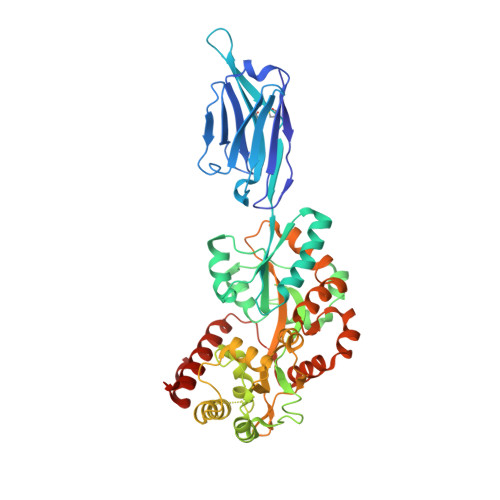
Nanobody, Maltose/maltodextrin-binding periplasmic protein,Maltodextrin-binding protein,Maltose/maltodextrin-binding periplasmic proteinA,
C [auth D]
486Lama glamaEscherichia coli K-12
This entity is chimeric
Mutation(s): 0 
Gene Names: malEb4034JW3994
Membrane Entity: Yes 
UniProt
Find proteins for P0AEX9 (Escherichia coli (strain K12))
Explore P0AEX9 
Go to UniProtKB:  P0AEX9
Entity Groups
Sequence Clusters30% Identity50% Identity70% Identity90% Identity95% Identity100% Identity
UniProt GroupP0AEX9
Sequence Annotations
Expand
Reference Sequence
Find similar proteins by:|  3D Structure
Entity ID: 2
MoleculeChains  Sequence LengthOrganismDetailsImage
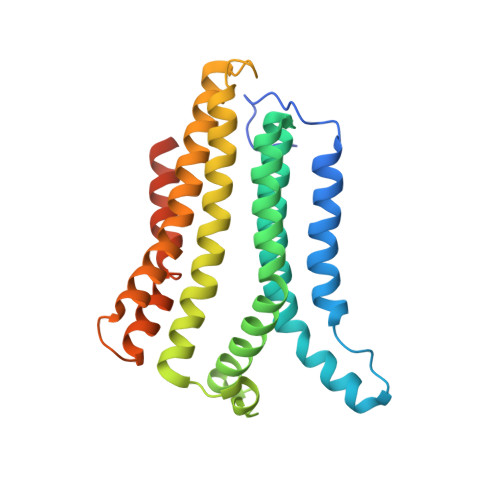
Uncharacterized proteinB,
D [auth E]
255Marivirga tractuosa DSM 4126Mutation(s): 0 
Gene Names: Ftrac_2467
Membrane Entity: Yes 
UniProt
Find proteins for E4TN31 (Marivirga tractuosa (strain ATCC 23168 / DSM 4126 / NBRC 15989 / NCIMB 1408 / VKM B-1430 / H-43))
Explore E4TN31 
Go to UniProtKB:  E4TN31
Entity Groups
Sequence Clusters30% Identity50% Identity70% Identity90% Identity95% Identity100% Identity
UniProt GroupE4TN31
Sequence Annotations
Expand
Reference Sequence

Oligosaccharides

Help  
Entity ID: 3
MoleculeChains Length2D Diagram GlycosylationD Interactions
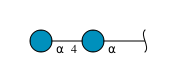
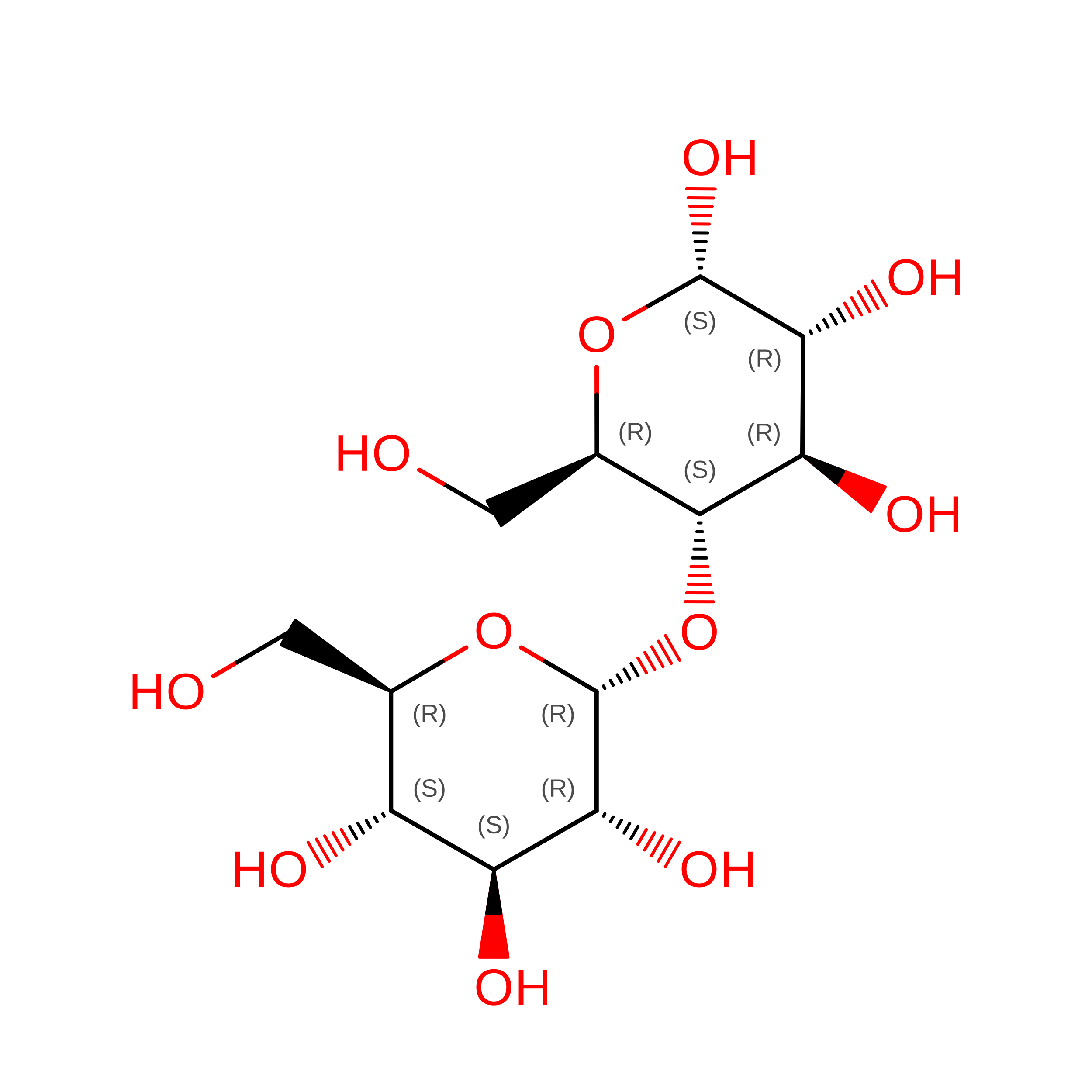
alpha-D-glucopyranose-(1-4)-alpha-D-glucopyranoseE [auth C],
F
2N/A
Glycosylation Resources
GlyTouCan: G07411ON
GlyCosmos: G07411ON

Biologically Interesting Molecules (External Reference) 

1 Unique

Experimental Data & Validation

Experimental Data

  • Method: X-RAY DIFFRACTION
  • Resolution: 3.20 Å
  • R-Value Free:  0.299 (Depositor), 0.323 (DCC) 
  • R-Value Work:  0.269 (Depositor), 0.297 (DCC) 
Space Group: P 21 2 21
Unit Cell:
Length ( Å )Angle ( ˚ )
a = 129.788α = 90
b = 131.611β = 90
c = 151.771γ = 90
Software Package:
Software NamePurpose
BUSTERrefinement
XDSdata reduction
Aimlessdata scaling
PHASERphasing

Structure Validation

View Full Validation Report


Entry History 

Deposition Data

Revision History  (Full details and data files)

  • Version 1.0: 2020-04-15
    Type: Initial release
  • Version 1.1: 2020-04-22
    Changes: Database references
  • Version 2.0: 2020-07-29
    Type: Remediation
    Reason: Carbohydrate remediation
    Changes: Advisory, Atomic model, Data collection, Derived calculations, Non-polymer description, Structure summary
  • Version 2.1: 2020-09-30
    Changes: Database references, Structure summary
  • Version 2.2: 2024-01-24
    Changes: Data collection, Database references, Refinement description
  • Version 2.3: 2024-11-20
    Changes: Structure summary