5NRD | pdb_00005nrd

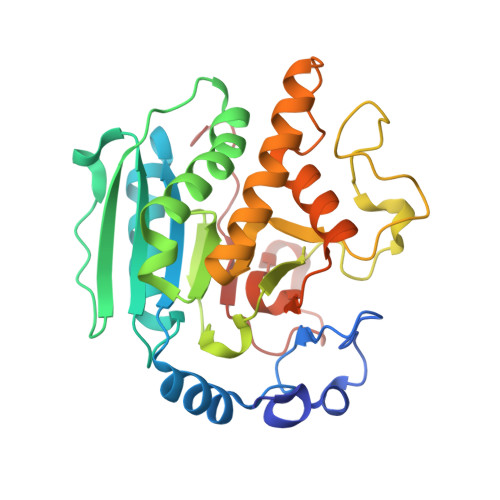
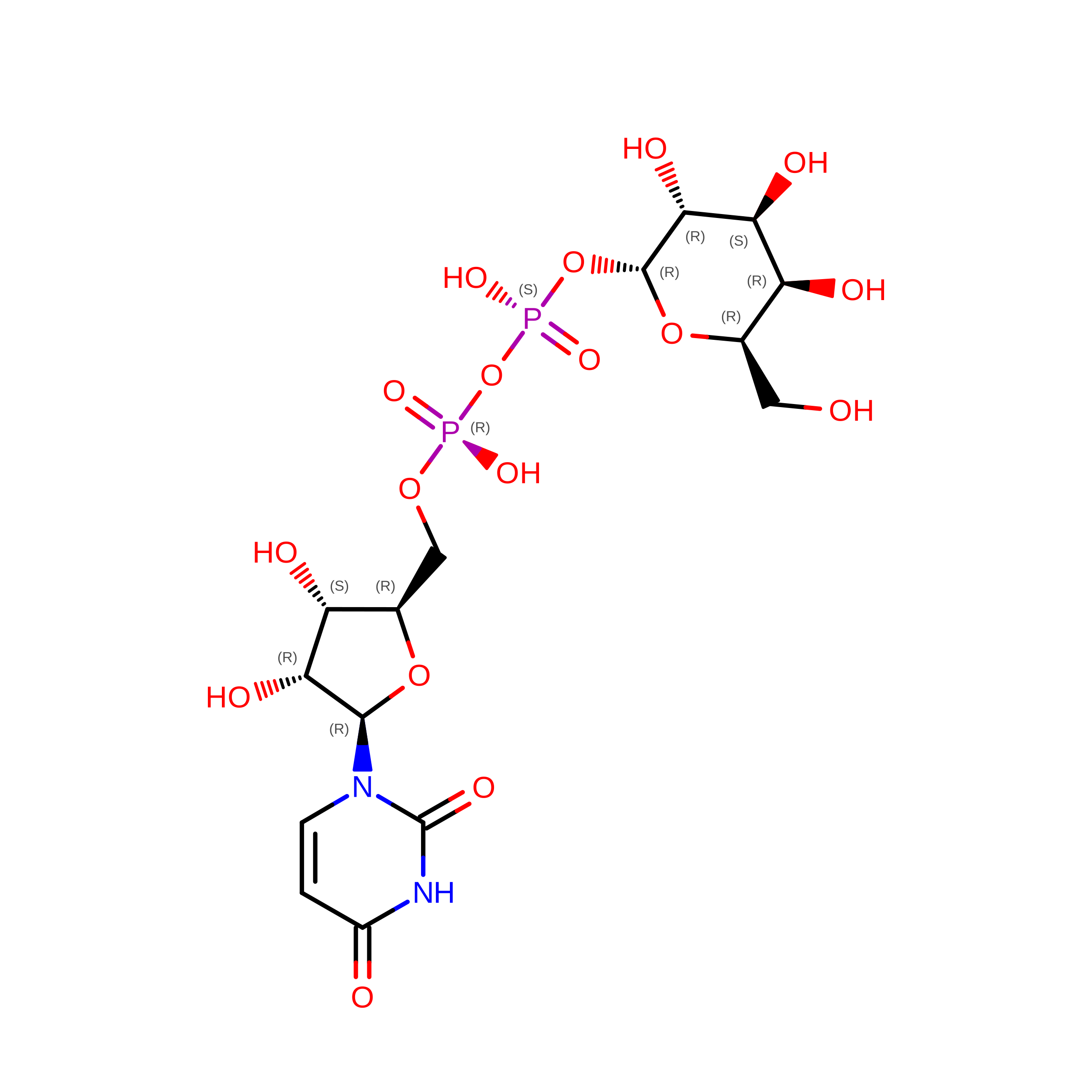
A Native Ternary Complex of Alpha-1,3-Galactosyltransferase (a-3GalT) Supports a Conserved Reaction Mechanism for Retaining Glycosyltransferases - alpha-3GalT in complex with Co2+, UDP-Gal and lactose - a3GalT-Co2+-UDP-Gal-LAT-2


Experimental Data Snapshot

  • Method: X-RAY DIFFRACTION
  • Resolution: 2.12 Å
  • R-Value Free: 
    0.249 (Depositor), 0.248 (DCC) 
  • R-Value Work: 
    0.212 (Depositor), 0.215 (DCC) 
  • R-Value Observed: 
    0.214 (Depositor) 

Starting Model: experimental
View more details

wwPDB Validation 3D Report Full Report

Validation slider image for 5NRD

Ligand Structure Quality Assessment 


This is version 2.1 of the entry. See complete history

Literature

Structural Snapshots of alpha-1,3-Galactosyltransferase with Native Substrates: Insight into the Catalytic Mechanism of Retaining Glycosyltransferases.

Albesa-Jove, D.Sainz-Polo, M.A.Marina, A.Guerin, M.E.

(2017) Angew Chem Int Ed Engl 56: 14853-14857

  • DOI: https://doi.org/10.1002/anie.201707922
  • Primary Citation Related Structures: 
    5NR9, 5NRB, 5NRD, 5NRE

  • PubMed Abstract: 

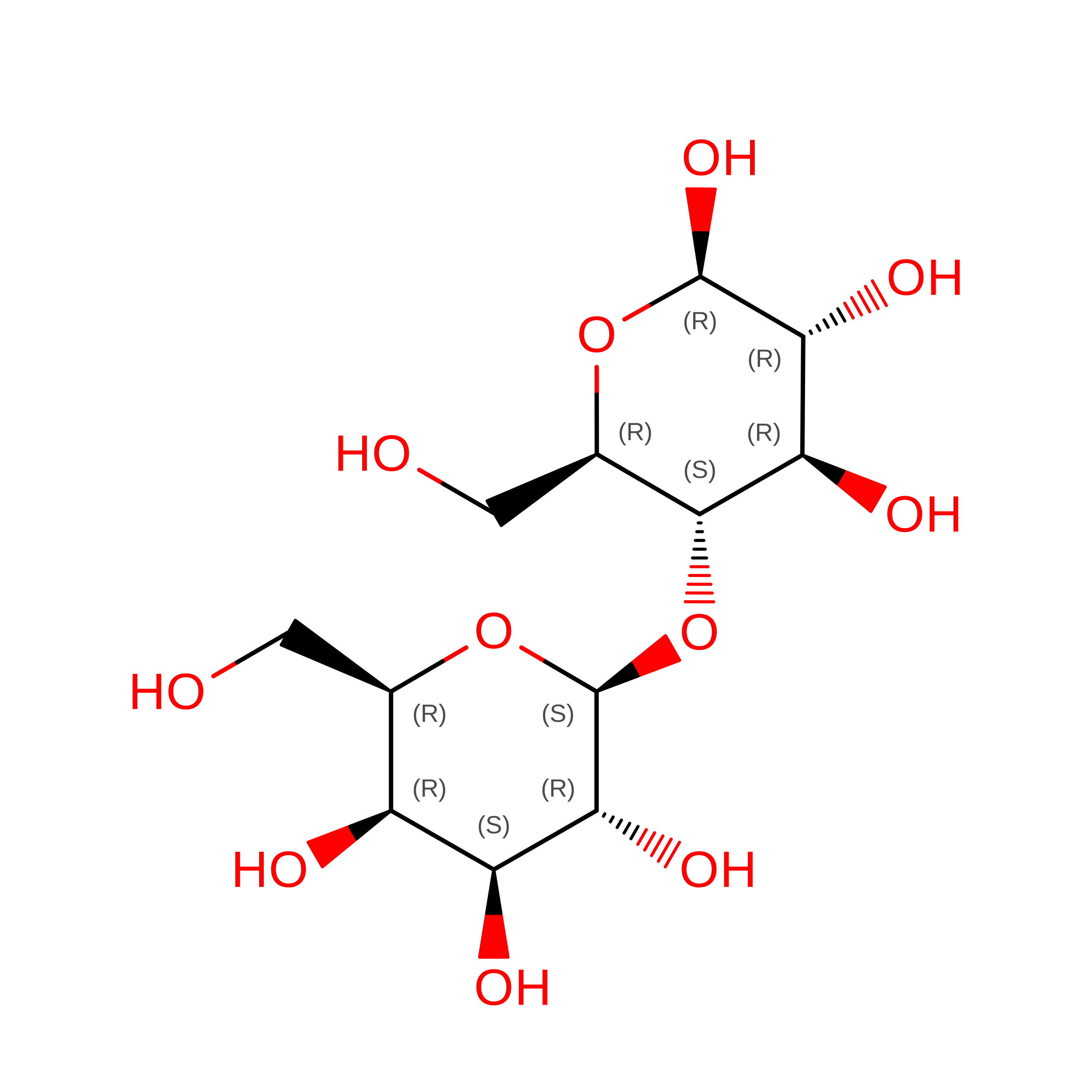
    Glycosyltransferases (GTs) are a key family of enzymes that catalyze the synthesis of glycosidic bonds in all living organisms. The reaction involves the transfer of a glycosyl moiety and can proceed with retention or inversion of the anomeric configuration. To date, the catalytic mechanism of retaining GTs is a topic of great controversy, particularly for those enzymes containing a putative nucleophilic residue in the active site, for which the occurrence of a double-displacement mechanism has been suggested. We report native ternary complexes of the retaining glycosyltransferase α-1,3-galactosyltransferase (α3GalT) from Bos taurus, which contains such a nucleophile in the active site, in a productive mode for catalysis in the presence of its sugar donor UDP-Gal, the acceptor substrate lactose, and the divalent cation cofactor. This new experimental evidence supports the occurrence of a front-side substrate-assisted S N i-type reaction for α3GalT, and suggests a conserved common catalytic mechanism among retaining GTs.


  • Organizational Affiliation
    • Structural Biology Unit-CIC bioGUNE, Technological Park of Bizkaia-Ed 800, 48160, Derio, Vizcaya, Spain.

Macromolecule Content 

  • Total Structure Weight: 70.42 kDa 
  • Atom Count: 4,873 
  • Modeled Residue Count: 561 
  • Deposited Residue Count: 584 
  • Unique protein chains: 1

Macromolecules

Find similar proteins by:|  3D Structure
Entity ID: 1
MoleculeChains  Sequence LengthOrganismDetailsImage
N-acetyllactosaminide alpha-1,3-galactosyltransferase
A, B
292Bos taurusMutation(s): 0 
Gene Names: GGTA1
EC: 2.4.1.87
UniProt
Find proteins for P14769 (Bos taurus)
Explore P14769 
Go to UniProtKB:  P14769
Entity Groups
Sequence Clusters30% Identity50% Identity70% Identity90% Identity95% Identity100% Identity
UniProt GroupP14769
Sequence Annotations
Expand
Reference Sequence

Oligosaccharides

Help  
Entity ID: 2
MoleculeChains Length2D Diagram GlycosylationD Interactions
beta-D-galactopyranose-(1-4)-beta-D-glucopyranose
C
2N/A
Glycosylation Resources
GlyTouCan: G84224TW
GlyCosmos: G84224TW
GlyGen: G84224TW

Biologically Interesting Molecules (External Reference) 

1 Unique

Experimental Data & Validation

Experimental Data

  • Method: X-RAY DIFFRACTION
  • Resolution: 2.12 Å
  • R-Value Free:  0.249 (Depositor), 0.248 (DCC) 
  • R-Value Work:  0.212 (Depositor), 0.215 (DCC) 
  • R-Value Observed: 0.214 (Depositor) 
Space Group: C 1 2 1
Unit Cell:
Length ( Å )Angle ( ˚ )
a = 133.414α = 90
b = 65.694β = 102.89
c = 83.014γ = 90
Software Package:
Software NamePurpose
PHENIXrefinement
XDSdata reduction
XDSdata scaling
PHASERphasing

Structure Validation

View Full Validation Report


Ligand Structure Quality Assessment 


Entry History 

Deposition Data

Revision History  (Full details and data files)

  • Version 1.0: 2017-10-11
    Type: Initial release
  • Version 1.1: 2017-11-01
    Changes: Database references
  • Version 1.2: 2017-11-22
    Changes: Database references
  • Version 2.0: 2020-07-29
    Type: Remediation
    Reason: Carbohydrate remediation
    Changes: Atomic model, Data collection, Derived calculations, Non-polymer description, Structure summary
  • Version 2.1: 2024-01-17
    Changes: Data collection, Database references, Refinement description, Structure summary