1FSZ | pdb_00001fsz

CRYSTAL STRUCTURE OF THE CELL-DIVISION PROTEIN FTSZ AT 2.8A RESOLUTION


Experimental Data Snapshot

  • Method: X-RAY DIFFRACTION
  • Resolution: 2.80 Å
  • R-Value Free: 
    0.282 (Depositor), 0.276 (DCC) 
  • R-Value Work: 
    0.199 (Depositor), 0.198 (DCC) 
  • R-Value Observed: 
    0.199 (Depositor) 

wwPDB Validation 3D Report Full Report

Validation slider image for 1FSZ

Ligand Structure Quality Assessment 


This is version 1.3 of the entry. See complete history

Literature

Crystal structure of the bacterial cell-division protein FtsZ.

Lowe, J.Amos, L.A.

(1998) Nature 391: 203-206

  • DOI: https://doi.org/10.1038/34472
  • Primary Citation Related Structures: 
    1FSZ

  • PubMed Abstract: 

    Bacterial cell division ends with septation, the constriction of the cell wall and cell membranes that leads to the formation of two daughter cells. During septation, FtsZ, a protein of relative molecular mass 40,000 which is ubiquitous in eubacteria and is also found in archaea and chloroplasts, localizes early at the division site to form a ring-shaped septum. This septum is required for the mechanochemical process of membrane constriction. FtsZ is a GTPase with weak sequence homology to tubulins. The nature of FtsZ polymers in vivo is unknown, but FtsZ can form tubules, sheets and minirings in vitro. Here we report the crystal structure at 2.8 A resolution of recombinant FtsZ from the hyperthermophilic methanogen Methanococcus jannaschii. FtsZ has two domains, one of which is a GTPase domain with a fold related to one found in the proteins p21ras and elongation factor EF-Tu. The carboxy-terminal domain, whose function is unknown, is a four-stranded beta-sheet tilted by 90 degrees against the beta-sheet of the GTPase domain. The two domains are arranged around a central helix. GDP binding is different from that typically found in GTPases and involves four phosphate-binding loops and a sugar-binding loop in the first domain, with guanine being recognized by residues in the central connecting helix. The three-dimensional structure of FtsZ is similar to the structure of alpha- and beta-tubulin.


  • Organizational Affiliation
    • MRC Laboratory of Molecular Biology, Cambridge, UK.

Macromolecule Content 

  • Total Structure Weight: 40.39 kDa 
  • Atom Count: 2,623 
  • Modeled Residue Count: 334 
  • Deposited Residue Count: 372 
  • Unique protein chains: 1

Macromolecules

Find similar proteins by:|  3D Structure
Entity ID: 1
MoleculeChains  Sequence LengthOrganismDetailsImage
FTSZ372Methanocaldococcus jannaschiiMutation(s): 0 
UniProt
Find proteins for Q57816 (Methanocaldococcus jannaschii (strain ATCC 43067 / DSM 2661 / JAL-1 / JCM 10045 / NBRC 100440))
Explore Q57816 
Go to UniProtKB:  Q57816
Entity Groups
Sequence Clusters30% Identity50% Identity70% Identity90% Identity95% Identity100% Identity
UniProt GroupQ57816
Sequence Annotations
Expand
Reference Sequence

Small Molecules

Ligands 1 Unique
IDChains Name / Formula / InChI Key2D Diagram3D Interactions
GDP

Query on GDP


Download:Ideal Coordinates CCD File
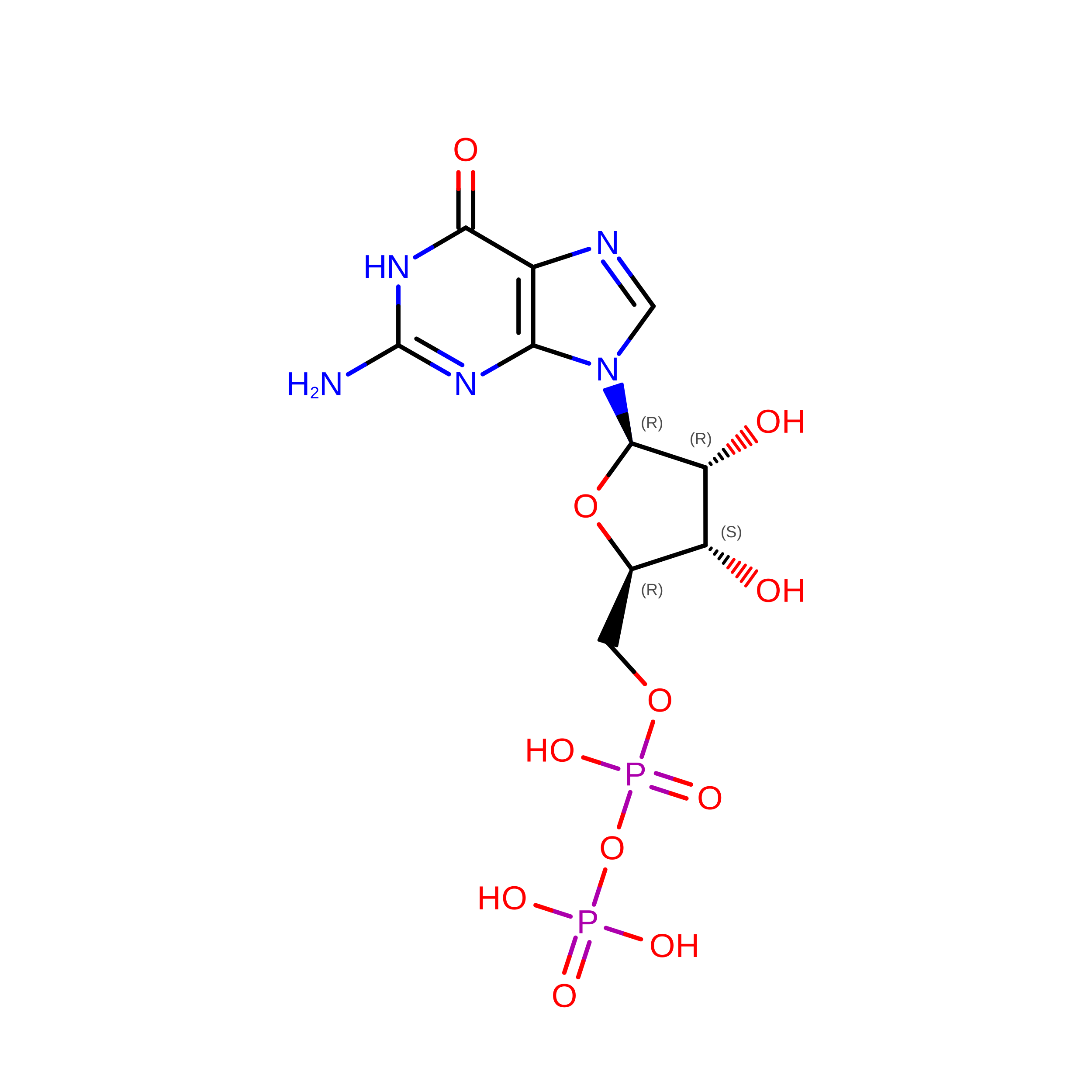
B [auth A]GUANOSINE-5'-DIPHOSPHATE
C10 H15 N5 O11 P2
QGWNDRXFNXRZMB-UUOKFMHZSA-N

Experimental Data & Validation

Experimental Data

  • Method: X-RAY DIFFRACTION
  • Resolution: 2.80 Å
  • R-Value Free:  0.282 (Depositor), 0.276 (DCC) 
  • R-Value Work:  0.199 (Depositor), 0.198 (DCC) 
  • R-Value Observed: 0.199 (Depositor) 
Space Group: I 21 3
Unit Cell:
Length ( Å )Angle ( ˚ )
a = 159.14α = 90
b = 159.14β = 90
c = 159.14γ = 90
Software Package:
Software NamePurpose
MLPHAREphasing
SOLOMONphasing
X-PLORrefinement
MOSFLMdata reduction
CCP4data scaling

Structure Validation

View Full Validation Report


Ligand Structure Quality Assessment 


Entry History 

Deposition Data

Revision History  (Full details and data files)

  • Version 1.0: 1998-06-24
    Type: Initial release
  • Version 1.1: 2008-03-24
    Changes: Version format compliance
  • Version 1.2: 2011-07-13
    Changes: Version format compliance
  • Version 1.3: 2024-02-07
    Changes: Data collection, Database references, Derived calculations