Download Mendeley
Mechanisms of disassembly at the actin filament pointed and barbed ends.
Palmer, N.J., Boczkowska, M., Rebowski, G., Dominguez, R.(2026) Sci Adv 12: eaee5882-eaee5882
- PubMed: 41931606 Search on PubMedSearch on PubMed Central
- DOI: https://doi.org/10.1126/sciadv.aee5882
- Primary Citation Related Structures:
9Q7K, 9Q7L, 9Q7M, 9Q7N, 9Q7O, 9XYE, 9Y52, 9Y9J, 9Y9L, 9Y9M, 9Y9P, 9YIM - PubMed Abstract:
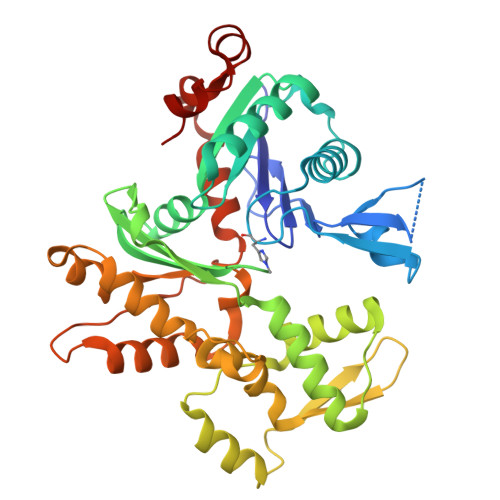
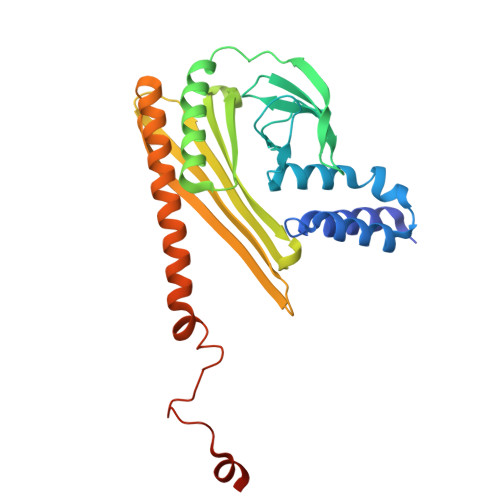
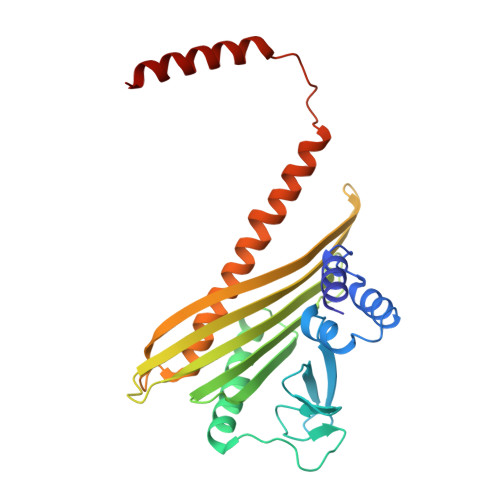
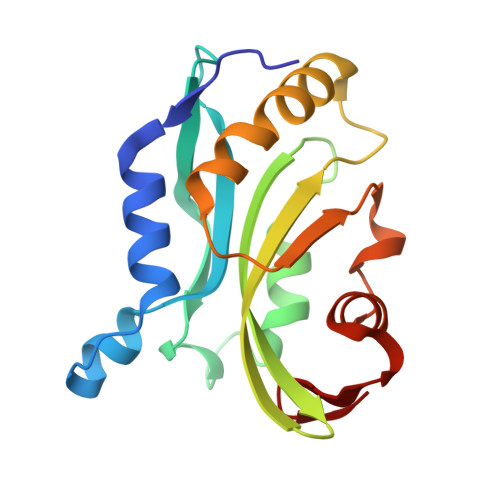
Actin cytoskeleton dynamics power processes from cell motility to organelle trafficking, requiring rapid polymerization and depolymerization accelerated in cells by regulatory proteins. While mechanisms of accelerated polymerization are relatively well studied, those of depolymerization remain poorly understood. Here, we present twelve cryo-electron microscopy structures showing how cofilin, cyclase-associated protein (CAP), and capping protein (CP) coordinate their activities to accelerate depolymerization at both filament ends. Alone, CAP produces a ~4.0 Å lateral displacement of the first pointed-end subunit, whereas cofilin reverts terminal subunits at the pointed and barbed ends to a G-actin-like conformation and undertwists the filament short-pitch helix. When functioning together, these cofilin- and CAP-induced conformational changes are amplified to accelerate pointed-end disassembly. At the barbed end, the cofilin-induced changes trigger stepwise CP dissociation and favor depolymerization. These findings support end-specific mechanisms of filament disassembly through accelerated subunit dissociation, slowed subunit addition, and barbed-end uncapping.
- Department of Physiology and Biochemistry Biophysics & Chemical Biology Graduate Group, University of Pennsylvania Perelman School of Medicine, Philadelphia, PA, USA.
Organizational Affiliation: