Download Mendeley
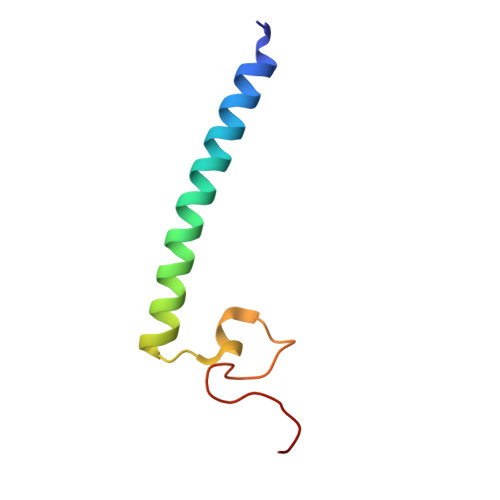
Structural basis of the oligomerization of anti-silencer Ler from enterohemorrhagic E. coli (EHEC).
Wang, G., Duan, B., Xia, B.(2026) Struct Dyn 13: 024702-024702
- PubMed: 41987883 Search on PubMedSearch on PubMed Central
- DOI: https://doi.org/10.1063/4.0001203
- Primary Citation Related Structures:
9XUZ - PubMed Abstract:
The locus of enterocyte effacement-encoded regulator (Ler) is a master transcriptional activator essential for the virulence of enterohemorrhagic and enteropathogenic Escherichia coli . Although Ler shares homology with the global silencer H-NS, it functions uniquely as an anti-silencer, a role strictly dependent on its oligomerization state. However, the structural mechanism governing Ler assembly remains poorly understood. In this study, we have characterized the N-terminal oligomerization domain (Ler 1-74 ) of Ler using solution NMR spectroscopy and biophysical assays, and found that Ler 1-74 shows concentration-dependent oligomerization. We demonstrate that Ler oligomerization is driven by two distinct interfaces with contrasting dynamic properties. We determined the solution structure of the Ler 18-74 dimer, revealing a stable, anti-parallel "tail-to-tail" interface (dimer Site-2, residues 35-66) stabilized by a hydrophobic core. In contrast, the N-terminal interface (dimer Site-1, residues 12-33) forms a highly dynamic "head-to-head" dimer, which undergoes significant conformational exchange and exhibits concentration- and temperature-dependent dimerization. Based on these findings, we propose a structural model wherein Ler forms supramolecular assemblies through the propagation of alternating stable (Site-2) and dynamic (Site-1) interactions. This architecture, while reminiscent of H-NS, displays distinct stability features that may underlie Ler's specific anti-silencing function in bacterial pathogenesis.