Download Mendeley
A distinct gene expression mechanism for d-amino acid utilization in hyperthermophilic archaeon Pyrococcus horikoshii.
Kawakami, R., Kawase, T., Uehara, T., Sakuraba, H., Matsuzawa, T., Hayashi, J., Ohshima, T.(2026) FEBS J
- PubMed: 41991193 Search on PubMed
- DOI: https://doi.org/10.1111/febs.70545
- Primary Citation Related Structures:
9W4V, 9W4W - PubMed Abstract:
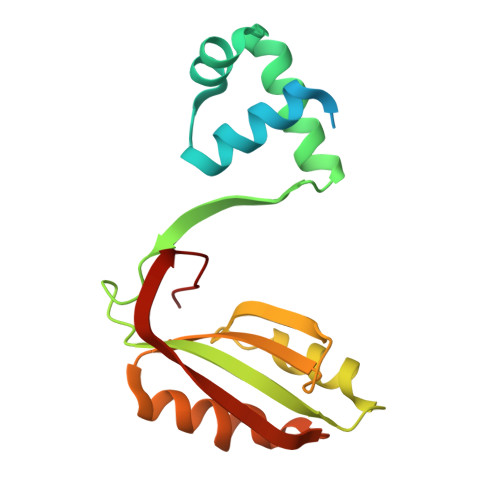
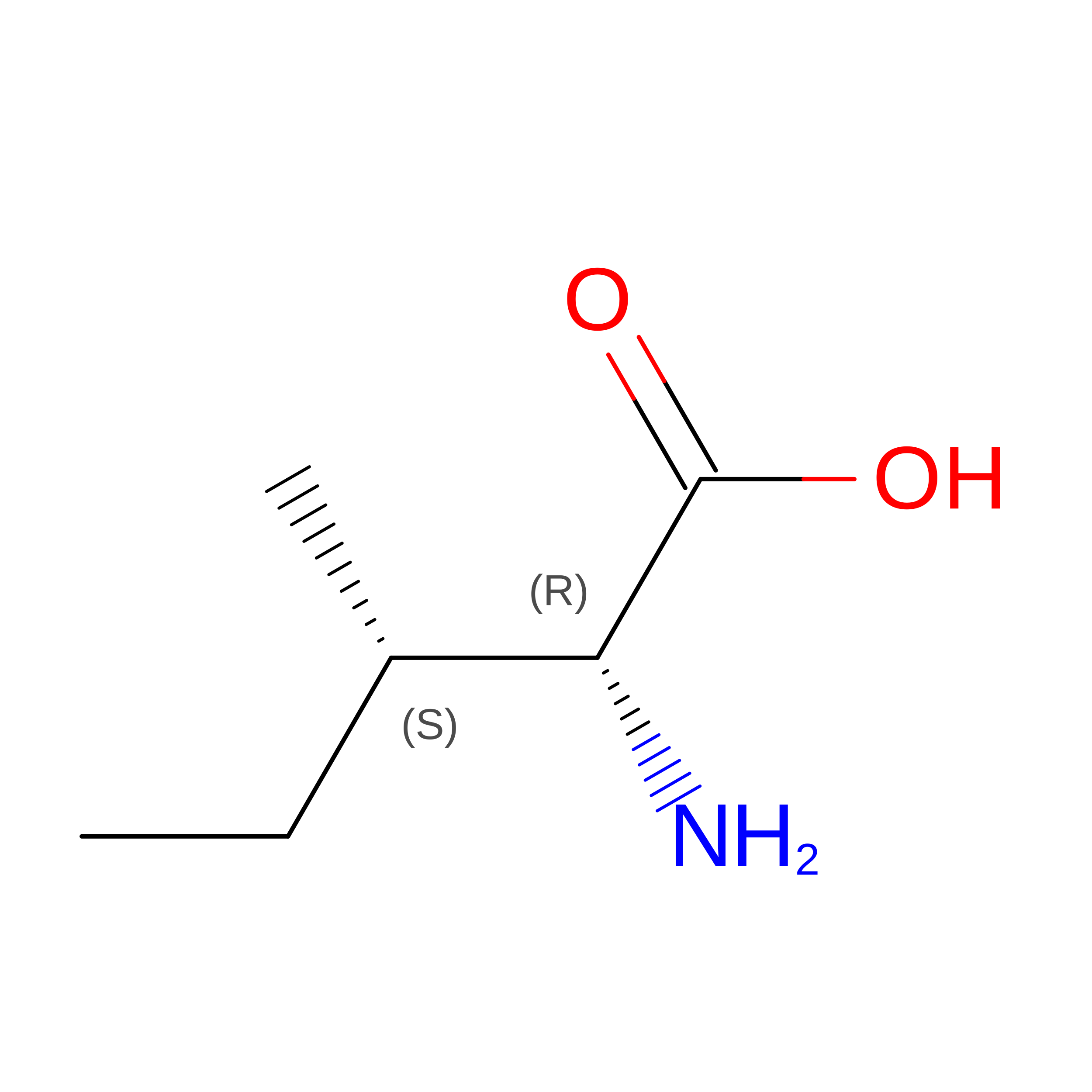
Growing the hyperthermophilic archaeon Pyrococcus horikoshii OT-3 in medium supplemented with d-allo-Ile instead of l-Ile markedly upregulates the activity of broad substrate specificity amino acid racemase (BAR). In P. horikoshii genome, the BAR gene (PH0138) forms a cluster with PH0137, which encodes a putative transporter protein, and PH0140 that encodes a feast/famine regulatory protein (FFRP), involved in the transcriptional regulation of metabolic pathway genes. Here, we performed gene expression, protein-DNA interaction, and crystallographic analyses to elucidate the expression mechanism of the BAR cluster. Gene expression analysis revealed that d-allo-Ile simultaneously induces PH0138 and PH0137. Electrophoretic mobility shift assays demonstrated that the PH0140 protein binds to the PH0137 promoter in the presence of l-Ile, but this interaction is disrupted by d-allo-Ile, identifying PH0140 as a d-amino acid-responsive regulatory protein (DARP). The crystal structures of DARP bound to l-Ile and d-allo-Ile were compared with those of another FFRP family member, P. horikoshii FL11. Our findings reveal a dimeric arrangement of l-Ile-bound DARP resembling the DNA-bound (open) form of FL11, whereas d-allo-Ile-bound DARP corresponds to the DNA-unbound (closed) form. These conformational changes result from subtle alterations in hydrogen bonding around the coregulators. Furthermore, cultivation in d-allo-Ile substitution medium only impacted the expression of PH0138 and PH0137, and not the other genes, suggesting that DARP regulates a more limited gene set than FL11. Cumulatively, these results reveal a distinct mechanism by which an FFRP homolog controls d-amino acid utilization.
- Division of Bioscience and Bioindustry, Graduate School of Technology, Industrial and Social Sciences, Tokushima University, Japan.
Organizational Affiliation: