Find PDB structures and Computed Structure Models (CSM) by combining queries from tools in this suite: Attribute Search, Sequence Similarity, Sequence Motif, 3D Similarity, and 3D Motif with 'AND' logic.
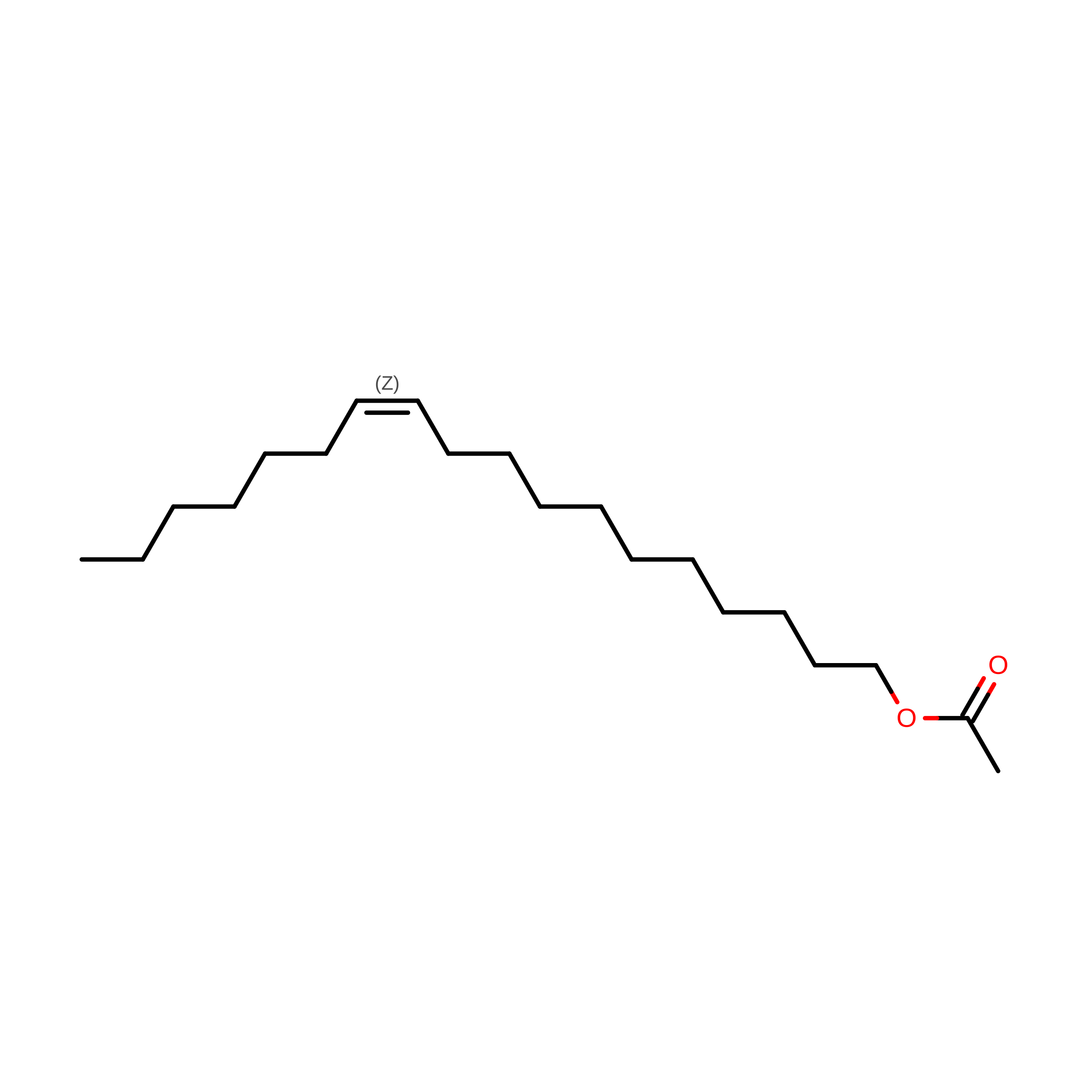
Pheromones mediate intraspecific communication to regulate the physiology and behavior of animals, particularly insects. The detection of pheromones is initiated by the binding of pheromone molecules, e.g., 11-cis-vaccenyl acetate (cVA) in Drosophila, to specific receptor proteins in chemosensory neurons, but the underlying molecular mechanisms remain unclear. Here, we report structures of Drosophila pheromone receptor OR67d-Orco complexes in apo closed, pheromone-bound open, and synthetic agonist VUAA1-bound open conformations. OR67d and Orco assemble into a hetero-tetrameric channel with a 1:3 stoichiometry. In OR67d, the inverted L-shaped cVA or its analog binds into a deep and bent hydrophobic pocket, inducing both local and global conformational changes that lead to an asymmetrical opening of the channel gate. By comparison, VUAA1 binds to Orco instead of OR67d to cause a similar asymmetrical opening. Together, our studies reveal the structural basis for pheromone activation of hetero-tetrameric pheromone receptors.
Organizational Affiliation:
Department of Neurology of the Fourth Affiliated Hospital, and Department of Biophysics, Zhejiang University School of Medicine, Hangzhou, Zhejiang, China.
Nanhu Brain-computer Interface Institute, Hangzhou, Zhejiang, China.
Center for Membrane Receptors and Brain Medicine, the Fourth Affiliated Hospital of School of Medicine, and International School of Medicine, International Institutes of Medicine, Zhejiang University, Yiwu, Zhejiang, China.
New Cornerstone Science Laboratory and Liangzhu Laboratory, the Second Affiliated Hospital and School of Basic Medical Sciences, Zhejiang University, Hangzhou, Zhejiang, China.
Center of Cryo-Electron Microscopy, Zhejiang University School of Medicine, Hangzhou, Zhejiang, China.
College of Life Sciences, Zhejiang University, Hangzhou, Zhejiang, China.
The Provincial International Science and Technology Cooperation Base on Engineering Biology, International Campus of Zhejiang University, Haining, Zhejiang, China.
State Key Laboratory of Plant Environmental Resilience, College of Life Science, Zhejiang University, Hangzhou, Zhejiang, China.
Ministry of Agriculture Key Laboratory of Molecular Biology of Crop Pathogens and Insects, Institute of Insect Sciences, College of Agriculture and Biotechnology, Zhejiang University, Hangzhou, Zhejiang, China.
CAS Center for Excellence in Molecular Plant Sciences, Institute of Plant Physiology and Ecology, Chinese Academy of Sciences, Shanghai, China.
College of Life Sciences, Zhejiang University, Hangzhou, Zhejiang, China. yongwang_isb@zju.edu.cn.
The Provincial International Science and Technology Cooperation Base on Engineering Biology, International Campus of Zhejiang University, Haining, Zhejiang, China. yongwang_isb@zju.edu.cn.
New Cornerstone Science Laboratory and Liangzhu Laboratory, the Second Affiliated Hospital and School of Basic Medical Sciences, Zhejiang University, Hangzhou, Zhejiang, China. haoxingx@zju.edu.cn.
Department of Molecular, Cellular, and Developmental Biology, University of Michigan, Ann Arbor, MI, USA. haoxingx@zju.edu.cn.
Center for Membrane Receptors and Brain Medicine, the Fourth Affiliated Hospital of School of Medicine, and International School of Medicine, International Institutes of Medicine, Zhejiang University, Yiwu, Zhejiang, China. sunannan@zju.edu.cn.
Department of Neurology of the Fourth Affiliated Hospital, and Department of Biophysics, Zhejiang University School of Medicine, Hangzhou, Zhejiang, China. jiangtaoguo@zju.edu.cn.
Nanhu Brain-computer Interface Institute, Hangzhou, Zhejiang, China. jiangtaoguo@zju.edu.cn.
State Key Laboratory of Plant Environmental Resilience, College of Life Science, Zhejiang University, Hangzhou, Zhejiang, China. jiangtaoguo@zju.edu.cn.
NHC and CAMS Key Laboratory of Medical Neurobiology, MOE Frontier Science Center for Brain Science and Brain-machine Integration, School of Brain Science and Brain Medicine, Zhejiang University, Hangzhou, Zhejiang, China. jiangtaoguo@zju.edu.cn.
Cancer Center, Zhejiang University, Hangzhou, Zhejiang, China. jiangtaoguo@zju.edu.cn.

 Download Mendeley