Download Mendeley
Structural basis for sialoglycan recognition by the immune inhibitory receptor Siglec-10.
Medina, E., Mason, C., Tran, T.H., Julia, E.P., Ming, Q., Taibi, L.M., Hwu, P., Maute, R.L., Burg, J.S., Luca, V.C.(2026) Structure 34: 768-777.e5
- PubMed: 41747717 Search on PubMed
- DOI: https://doi.org/10.1016/j.str.2026.01.018
- Primary Citation Related Structures:
9O6J, 9O6N, 9O6O - PubMed Abstract:
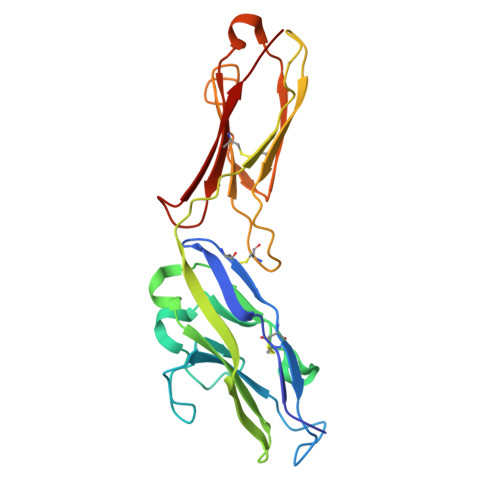
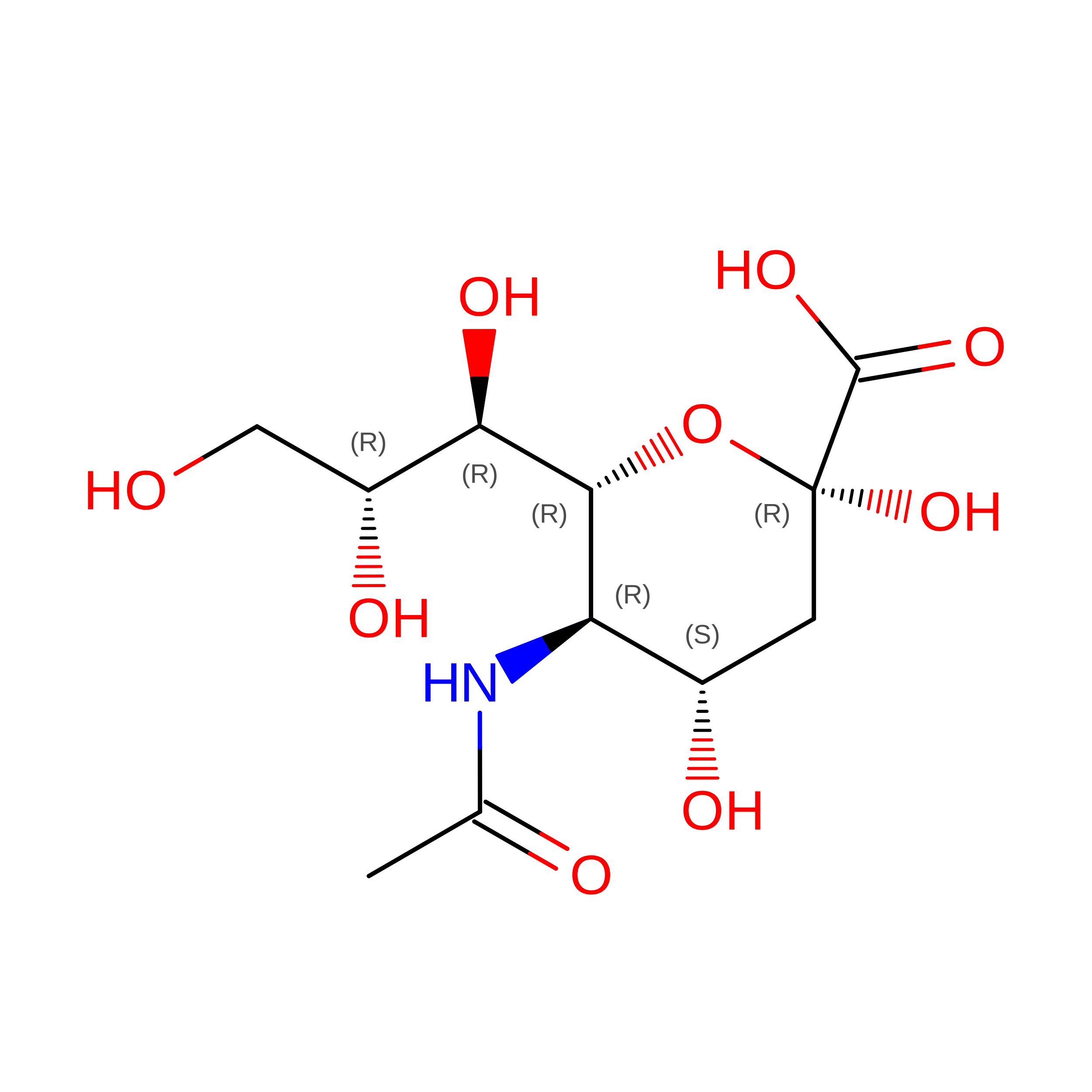
Sialic acid-binding immunoglobulin-like lectin 10 (Siglec-10) inhibits immune cell function by sensing the presence of sialylated glycoproteins. Here, we determined structures of Siglec-10 bound to sialyllactose (SL) ligands to visualize the molecular recognition events underlying Siglec-10 signaling. The structures reveal that domain 1 (D1) of Siglec-10 engages SL using a non-conserved, selectivity determining CC' loop. Siglec-10 binds α2,3- and α2,6-linked SL with similar affinities despite minor additional contacts between D1 and the α2,3-SL galactose. Homodimerization of Siglec-10 is mediated by a hydrophobic domain 2 (D2) interface, and mutation of this interface ablates cellular binding similarly to mutations in the CC' loop and glycan-binding site. Surprisingly, knockout of the putative Siglec-10 ligand, CD24, did not affect binding to breast cancer cells, indicating that Siglec-10 has a broader-than-expected glycoprotein recognition profile. These findings emphasize how a complex interplay between Siglec-10 multimerization and ligand engagement facilitate cell surface interactions.
- Department of Immunology, Moffitt Cancer Center, Tampa, FL 33612, USA; Cancer Biology PhD Program, University of South Florida, Tampa, FL 33612, USA.
Organizational Affiliation: