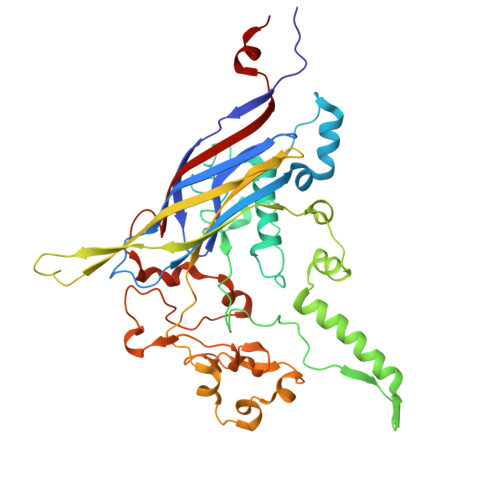
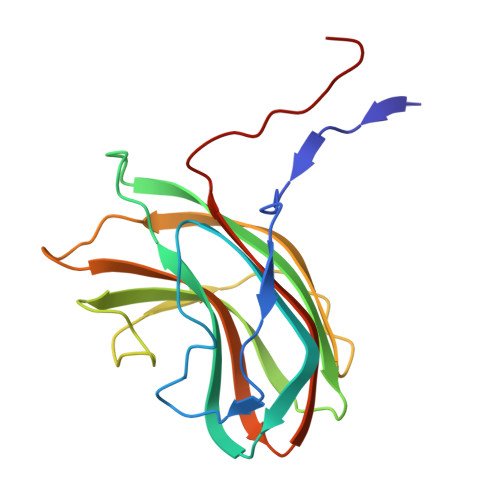
9K3M | pdb_00009k3m

The structure of Microviridae PJNS001


Experimental Data Snapshot

  • Method: ELECTRON MICROSCOPY
  • Resolution: 2.68 Å
  • Aggregation State: PARTICLE 
  • Reconstruction Method: SINGLE PARTICLE 

Starting Model: in silico
View more details

wwPDB Validation 3D Report Full Report

Validation slider image for 9K3M

This is version 1.1 of the entry. See complete history

Literature

Structural basis for Salmonella infection by two Microviridae phages.

Hu, W.Liu, Z.Wei, Y.Bian, Q.Lan, W.Fan, C.Song, J.Sun, Q.Zhang, X.Liu, Y.Gao, Y.Chen, Y.

(2025) Commun Biol 8: 1166-1166

  • DOI: https://doi.org/10.1038/s42003-025-08595-7
  • Primary Citation Related Structures: 
    9K3M, 9K3N

  • PubMed Abstract: 

    The global resurgence of multidrug-resistant Salmonella species, responsible for millions of annual infections, underscores the urgent need for alternative antimicrobial strategies, such as phage therapy. Microviridae phages offer a promising model for studying phage-host interactions with their unique structural and infection mechanisms. Here, we identify two Microviridae phages, PJNS001 and PJNS002, with different host receptor dependencies, and determine their cryo-EM structures at 2.68 Å and 2.59 Å resolution, respectively. These icosahedral capsids with T = 1 symmetry exhibit a unique vertex reinforcement mechanism, stabilizing the viral assembly. The specific pentameric adaptations, coupled with DNA binding protein engagements and thermodynamic constraints, collectively preclude the formation of hybrid virions. Structural analysis and in situ visualization reveal spike protein features and host-attachment intermediates, informing host specificity. Together, these findings advance our understanding of Microviridae infection mechanisms and provide a structural framework for rational phage design against antibiotic-resistant pathogens.


  • Organizational Affiliation
    • Shanghai Institute for Advanced Immunochemical Studies, ShanghaiTech University, Shanghai, 201210, China.

Macromolecule Content 

  • Total Structure Weight: 4,311.13 kDa 
  • Atom Count: 302,160 
  • Modeled Residue Count: 38,280 
  • Deposited Residue Count: 38,400 
  • Unique protein chains: 3

Macromolecules

Find similar proteins by:|  3D Structure
Entity ID: 1
MoleculeChains  Sequence LengthOrganismDetailsImage
Capsid protein F427MicroviricetesMutation(s): 0 
UniProt
Find proteins for Q2LLZ1 (Enterobacteria phage ID34)
Explore Q2LLZ1 
Go to UniProtKB:  Q2LLZ1
Entity Groups
Sequence Clusters30% Identity50% Identity70% Identity90% Identity95% Identity100% Identity
UniProt GroupQ2LLZ1
Sequence Annotations
Expand
Reference Sequence
Find similar proteins by:|  3D Structure
Entity ID: 3
MoleculeChains  Sequence LengthOrganismDetailsImage
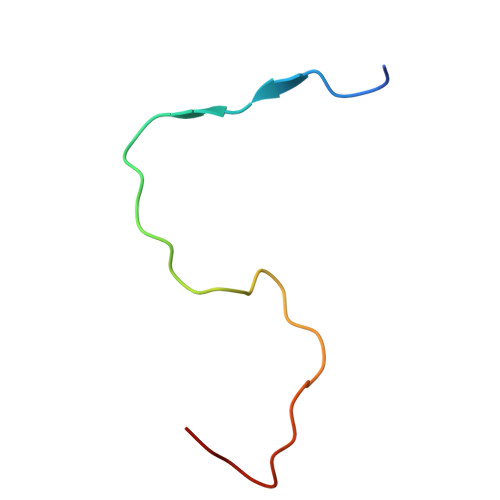
DNA-binding protein J38MicroviricetesMutation(s): 0 
UniProt
Find proteins for P69592 (Enterobacteria phage phiX174)
Explore P69592 
Go to UniProtKB:  P69592
Entity Groups
Sequence Clusters30% Identity50% Identity70% Identity90% Identity95% Identity100% Identity
UniProt GroupP69592
Sequence Annotations
Expand
Reference Sequence

Experimental Data & Validation

Experimental Data

  • Method: ELECTRON MICROSCOPY
  • Resolution: 2.68 Å
  • Aggregation State: PARTICLE 
  • Reconstruction Method: SINGLE PARTICLE 
EM Software:
TaskSoftware PackageVersion
RECONSTRUCTIONcryoSPARC4.0.1
MODEL REFINEMENTPHENIX1.20.1

Structure Validation

View Full Validation Report


Entry History 

& Funding Information

Deposition Data


Funding OrganizationLocationGrant Number
Other government23QA1406400

Revision History  (Full details and data files)

  • Version 1.0: 2025-08-13
    Type: Initial release
  • Version 1.1: 2025-08-20
    Changes: Data collection, Database references