9IRY | pdb_00009iry

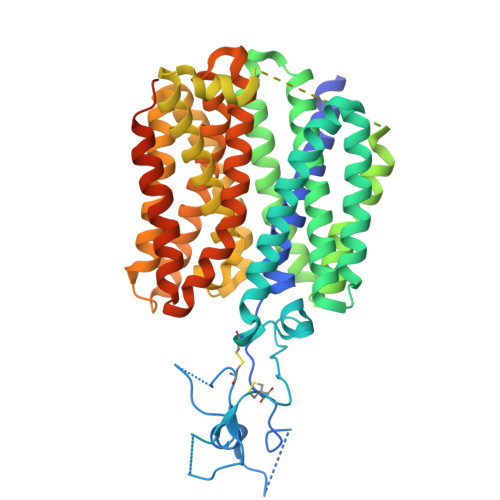
Structure of human URAT1 bound with verinurad

  • Classification: TRANSPORT PROTEIN
  • Organism(s): Homo sapiens
  • Expression System: Homo sapiens
  • Mutation(s): No 

  • Deposited: 2024-07-16 Released: 2025-01-15 
  • Deposition Author(s): Guo, W.J., Wei, M., Chen, L.
  • Funding Organization(s): Ministry of Science and Technology (MoST, China), National Natural Science Foundation of China (NSFC)

Experimental Data Snapshot

  • Method: ELECTRON MICROSCOPY
  • Resolution: 3.20 Å
  • Aggregation State: PARTICLE 
  • Reconstruction Method: SINGLE PARTICLE 

wwPDB Validation 3D Report Full Report

Validation slider image for 9IRY

This is version 1.1 of the entry. See complete history

Literature

Mechanisms of urate transport and uricosuric drugs inhibition in human URAT1.

Guo, W.Wei, M.Li, Y.Xu, J.Zang, J.Chen, Y.Chen, L.

(2025) Nat Commun 16: 1512-1512

  • DOI: https://doi.org/10.1038/s41467-025-56843-5
  • Primary Citation Related Structures: 
    9IRW, 9IRX, 9IRY

  • PubMed Abstract: 

    High urate levels in circulation lead to the accumulation of urate crystals in joints and ultimately inflammation and gout. The reabsorption process of urate in the kidney by the urate transporter URAT1 plays a pivotal role in controlling serum urate levels. Pharmacological inhibition of URAT1 by uricosuric drugs is a valid strategy for gout management. Despite the clinical significance of URAT1, its structural mechanism and dynamics remain incompletely understood. Here, we report the structures of human URAT1 (hURAT1) in complex with substrate urate or inhibitors benzbromarone and verinurad at resolution ranges from 3.0 to 3.3 Å. We observe urate in the central substrate-binding site of hURAT1 in the outward-facing conformation and urate is wrapped in the center of hURAT1 by five phenylalanines and coordinated by two positively charged residues on each side. Uricosuric compounds benzbromarone and verinurad occupy the urate-binding site of hURAT1 in the inward-facing conformation. Structural comparison between different conformations of hURAT1 reveals the rocker-switch-like mechanism for urate transport. Benzbromarone and verinurad exert their inhibitory effect by blocking not only the binding of urate but also the structural isomerization of hURAT1.


  • Organizational Affiliation
    • State Key Laboratory of Membrane Biology, College of Future Technology, Institute of Molecular Medicine, Peking. University, Beijing Key Laboratory of Cardiometabolic Molecular Medicine, Beijing, 100871, China.

Macromolecule Content 

  • Total Structure Weight: 59.9 kDa 
  • Atom Count: 3,146 
  • Modeled Residue Count: 421 
  • Deposited Residue Count: 553 
  • Unique protein chains: 1

Macromolecules

Find similar proteins by:|  3D Structure
Entity ID: 1
MoleculeChains  Sequence LengthOrganismDetailsImage
Solute carrier family 22 member 12553Homo sapiensMutation(s): 0 
Gene Names: SLC22A12OATL4URAT1UNQ6453/PRO34004
UniProt & NIH Common Fund Data Resources
Find proteins for Q96S37 (Homo sapiens)
Explore Q96S37 
Go to UniProtKB:  Q96S37
PHAROS:  Q96S37
GTEx:  ENSG00000197891 
Entity Groups
Sequence Clusters30% Identity50% Identity70% Identity90% Identity95% Identity100% Identity
UniProt GroupQ96S37
Sequence Annotations
Expand
Reference Sequence

Small Molecules

Ligands 1 Unique
IDChains Name / Formula / InChI Key2D Diagram3D Interactions
A1AIJ
(Subject of Investigation/LOI)

Query on A1AIJ


Download:Ideal Coordinates CCD File
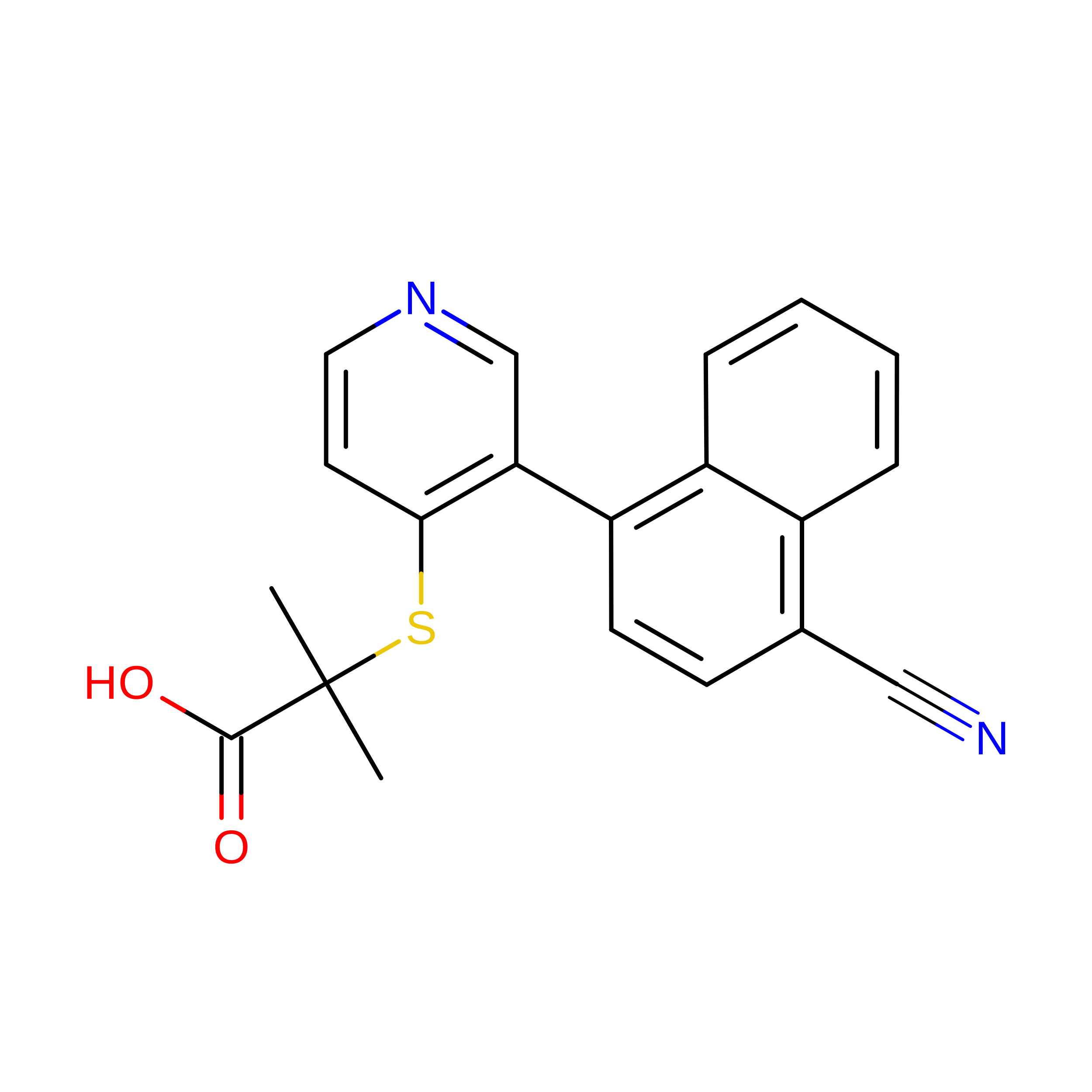
B [auth A]verinurad
C20 H16 N2 O2 S
YYBOLPLTQDKXPM-UHFFFAOYSA-N

Experimental Data & Validation

Experimental Data

  • Method: ELECTRON MICROSCOPY
  • Resolution: 3.20 Å
  • Aggregation State: PARTICLE 
  • Reconstruction Method: SINGLE PARTICLE 

Structure Validation

View Full Validation Report


Entry History 

& Funding Information

Deposition Data


Funding OrganizationLocationGrant Number
Ministry of Science and Technology (MoST, China)China2022YFA0806504
National Natural Science Foundation of China (NSFC)China32225027

Revision History  (Full details and data files)

  • Version 1.0: 2025-01-15
    Type: Initial release
  • Version 1.1: 2025-05-07
    Changes: Data collection, Database references