9I9H | pdb_00009i9h

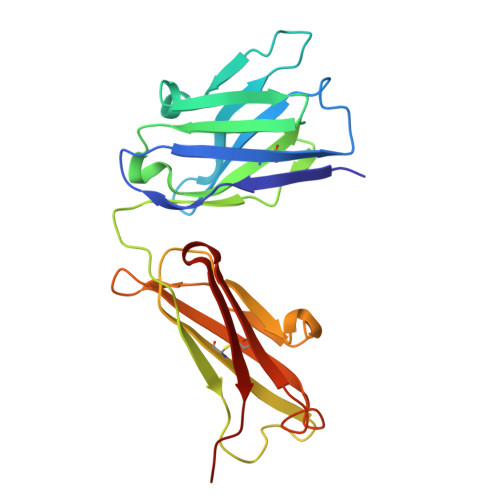
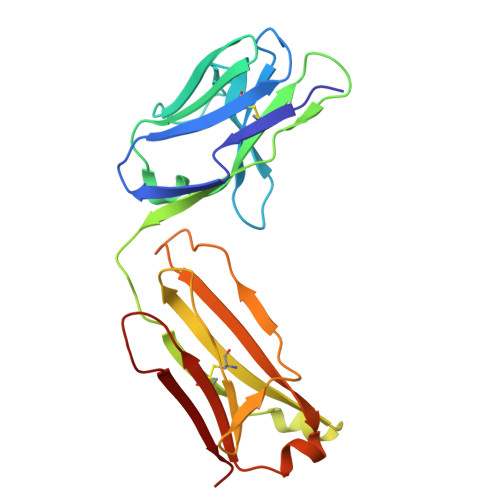
Structure of FAB-fragment GB11 in complex with Sialyl Lewis A


Experimental Data Snapshot

  • Method: X-RAY DIFFRACTION
  • Resolution: 2.96 Å
  • R-Value Free: 
    0.248 (Depositor), 0.255 (DCC) 
  • R-Value Work: 
    0.210 (Depositor), 0.217 (DCC) 

Starting Model: experimental
View more details

wwPDB Validation 3D Report Full Report

Validation slider image for 9I9H

Ligand Structure Quality Assessment 


This is version 1.1 of the entry. See complete history

Literature

Integrative Approach to Develop and Characterize Antibodies against the Cancer-Associated Antigen Sialyl Lewis A (CA 19-9).

Freitag, A.Khilji, S.K.Nedielkov, R.M Kumar, S.Krummhaar, M.Arndt, J.Moreira, G.M.S.G.Luhle, J.Goerdeler, F.Kamphues, C.Mroginski, M.A.Roth, C.Seeberger, P.H.Moller, H.M.Moscovitz, O.

(2026) JACS Au 6: 2274-2287

  • DOI: https://doi.org/10.1021/jacsau.5c01596
  • Primary Citation Related Structures: 
    9I6Q, 9I9H

  • PubMed Abstract: 

    Sialyl Lewis A (sLeA), or the CA 19-9 marker, is the best validated and only FDA-approved serologic marker clinically used to monitor recurrence, progression, and therapy efficiency in pancreatic ductal adenocarcinoma (PDAC) patients, making it an attractive target for antibody development. Recent clinical trials have demonstrated satisfying safety profiles and unique expression in a range of malignancies that highlight CA 19-9 as an attractive TACA to target using a stand-alone drug or an adjuvant therapy. Hence, we set out to explore the use of synthetic sLeA in the development of additional monoclonal antibodies (mAbs) with enhanced sLeA recognition and improved efficacy. Two mAbs targeting sLeA were generated through mice immunization with synthetic sLeA glycoconjugates, synthetic glycan arrays, and hybridoma technology. We then compared the antigen-binding properties of the newly developed mAbs with those of the widely used mAb 1116-NS-19-9 and demonstrated improved affinity and specificity for native sLeA ectopically expressed in B16 melanoma cells, surpassing the performance of the established mAb 1116-NS-19-9. Of the two mAbs, GB11 was more promising. Therefore, to elucidate the structural origin of improved GB11's antigen binding, we conducted high-resolution mapping of the molecular recognition patterns between sLeA and the different antibodies using X-ray crystallography and STD NMR. These analyses revealed subtle yet critical differences in the glycan engagement and identified key structural features underlying enhanced GB11's recognition of sLeA. MD simulations further supported these observations, indicating distinct orientations of sLeA within the binding pockets of each mAb. Our results suggest improved recognition of the native sLeA antigen by the newly generated GB11 antibody, providing a detailed and high-resolution elucidation of the molecular interactions underlying this recognition. Our study provides a tool with improved theranostic properties against sLeA-overexpressing malignancies.


  • Organizational Affiliation
    • Department of Biomolecular Systems, Max Planck Institute of Colloids and Interfaces, 14476 Potsdam, Germany.

Macromolecule Content 

  • Total Structure Weight: 192.07 kDa 
  • Atom Count: 13,504 
  • Modeled Residue Count: 1,716 
  • Deposited Residue Count: 1,716 
  • Unique protein chains: 2

Macromolecules

Find similar proteins by:|  3D Structure
Entity ID: 1
MoleculeChains  Sequence LengthOrganismDetailsImage
IgG antibody FAB fragmentA,
F [auth H],
G [auth C],
H [auth E]
217Mus musculusMutation(s): 0 
Find similar proteins by:|  3D Structure
Entity ID: 2
MoleculeChains  Sequence LengthOrganismDetailsImage
IgG antibody Fab fragmentB,
C [auth L],
D,
E [auth F]
212Mus musculusMutation(s): 0 

Oligosaccharides

Help  
Entity ID: 3
MoleculeChains Length2D Diagram GlycosylationD Interactions
beta-D-galactopyranose-(1-3)-[alpha-L-fucopyranose-(1-4)]2-acetamido-2-deoxy-beta-D-glucopyranoseI [auth T],
J [auth V]
3N/A
Glycosylation Resources
GlyTouCan: G39023AU
GlyCosmos: G39023AU
GlyGen: G39023AU
Entity ID: 4
MoleculeChains Length2D Diagram GlycosylationD Interactions
N-acetyl-alpha-neuraminic acid-(2-3)-beta-D-galactopyranose-(1-3)-[alpha-L-fucopyranose-(1-4)]2-acetamido-2-deoxy-beta-D-glucopyranoseK [auth U]4N/A
Glycosylation Resources
GlyTouCan: G00053MO
GlyCosmos: G00053MO
GlyGen: G00053MO
Entity ID: 5
MoleculeChains Length2D Diagram GlycosylationD Interactions
alpha-L-fucopyranose-(1-4)-2-acetamido-2-deoxy-beta-D-glucopyranoseL [auth S]2N/A
Glycosylation Resources
GlyTouCan: G35446HX
GlyCosmos: G35446HX
GlyGen: G35446HX

Small Molecules

Ligands 3 Unique
IDChains Name / Formula / InChI Key2D Diagram3D Interactions
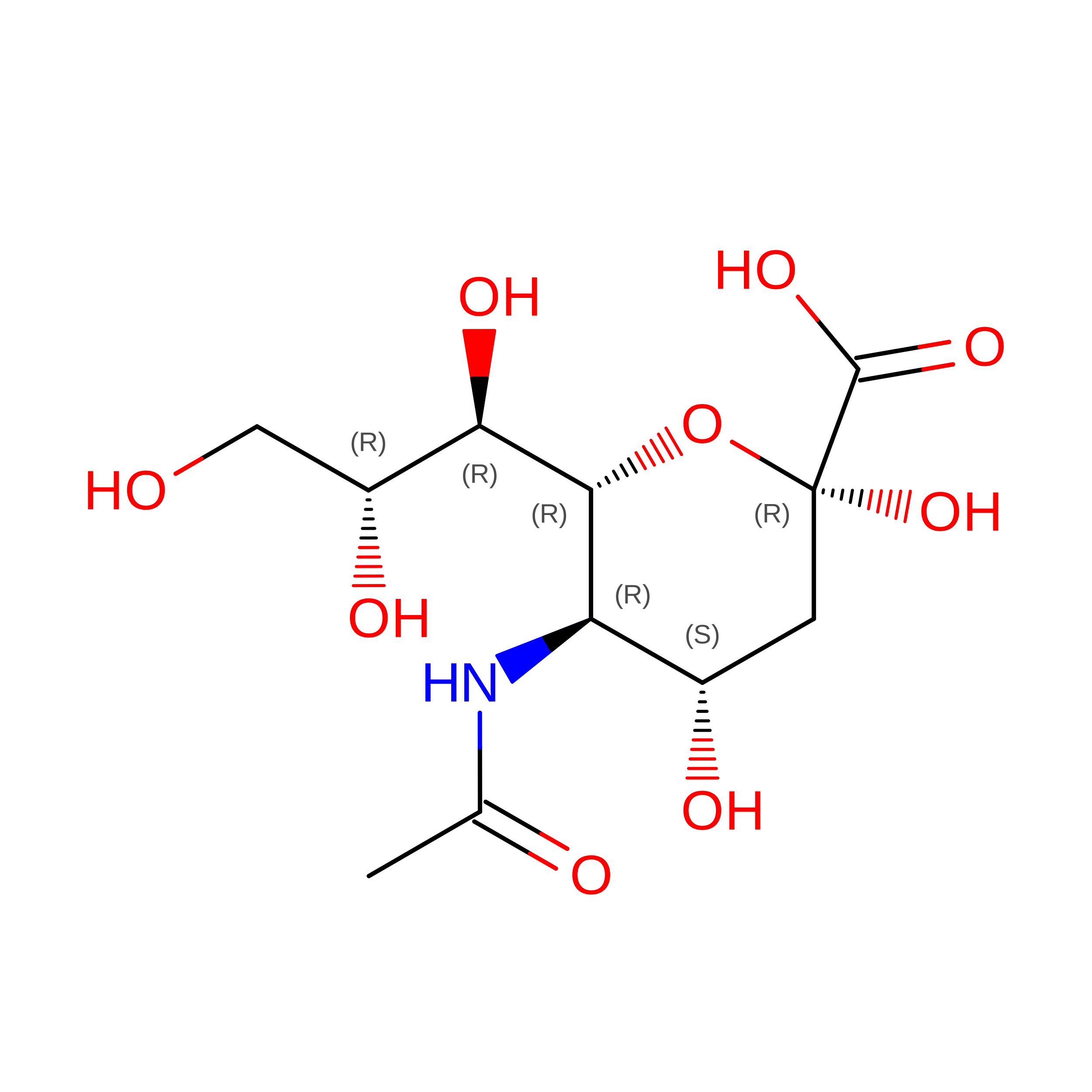
SIA
(Subject of Investigation/LOI)

Query on SIA


Download:Ideal Coordinates CCD File
M [auth B],
N [auth L],
P [auth F]
N-acetyl-alpha-neuraminic acid
C11 H19 N O9
SQVRNKJHWKZAKO-YRMXFSIDSA-N
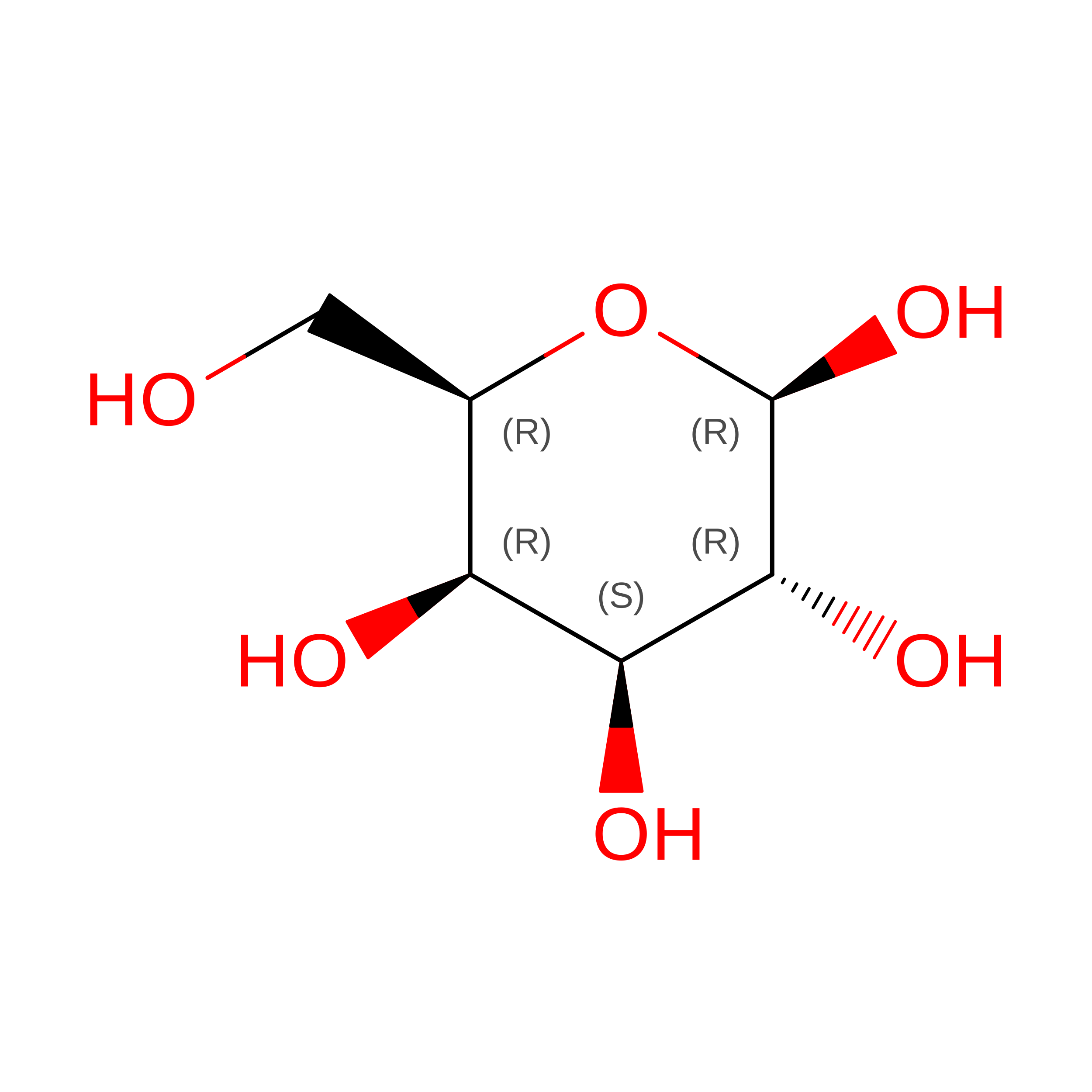
GAL
(Subject of Investigation/LOI)

Query on GAL


Download:Ideal Coordinates CCD File
Q [auth H]beta-D-galactopyranose
C6 H12 O6
WQZGKKKJIJFFOK-FPRJBGLDSA-N
PEG
(Subject of Investigation/LOI)

Query on PEG


Download:Ideal Coordinates CCD File
O [auth L],
R [auth H],
S [auth C],
T [auth C],
U [auth E]
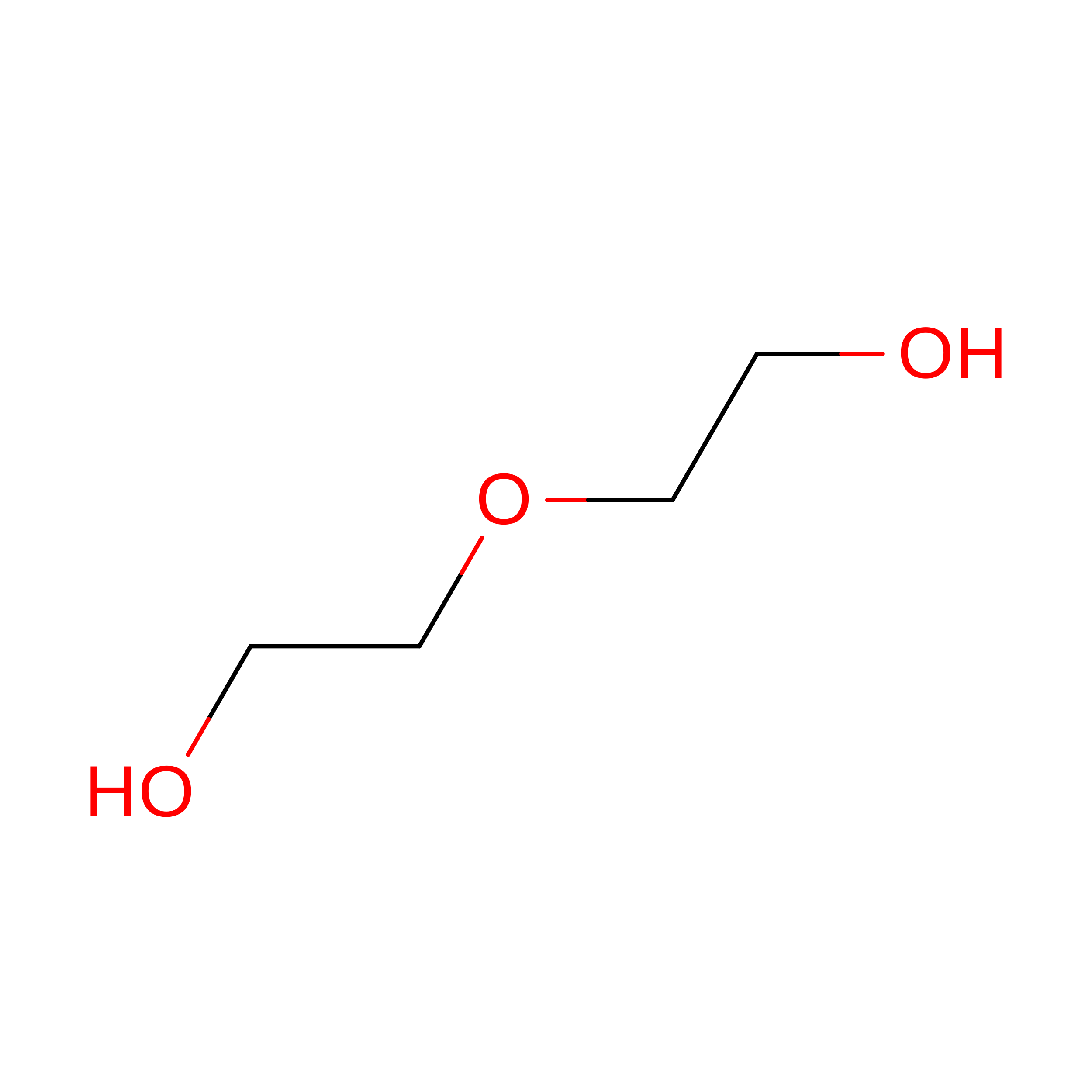
DI(HYDROXYETHYL)ETHER
C4 H10 O3
MTHSVFCYNBDYFN-UHFFFAOYSA-N

Experimental Data & Validation

Experimental Data

  • Method: X-RAY DIFFRACTION
  • Resolution: 2.96 Å
  • R-Value Free:  0.248 (Depositor), 0.255 (DCC) 
  • R-Value Work:  0.210 (Depositor), 0.217 (DCC) 
Space Group: P 1
Unit Cell:
Length ( Å )Angle ( ˚ )
a = 39.838α = 89.602
b = 108.697β = 87.339
c = 108.92γ = 89.251
Software Package:
Software NamePurpose
REFMACrefinement
DIALSdata reduction
Aimlessdata scaling
PHASERphasing

Structure Validation

View Full Validation Report


Ligand Structure Quality Assessment 


Entry History 

& Funding Information

Deposition Data


Funding OrganizationLocationGrant Number
Max Planck SocietyGermany--

Revision History  (Full details and data files)

  • Version 1.0: 2026-02-18
    Type: Initial release
  • Version 1.1: 2026-05-13
    Changes: Database references