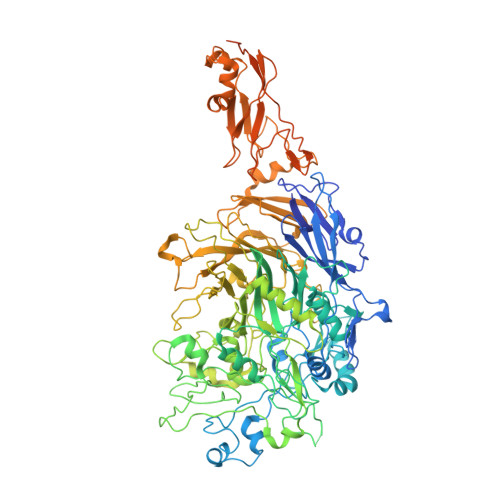
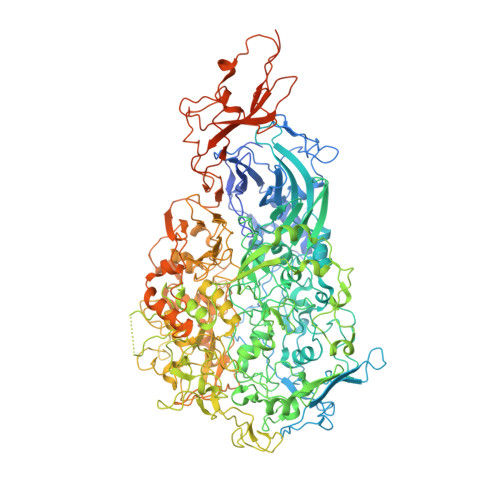
8PBY | pdb_00008pby

Single particle cryo-EM of the P140-P110 heterodimer with an alternative conformation in the P140 stalk of Mycoplasma genitalium at a resolution of 3.7 Angstrom.


Experimental Data Snapshot

  • Method: ELECTRON MICROSCOPY
  • Resolution: 3.70 Å
  • Aggregation State: PARTICLE 
  • Reconstruction Method: SINGLE PARTICLE 

Starting Models: experimental
View more details

wwPDB Validation 3D Report Full Report

Validation slider image for 8PBY

This is version 1.1 of the entry. See complete history

Literature

Cryo-electron tomography reveals the binding and release states of the major adhesion complex from Mycoplasma genitalium.

Sprankel, L.Scheffer, M.P.Manger, S.Ermel, U.H.Frangakis, A.S.

(2023) PLoS Pathog 19: e1011761-e1011761

  • DOI: https://doi.org/10.1371/journal.ppat.1011761
  • Primary Citation Related Structures: 
    8PBX, 8PBY, 8PBZ, 8PC0, 8PC1

  • PubMed Abstract: 

    The nap particle is an immunogenic surface adhesion complex from Mycoplasma genitalium. It is essential for motility and responsible for binding sialylated oligosaccharides on the surface of the host cell. The nap particle is composed of two P140-P110 heterodimers, the structure of which was recently solved. However, the interpretation of the mechanism by which the mycoplasma cells orchestrate adhesion remained challenging. Here, we provide cryo-electron tomography structures at ~11 Å resolution, which allow for the distinction between the bound and released state of the nap particle, displaying the in vivo conformational states. Fitting of the atomically resolved structures reveals that bound sialylated oligosaccharides are stabilized by both P110 and P140. Movement of the stalk domains allows for the transfer of conformational changes from the interior of the cell to the binding pocket, thus having the capability of an active release process. It is likely that the same mechanism can be transferred to other Mycoplasma species that belong to the pneumoniae cluster.


  • Organizational Affiliation
    • Buchmann Institute for Molecular Life Sciences and Institute of Biophysics, Goethe University Frankfurt, Frankfurt, Germany.

Macromolecule Content 

  • Total Structure Weight: 275.19 kDa 
  • Atom Count: 17,006 
  • Modeled Residue Count: 2,187 
  • Deposited Residue Count: 2,503 
  • Unique protein chains: 2

Macromolecules

Find similar proteins by:|  3D Structure
Entity ID: 1
MoleculeChains  Sequence LengthOrganismDetailsImage
Mgp-operon protein 31,059Mycoplasmoides genitalium G37Mutation(s): 0 
Gene Names: MG192
UniProt
Find proteins for P22747 (Mycoplasma genitalium (strain ATCC 33530 / DSM 19775 / NCTC 10195 / G37))
Explore P22747 
Go to UniProtKB:  P22747
Entity Groups
Sequence Clusters30% Identity50% Identity70% Identity90% Identity95% Identity100% Identity
UniProt GroupP22747
Sequence Annotations
Expand
Reference Sequence
Find similar proteins by:|  3D Structure
Entity ID: 2
MoleculeChains  Sequence LengthOrganismDetailsImage
Adhesin P11,444Mycoplasmoides genitalium G37Mutation(s): 0 
UniProt
Find proteins for P20796 (Mycoplasma genitalium (strain ATCC 33530 / DSM 19775 / NCTC 10195 / G37))
Explore P20796 
Go to UniProtKB:  P20796
Entity Groups
Sequence Clusters30% Identity50% Identity70% Identity90% Identity95% Identity100% Identity
UniProt GroupP20796
Sequence Annotations
Expand
Reference Sequence

Experimental Data & Validation

Experimental Data

  • Method: ELECTRON MICROSCOPY
  • Resolution: 3.70 Å
  • Aggregation State: PARTICLE 
  • Reconstruction Method: SINGLE PARTICLE 
EM Software:
TaskSoftware PackageVersion
MODEL REFINEMENTPHENIX
RECONSTRUCTIONcryoSPARC3.3.2

Structure Validation

View Full Validation Report


Entry History 

& Funding Information

Deposition Data


Funding OrganizationLocationGrant Number
German Research Foundation (DFG)GermanyFR 1653/6-3
German Research Foundation (DFG)GermanyGRK 2566/1

Revision History  (Full details and data files)

  • Version 1.0: 2023-11-01
    Type: Initial release
  • Version 1.1: 2023-11-22
    Changes: Database references