Download Mendeley
Structure-function analysis of carrier protein-dependent 2-sulfamoylacetyl transferase in the biosynthesis of altemicidin.
Zhu, Y., Mori, T., Karasawa, M., Shirai, K., Cheng, W., Terada, T., Awakawa, T., Abe, I.(2024) Nat Commun 15: 10896-10896
- PubMed: 39738057 Search on PubMedSearch on PubMed Central
- DOI: https://doi.org/10.1038/s41467-024-55265-z
- Primary Citation Related Structures:
8ZT3, 8ZT4 - PubMed Abstract:
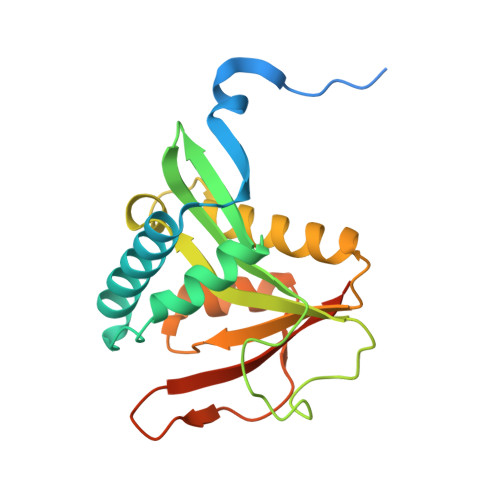
The general control non-repressible 5 (GCN5)-related N-acetyltransferase (GNAT) SbzI, in the biosynthesis of the sulfonamide antibiotic altemicidin, catalyzes the transfer of the 2-sulfamoylacetyl (2-SA) moiety onto 6-azatetrahydroindane dinucleotide. While most GNAT superfamily utilize acyl-coenzyme A (acyl-CoA) as substrates, SbzI recognizes a carrier-protein (CP)-tethered 2-SA substrate. Moreover, SbzI is the only naturally occurring enzyme that catalyzes the direct incorporation of sulfonamide, a valuable pharmacophore in medicinal chemistry. Here, we present the structure-function analysis and structure-based engineering of SbzI. The crystal structure of SbzI in complex with the CP SbzG, along with cross-linking and isothermal titration calorimetry analyses of their variants, revealed the structural basis for CP recognition by the GNAT SbzI. Furthermore, docking simulation, molecular dynamics simulation, and mutagenesis studies indicated the intimate structural details of the unique reaction mechanism of SbzI, which does not utilize a general base residue in contrast to other typical GNATs. These findings facilitated rational engineering of the enzyme to expand the substrate range and to generate azaindane dinucleotide derivatives.
- Graduate School of Pharmaceutical Sciences, The University of Tokyo, Tokyo, Japan.
Organizational Affiliation: