8UQ8 | pdb_00008uq8

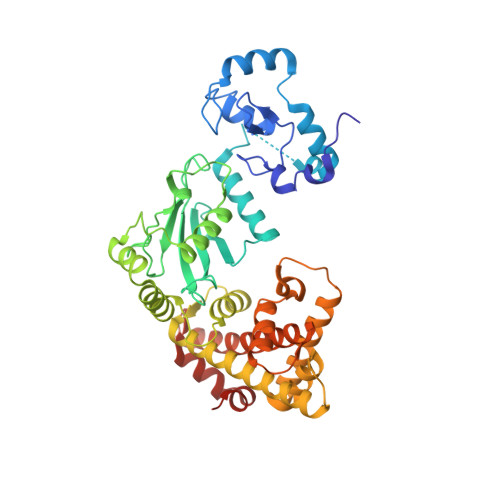
Crystal structure of RNF168 (RING)-UbcH5c fused to H2A-H2B via a 2-residue linker

  • Classification: TRANSFERASE
  • Organism(s): Homo sapiens
  • Expression System: Escherichia coli
  • Mutation(s): No 

  • Deposited: 2023-10-23 Released: 2024-01-17 
  • Deposition Author(s): Hu, Q., Botuyan, M.V., Mer, G.
  • Funding Organization(s): National Institutes of Health/National Institute of General Medical Sciences (NIH/NIGMS), National Institutes of Health/National Cancer Institute (NIH/NCI)

Experimental Data Snapshot

  • Method: X-RAY DIFFRACTION
  • Resolution: 2.34 Å
  • R-Value Free: 
    0.236 (Depositor), 0.209 (DCC) 
  • R-Value Work: 
    0.196 (Depositor) 
  • R-Value Observed: 
    0.197 (Depositor) 

Starting Models: experimental
View more details

wwPDB Validation 3D Report Full Report

Validation slider image for 8UQ8

This is version 1.2 of the entry. See complete history

Literature

Mechanisms of RNF168 nucleosome recognition and ubiquitylation.

Hu, Q.Zhao, D.Cui, G.Bhandari, J.Thompson, J.R.Botuyan, M.V.Mer, G.

(2024) Mol Cell 84: 839-853.e12

  • DOI: https://doi.org/10.1016/j.molcel.2023.12.036
  • Primary Citation Related Structures: 
    8SMW, 8SMX, 8SMY, 8SMZ, 8SN0, 8SN1, 8SN2, 8SN3, 8SN4, 8SN5, 8SN6, 8SN7, 8SN8, 8SN9, 8SNA, 8TXV, 8TXW, 8TXX, 8U13, 8U14, 8UPF, 8UQ8, 8UQ9, 8UQA, 8UQB, 8UQC, 8UQD, 8UQE

  • PubMed Abstract: 

    RNF168 plays a central role in the DNA damage response (DDR) by ubiquitylating histone H2A at K13 and K15. These modifications direct BRCA1-BARD1 and 53BP1 foci formation in chromatin, essential for cell-cycle-dependent DNA double-strand break (DSB) repair pathway selection. The mechanism by which RNF168 catalyzes the targeted accumulation of H2A ubiquitin conjugates to form repair foci around DSBs remains unclear. Here, using cryoelectron microscopy (cryo-EM), nuclear magnetic resonance (NMR) spectroscopy, and functional assays, we provide a molecular description of the reaction cycle and dynamics of RNF168 as it modifies the nucleosome and recognizes its ubiquitylation products. We demonstrate an interaction of a canonical ubiquitin-binding domain within full-length RNF168, which not only engages ubiquitin but also the nucleosome surface, clarifying how such site-specific ubiquitin recognition propels a signal amplification loop. Beyond offering mechanistic insights into a key DDR protein, our study aids in understanding site specificity in both generating and interpreting chromatin ubiquitylation.


  • Organizational Affiliation
    • Department of Biochemistry and Molecular Biology, Mayo Clinic College of Medicine and Science, Rochester, MN 55905, USA.

Macromolecule Content 

  • Total Structure Weight: 99.2 kDa 
  • Atom Count: 6,965 
  • Modeled Residue Count: 849 
  • Deposited Residue Count: 874 
  • Unique protein chains: 1

Macromolecules

Find similar proteins by:|  3D Structure
Entity ID: 1
MoleculeChains  Sequence LengthOrganismDetailsImage
E3 ubiquitin-protein ligase RNF168,Ubiquitin-conjugating enzyme E2 D3,Histone H2B type 2-E,Histone H2A type 1-B/EA,
B [auth a]
437Homo sapiensMutation(s): 0 
Gene Names: 
EC: 2.3.2.23 (PDB Primary Data), 2.3.2.24 (PDB Primary Data), 2.3.2.27 (UniProt)
UniProt & NIH Common Fund Data Resources
Find proteins for P04908 (Homo sapiens)
Explore P04908 
Go to UniProtKB:  P04908
Find proteins for P61077 (Homo sapiens)
Explore P61077 
Go to UniProtKB:  P61077
PHAROS:  P61077
GTEx:  ENSG00000109332 
Find proteins for Q16778 (Homo sapiens)
Explore Q16778 
Go to UniProtKB:  Q16778
PHAROS:  Q16778
GTEx:  ENSG00000184678 
Find proteins for Q8IYW5 (Homo sapiens)
Explore Q8IYW5 
Go to UniProtKB:  Q8IYW5
PHAROS:  Q8IYW5
GTEx:  ENSG00000163961 
Entity Groups
Sequence Clusters30% Identity50% Identity70% Identity90% Identity95% Identity100% Identity
UniProt GroupsQ8IYW5P61077P04908Q16778
Sequence Annotations
Expand
Reference Sequence

Small Molecules

Ligands 4 Unique
IDChains Name / Formula / InChI Key2D Diagram3D Interactions
GOL

Query on GOL


Download:Ideal Coordinates CCD File
G [auth A],
H [auth A],
L [auth A],
Y [auth a],
Z [auth a]
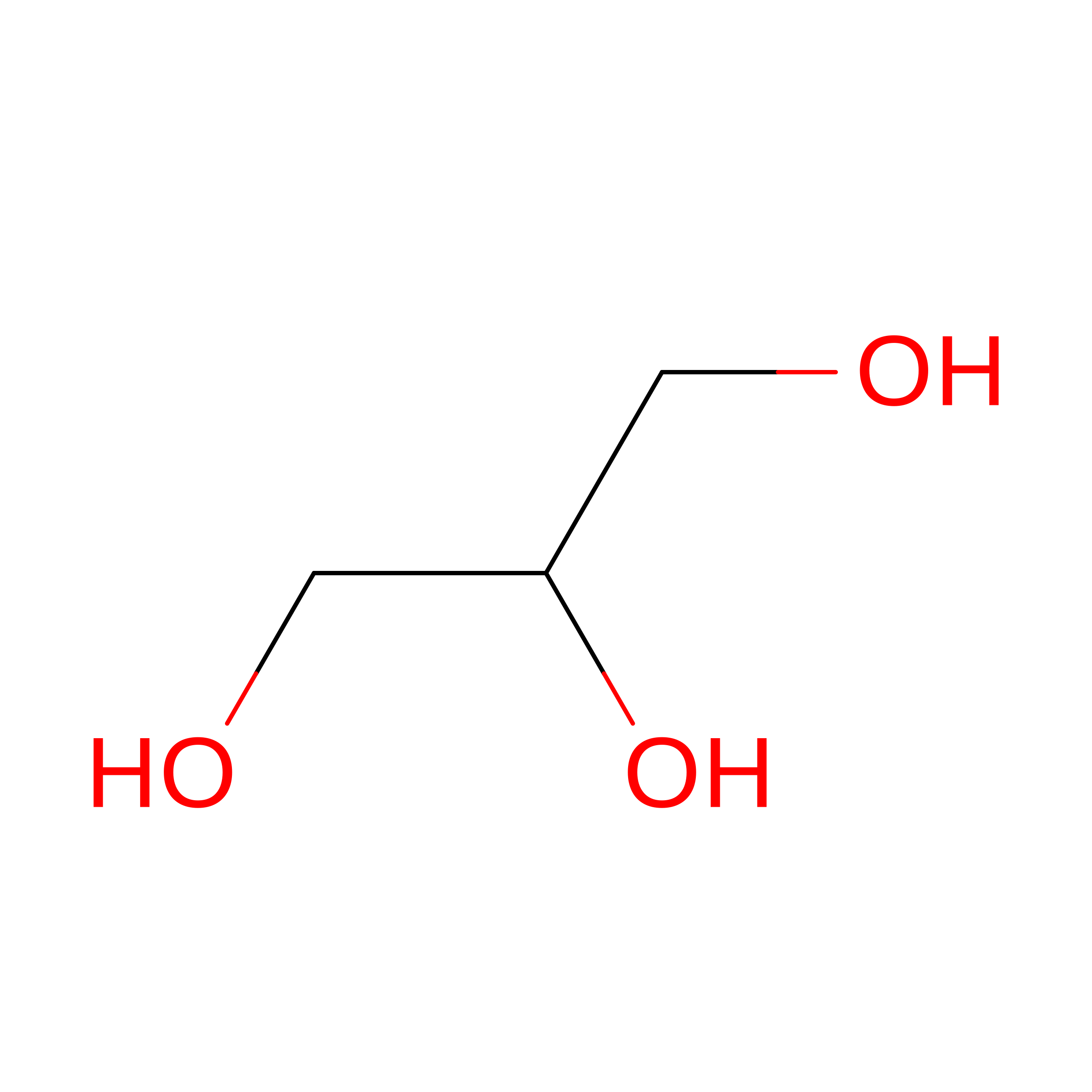
GLYCEROL
C3 H8 O3
PEDCQBHIVMGVHV-UHFFFAOYSA-N
ZN
(Subject of Investigation/LOI)

Query on ZN


Download:Ideal Coordinates CCD File
AA [auth a],
BA [auth a],
I [auth A],
J [auth A]
ZINC ION
Zn
PTFCDOFLOPIGGS-UHFFFAOYSA-N
CL

Query on CL


Download:Ideal Coordinates CCD File
C [auth A]
CA [auth a]
D [auth A]
DA [auth a]
E [auth A]
C [auth A],
CA [auth a],
D [auth A],
DA [auth a],
E [auth A],
EA [auth a],
F [auth A],
FA [auth a],
IA [auth a],
JA [auth a],
KA [auth a],
O [auth A],
P [auth A],
Q [auth A],
R [auth a],
S [auth a],
T [auth a],
U [auth a],
V [auth a],
W [auth a],
X [auth a]
CHLORIDE ION
Cl
VEXZGXHMUGYJMC-UHFFFAOYSA-M
NA

Query on NA


Download:Ideal Coordinates CCD File
GA [auth a],
HA [auth a],
K [auth A],
M [auth A],
N [auth A]
SODIUM ION
Na
FKNQFGJONOIPTF-UHFFFAOYSA-N

Experimental Data & Validation

Experimental Data

  • Method: X-RAY DIFFRACTION
  • Resolution: 2.34 Å
  • R-Value Free:  0.236 (Depositor), 0.209 (DCC) 
  • R-Value Work:  0.196 (Depositor) 
  • R-Value Observed: 0.197 (Depositor) 
Space Group: P 31
Unit Cell:
Length ( Å )Angle ( ˚ )
a = 107.539α = 90
b = 107.539β = 90
c = 113.985γ = 120
Software Package:
Software NamePurpose
PHENIXrefinement
HKL-2000data reduction
HKL-2000data scaling
PHENIXphasing

Structure Validation

View Full Validation Report


Entry History 

& Funding Information

Deposition Data


Funding OrganizationLocationGrant Number
National Institutes of Health/National Institute of General Medical Sciences (NIH/NIGMS)United StatesR35 GM136262
National Institutes of Health/National Cancer Institute (NIH/NCI)United StatesR01 CA132878

Revision History  (Full details and data files)

  • Version 1.0: 2024-01-17
    Type: Initial release
  • Version 1.1: 2024-01-31
    Changes: Database references
  • Version 1.2: 2024-03-20
    Changes: Database references