8T9R | pdb_00008t9r

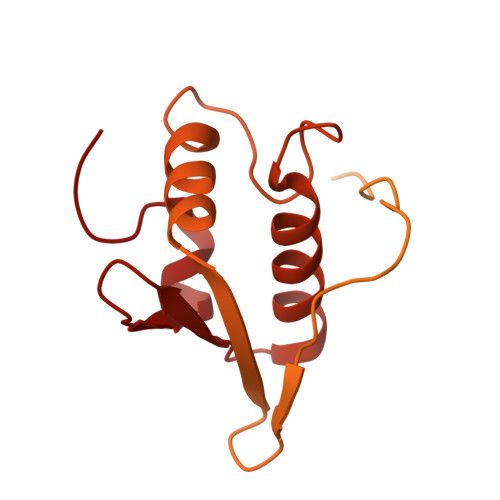
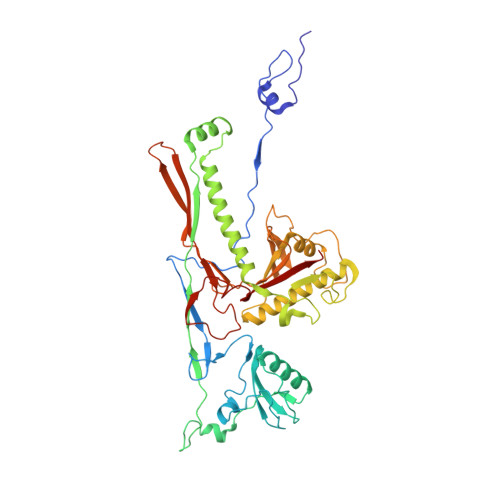
T4 highly immunogenic outer capsid protein C-terminal domain bound to a vertex-proximal gp23* capsomer of the prolate capsid in two preferred orientations.

  • Classification: VIRAL PROTEIN
  • Organism(s): Escherichia phage T4
  • Mutation(s): No 

  • Deposited: 2023-06-24 Released: 2023-07-19 
  • Deposition Author(s): Fokine, A., Rao, V.B.
  • Funding Organization(s): National Institutes of Health/National Institute Of Allergy and Infectious Diseases (NIH/NIAID)

Experimental Data Snapshot

  • Method: ELECTRON MICROSCOPY
  • Resolution: 3.40 Å
  • Aggregation State: PARTICLE 
  • Reconstruction Method: SINGLE PARTICLE 

wwPDB Validation 3D Report Full Report

Validation slider image for 8T9R

This is version 1.3 of the entry. See complete history

Literature

Structure and Function of Hoc-A Novel Environment Sensing Device Encoded by T4 and Other Bacteriophages.

Fokine, A.Islam, M.Z.Fang, Q.Chen, Z.Sun, L.Rao, V.B.

(2023) Viruses 15

  • DOI: https://doi.org/10.3390/v15071517
  • Primary Citation Related Structures: 
    8T1X, 8T9R

  • PubMed Abstract: 

    Bacteriophage T4 is decorated with 155 180 Å-long fibers of the highly antigenic outer capsid protein (Hoc). In this study, we describe a near-atomic structural model of Hoc by combining cryo-electron microscopy and AlphaFold structure predictions. It consists of a conserved C-terminal capsid-binding domain attached to a string of three variable immunoglobulin (Ig)-like domains, an architecture well-preserved in hundreds of Hoc molecules found in phage genomes. Each T4-Hoc fiber attaches randomly to the center of gp23* hexameric capsomers in one of the six possible orientations, though at the vertex-proximal hexamers that deviate from 6-fold symmetry, Hoc binds in two preferred orientations related by 180° rotation. Remarkably, each Hoc fiber binds to all six subunits of the capsomer, though the interactions are greatest with three of the subunits, resulting in the off-centered attachment of the C-domain. Biochemical analyses suggest that the acidic Hoc fiber (pI, ~4-5) allows for the clustering of virions in acidic pH and dispersion in neutral/alkaline pH. Hoc appears to have evolved as a sensing device that allows the phage to navigate its movements through reversible clustering-dispersion transitions so that it reaches its destination, the host bacterium, and persists in various ecological niches such as the human/mammalian gut.


  • Organizational Affiliation
    • Department of Biological Sciences, Purdue University, West Lafayette, IN 47907, USA.

Macromolecule Content 

  • Total Structure Weight: 373.03 kDa 
  • Atom Count: 22,160 
  • Modeled Residue Count: 2,928 
  • Deposited Residue Count: 3,488 
  • Unique protein chains: 2

Macromolecules

Find similar proteins by:|  3D Structure
Entity ID: 1
MoleculeChains  Sequence LengthOrganismDetailsImage
Highly immunogenic outer capsid proteinA [auth X],
B [auth Y]
376Escherichia phage T4Mutation(s): 0 
UniProt
Find proteins for P18056 (Enterobacteria phage T4)
Explore P18056 
Go to UniProtKB:  P18056
Entity Groups
Sequence Clusters30% Identity50% Identity70% Identity90% Identity95% Identity100% Identity
UniProt GroupP18056
Sequence Annotations
Expand
Reference Sequence
Find similar proteins by:|  3D Structure
Entity ID: 2
MoleculeChains  Sequence LengthOrganismDetailsImage
Mature major capsid protein456Escherichia phage T4Mutation(s): 0 
UniProt
Find proteins for P04535 (Enterobacteria phage T4)
Explore P04535 
Go to UniProtKB:  P04535
Entity Groups
Sequence Clusters30% Identity50% Identity70% Identity90% Identity95% Identity100% Identity
UniProt GroupP04535
Sequence Annotations
Expand
Reference Sequence

Experimental Data & Validation

Experimental Data

  • Method: ELECTRON MICROSCOPY
  • Resolution: 3.40 Å
  • Aggregation State: PARTICLE 
  • Reconstruction Method: SINGLE PARTICLE 
EM Software:
TaskSoftware PackageVersion
MODEL REFINEMENTPHENIX

Structure Validation

View Full Validation Report


Entry History 

& Funding Information

Deposition Data


Funding OrganizationLocationGrant Number
National Institutes of Health/National Institute Of Allergy and Infectious Diseases (NIH/NIAID)United States--

Revision History  (Full details and data files)

  • Version 1.0: 2023-07-19
    Type: Initial release
  • Version 1.1: 2023-08-09
    Changes: Database references
  • Version 1.2: 2024-06-19
    Changes: Data collection
  • Version 1.3: 2025-05-21
    Changes: Data collection, Structure summary