8RAH | pdb_00008rah

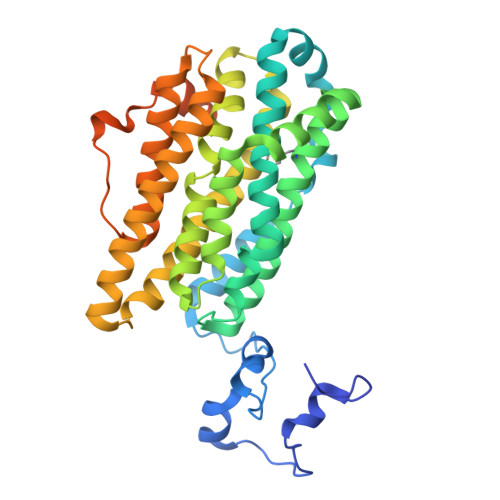
Crystal structure of class Ie ribonucleotide reductase R2 subunit with post-translational modification of Y150 into a DOPA from Gardnerella vaginalis


Experimental Data Snapshot

  • Method: X-RAY DIFFRACTION
  • Resolution: 1.90 Å
  • R-Value Free: 
    0.189 (Depositor), 0.190 (DCC) 
  • R-Value Work: 
    0.171 (Depositor), 0.172 (DCC) 
  • R-Value Observed: 
    0.171 (Depositor) 

Starting Model: experimental
View more details

wwPDB Validation 3D Report Full Report

Validation slider image for 8RAH

This is version 2.0 of the entry. See complete history

Literature

Characterization of a second class Ie ribonucleotide reductase.

John, J.Lundin, D.Branca, R.M.Kumar, R.Srinivas, V.Lebrette, H.Hogbom, M.

(2025) Commun Biol 8: 281-281

  • DOI: https://doi.org/10.1038/s42003-025-07565-3
  • Primary Citation Related Structures: 
    8RAG, 8RAH

  • PubMed Abstract: 

    Class I ribonucleotide reductases (RNRs) convert ribonucleotides into deoxyribonucleotides under oxic conditions. The R2 subunit provides a radical required for catalysis conducted by the R1 subunit. In most R2s the radical is generated on a tyrosine via oxidation by an adjacent metal site. The discovery of a metal-free R2 defined the new RNR subclass Ie. In R2e, three of the otherwise strictly conserved metal-binding glutamates in the active site are substituted. Two variants have been found, VPK and QSK. To date, the VPK version has been the focus of biochemical characterization. Here we characterize a QSK variant of R2e. We analyse the organismal distribution of the two R2e versions and find dozens of organisms relying solely on the QSK RNR for deoxyribonucleotide production. We demonstrate that the R2e QSK of the human pathogen Gardnerella vaginalis (Bifidobacterium vaginale) modifies the active site-adjacent tyrosine to DOPA. The amount of modified protein is shown to be dependent on coexpression with the other proteins encoded in the RNR operon. The DOPA containing R2e QSK can support ribonucleotide reduction in vitro while the unmodified protein cannot. Finally, we determined the first structures of R2e QSK in the unmodified and DOPA states.


  • Organizational Affiliation
    • Department of Biochemistry and Biophysics, Stockholm University, Arrhenius Laboratories for Natural Sciences, Stockholm, Sweden.

Macromolecule Content 

  • Total Structure Weight: 171.38 kDa 
  • Atom Count: 11,448 
  • Modeled Residue Count: 1,302 
  • Deposited Residue Count: 1,488 
  • Unique protein chains: 1

Macromolecules

Find similar proteins by:|  3D Structure
Entity ID: 1
MoleculeChains  Sequence LengthOrganismDetailsImage
ribonucleoside-diphosphate reductase
A, B, C, D
372Gardnerella vaginalis ATCC 14019Mutation(s): 0 
Gene Names: HMPREF0421_21333
EC: 1.17.4.1
UniProt
Find proteins for E3D8A3 (Gardnerella vaginalis (strain ATCC 14019 / 317))
Explore E3D8A3 
Go to UniProtKB:  E3D8A3
Entity Groups
Sequence Clusters30% Identity50% Identity70% Identity90% Identity95% Identity100% Identity
UniProt GroupE3D8A3
Sequence Annotations
Expand
Reference Sequence

Small Molecules

Modified Residues  1 Unique
IDChains TypeFormula2D DiagramParent
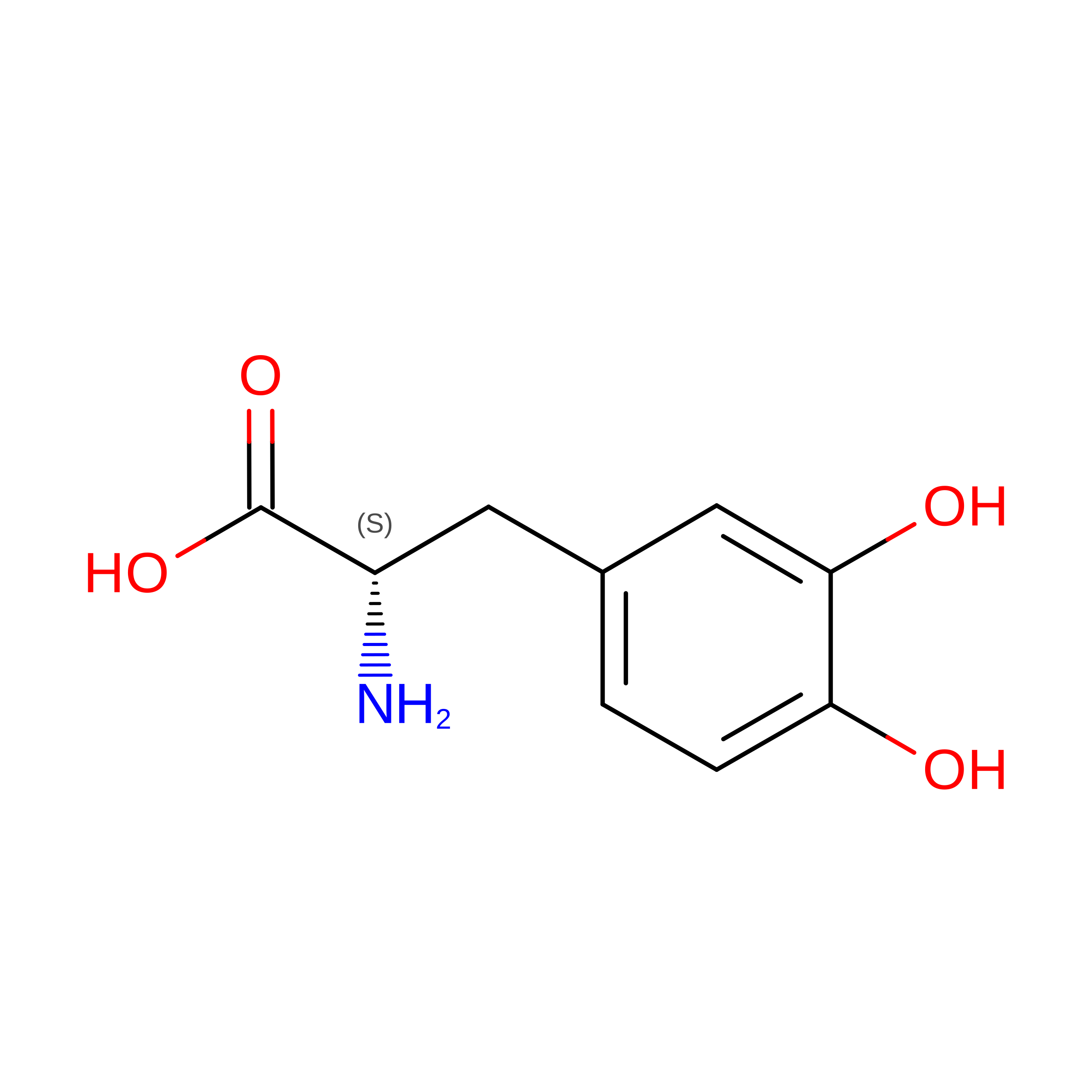
DAH
Query on DAH
A, B, C, D
L-PEPTIDE LINKINGC9 H11 N O4TYR

Experimental Data & Validation

Experimental Data

  • Method: X-RAY DIFFRACTION
  • Resolution: 1.90 Å
  • R-Value Free:  0.189 (Depositor), 0.190 (DCC) 
  • R-Value Work:  0.171 (Depositor), 0.172 (DCC) 
  • R-Value Observed: 0.171 (Depositor) 
Space Group: P 31 2 1
Unit Cell:
Length ( Å )Angle ( ˚ )
a = 173.71α = 90
b = 173.71β = 90
c = 157.89γ = 120
Software Package:
Software NamePurpose
PHENIXrefinement
XDSdata reduction
XDSdata scaling
PHASERphasing

Structure Validation

View Full Validation Report


Entry History 

& Funding Information

Deposition Data


Funding OrganizationLocationGrant Number
Swedish Research CouncilSweden2021-03992
Knut and Alice Wallenberg FoundationSweden2019.0436

Revision History  (Full details and data files)

  • Version 1.0: 2024-12-11
    Type: Initial release
  • Version 1.1: 2025-03-05
    Changes: Database references
  • Version 2.0: 2025-09-17
    Changes: Atomic model, Data collection, Database references, Derived calculations, Polymer sequence