8PDK | pdb_00008pdk

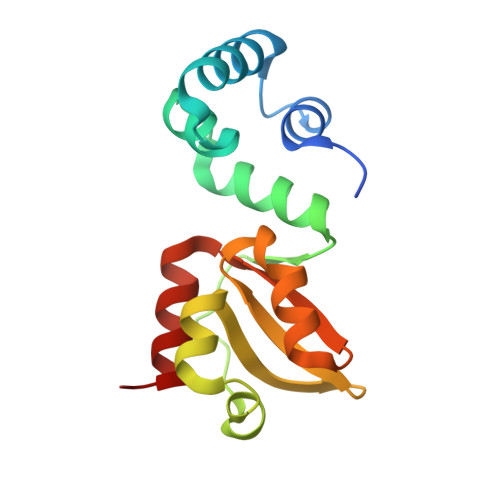
X-ray structure of the Thermus thermophilus PilF-GSPIIB domain in the c-di-GMP bound state


Experimental Data Snapshot

  • Method: X-RAY DIFFRACTION
  • Resolution: 2.00 Å
  • R-Value Free: 
    0.212 (Depositor), 0.212 (DCC) 
  • R-Value Work: 
    0.178 (Depositor), 0.181 (DCC) 
  • R-Value Observed: 
    0.179 (Depositor) 

Starting Model: experimental
View more details

wwPDB Validation 3D Report Full Report

Validation slider image for 8PDK

Ligand Structure Quality Assessment 


This is version 1.1 of the entry. See complete history

Literature

The structural basis for high-affinity c-di-GMP binding to the GSPII-B domain of the traffic ATPase PilF from Thermus thermophilus.

Neissner, K.Keller, H.Kirchner, L.Dusterhus, S.Duchardt-Ferner, E.Averhoff, B.Wohnert, J.

(2024) J Biological Chem 301: 108041-108041

  • DOI: https://doi.org/10.1016/j.jbc.2024.108041
  • Primary Citation Related Structures: 
    8PDK, 8PE0, 8PFA, 8PKZ, 8PQU

  • PubMed Abstract: 

    c-di-GMP is an important second messenger in bacteria regulating, for example motility, biofilm formation, cell wall biosynthesis, infectivity, and natural transformability. It binds to a multitude of intracellular receptors. This includes proteins containing general secretory pathway II (GSPII) domains such as the N-terminal domain of the Vibrio cholerae ATPase MshE (MshEN) which binds c-di-GMP with two copies of a 24-amino acids sequence motif. The traffic ATPase PilF from Thermus thermophilus is important for type IV pilus biogenesis, twitching motility, surface attachment, and natural DNA-uptake and contains three consecutive homologous GPSII domains. We show that only two of these domains bind c-di-GMP and define the structural basis for the exceptional high affinity of the GSPII-B domain for c-di-GMP, which is 83-fold higher than that of the prototypical MshEN domain. Our work establishes an extended consensus sequence for the c-di-GMP-binding motif and highlights the role of hydrophobic residues for high-affinity recognition of c-di-GMP. Our structure is the first example for a c-di-GMP-binding domain not relying on arginine residues for ligand recognition. We also show that c-di-GMP-binding induces local unwinding of an α-helical turn as well as subdomain reorientation to reinforce intermolecular contacts between c-di-GMP and the C-terminal subdomain. Abolishing c-di-GMP binding to GSPII-B reduces twitching motility and surface attachment but not natural DNA-uptake. Overall, our work contributes to a better characterization of c-di-GMP binding in this class of effector domains, allows the prediction of high-affinity c-di-GMP-binding family members, and advances our understanding of the importance of c-di-GMP binding for T4P-related functions.


  • Organizational Affiliation
    • Institute for Molecular Biosciences, Goethe-University Frankfurt/M., Frankfurt, Germany; Center for Biomolecular Magnetic Resonance (BMRZ), Goethe-University Frankfurt/M., Frankfurt, Germany.

Macromolecule Content 

  • Total Structure Weight: 35.36 kDa 
  • Atom Count: 2,487 
  • Modeled Residue Count: 276 
  • Deposited Residue Count: 292 
  • Unique protein chains: 1

Macromolecules

Find similar proteins by:|  3D Structure
Entity ID: 1
MoleculeChains  Sequence LengthOrganismDetailsImage
c-di-GMP binding domain of the ATPase enzyme PilF
A, B
146Thermus thermophilus HB27Mutation(s): 0 
Gene Names: pilFTT_C1622
UniProt
Find proteins for Q5SLC9 (Thermus thermophilus (strain ATCC 27634 / DSM 579 / HB8))
Explore Q5SLC9 
Go to UniProtKB:  Q5SLC9
Entity Groups
Sequence Clusters30% Identity50% Identity70% Identity90% Identity95% Identity100% Identity
UniProt GroupQ5SLC9
Sequence Annotations
Expand
Reference Sequence

Small Molecules

Ligands 3 Unique
IDChains Name / Formula / InChI Key2D Diagram3D Interactions
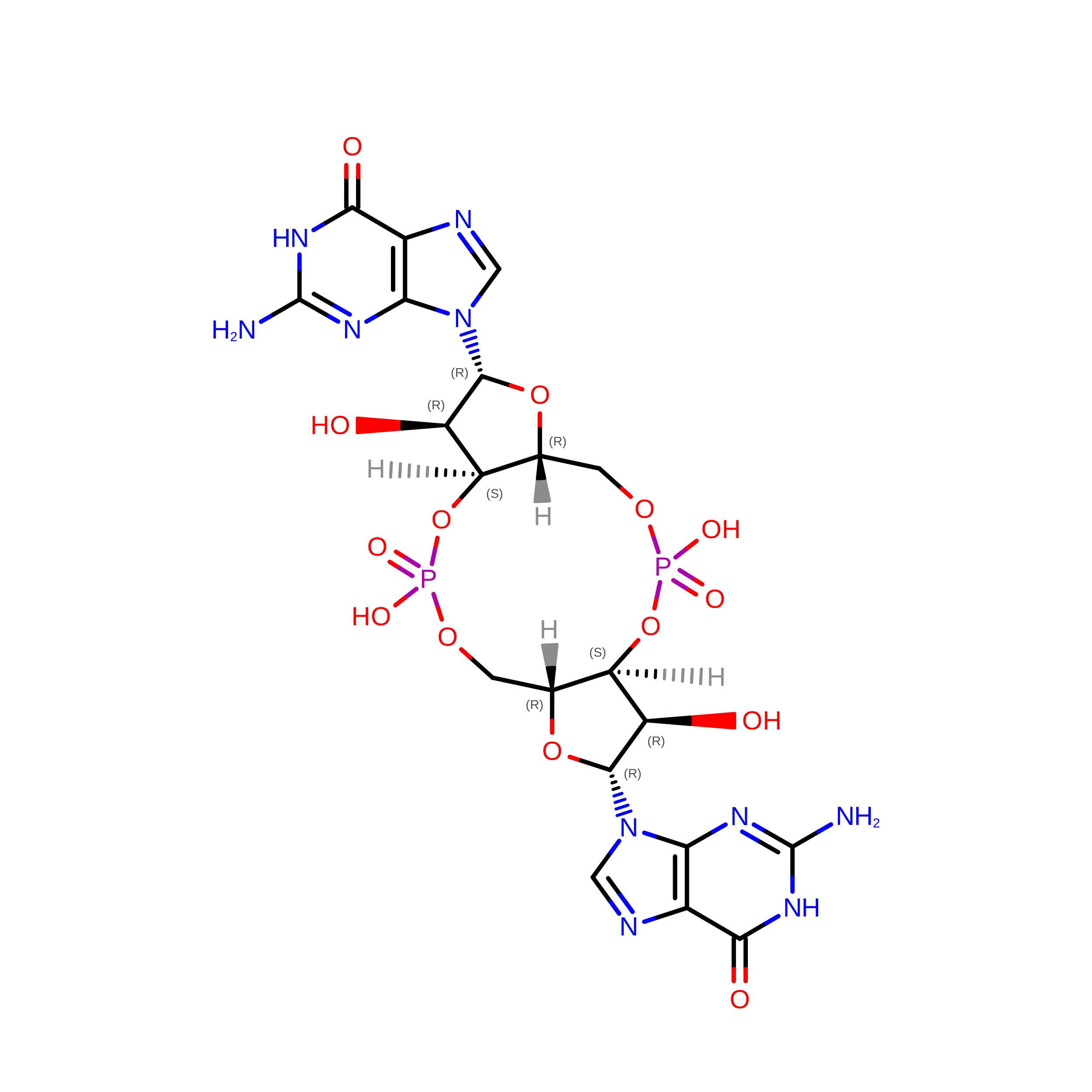
C2E
(Subject of Investigation/LOI)

Query on C2E


Download:Ideal Coordinates CCD File
C [auth A],
O [auth B]
9,9'-[(2R,3R,3aS,5S,7aR,9R,10R,10aS,12S,14aR)-3,5,10,12-tetrahydroxy-5,12-dioxidooctahydro-2H,7H-difuro[3,2-d:3',2'-j][1,3,7,9,2,8]tetraoxadiphosphacyclododecine-2,9-diyl]bis(2-amino-1,9-dihydro-6H-purin-6-one)
C20 H24 N10 O14 P2
PKFDLKSEZWEFGL-MHARETSRSA-N
SO4

Query on SO4


Download:Ideal Coordinates CCD File
D [auth A]
E [auth A]
F [auth A]
P [auth B]
Q [auth B]
D [auth A],
E [auth A],
F [auth A],
P [auth B],
Q [auth B],
R [auth B],
S [auth B]
SULFATE ION
O4 S
QAOWNCQODCNURD-UHFFFAOYSA-L
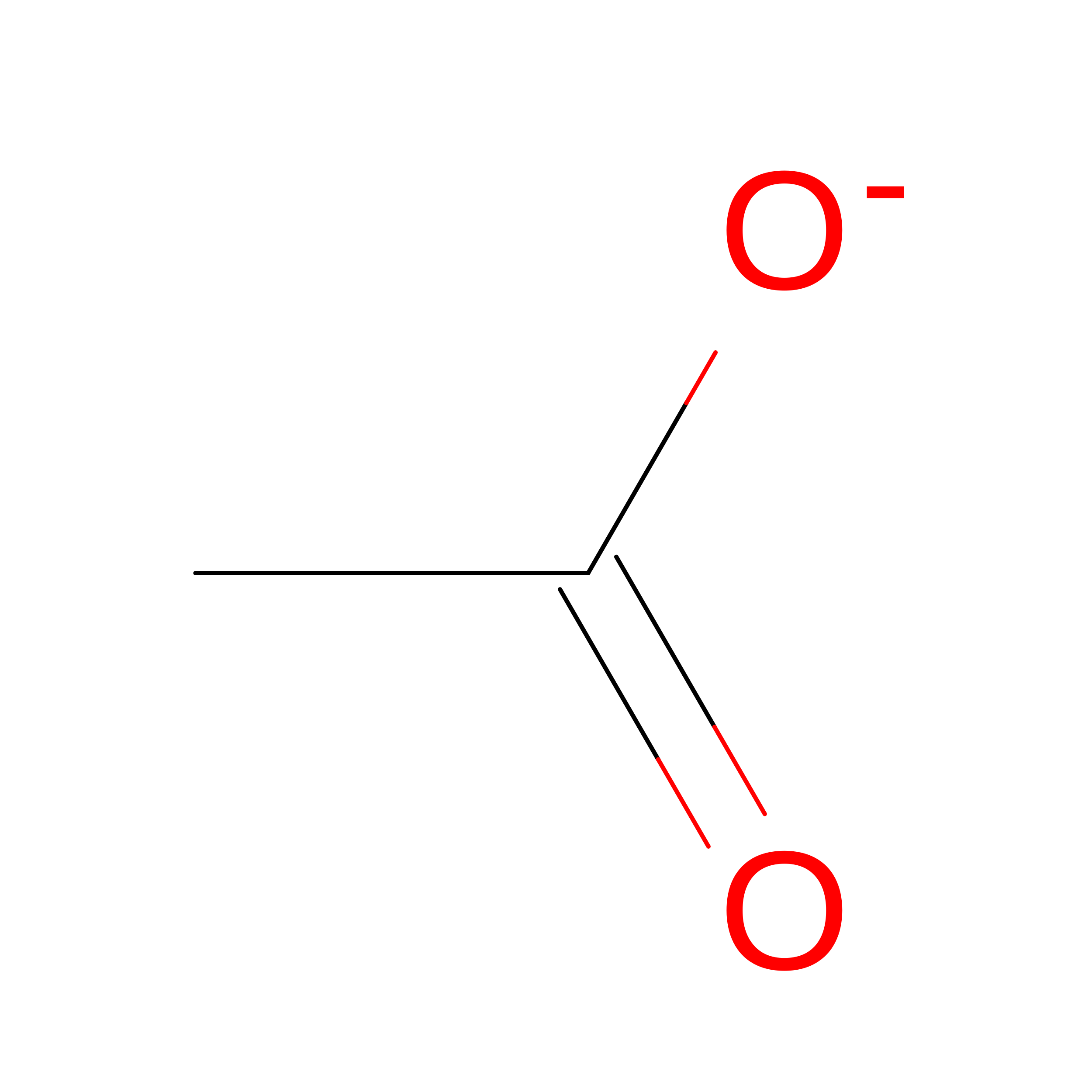
ACT

Query on ACT


Download:Ideal Coordinates CCD File
G [auth A]
H [auth A]
I [auth A]
J [auth A]
K [auth A]
G [auth A],
H [auth A],
I [auth A],
J [auth A],
K [auth A],
L [auth A],
M [auth A],
N [auth A],
T [auth B],
U [auth B],
V [auth B],
W [auth B],
X [auth B]
ACETATE ION
C2 H3 O2
QTBSBXVTEAMEQO-UHFFFAOYSA-M

Experimental Data & Validation

Experimental Data

  • Method: X-RAY DIFFRACTION
  • Resolution: 2.00 Å
  • R-Value Free:  0.212 (Depositor), 0.212 (DCC) 
  • R-Value Work:  0.178 (Depositor), 0.181 (DCC) 
  • R-Value Observed: 0.179 (Depositor) 
Space Group: H 3
Unit Cell:
Length ( Å )Angle ( ˚ )
a = 108.138α = 90
b = 108.138β = 90
c = 87.922γ = 120
Software Package:
Software NamePurpose
PHENIXrefinement
PHENIXrefinement
XDSdata reduction
XDSdata scaling
PHENIXphasing

Structure Validation

View Full Validation Report


Ligand Structure Quality Assessment 


Entry History 

& Funding Information

Deposition Data


Funding OrganizationLocationGrant Number
German Research Foundation (DFG)GermanyWo 901/12-1

Revision History  (Full details and data files)

  • Version 1.0: 2024-06-26
    Type: Initial release
  • Version 1.1: 2025-01-08
    Changes: Database references, Structure summary