Download Mendeley
Advancing Enzyme's Stability and Catalytic Efficiency through Synergy of Force-Field Calculations, Evolutionary Analysis, and Machine Learning.
Kunka, A., Marques, S.M., Havlasek, M., Vasina, M., Velatova, N., Cengelova, L., Kovar, D., Damborsky, J., Marek, M., Bednar, D., Prokop, Z.(2023) ACS Catal 13: 12506-12518
- PubMed: 37822856 Search on PubMedSearch on PubMed Central
- DOI: https://doi.org/10.1021/acscatal.3c02575
- Primary Citation Related Structures:
8OE2, 8OE6 - PubMed Abstract:
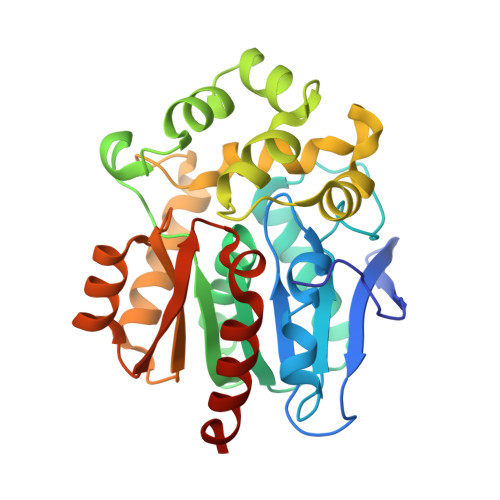
Thermostability is an essential requirement for the use of enzymes in the bioindustry. Here, we compare different protein stabilization strategies using a challenging target, a stable haloalkane dehalogenase DhaA115. We observe better performance of automated stabilization platforms FireProt and PROSS in designing multiple-point mutations over the introduction of disulfide bonds and strengthening the intra- and the inter-domain contacts by in silico saturation mutagenesis. We reveal that the performance of automated stabilization platforms was still compromised due to the introduction of some destabilizing mutations. Notably, we show that their prediction accuracy can be improved by applying manual curation or machine learning for the removal of potentially destabilizing mutations, yielding highly stable haloalkane dehalogenases with enhanced catalytic properties. A comparison of crystallographic structures revealed that current stabilization rounds were not accompanied by large backbone re-arrangements previously observed during the engineering stability of DhaA115. Stabilization was achieved by improving local contacts including protein-water interactions. Our study provides guidance for further improvement of automated structure-based computational tools for protein stabilization.
- Loschmidt Laboratories, Department of Experimental Biology and RECETOX, Faculty of Science, Masaryk University, Brno 601 77, Czech Republic.
Organizational Affiliation: