8KDK | pdb_00008kdk

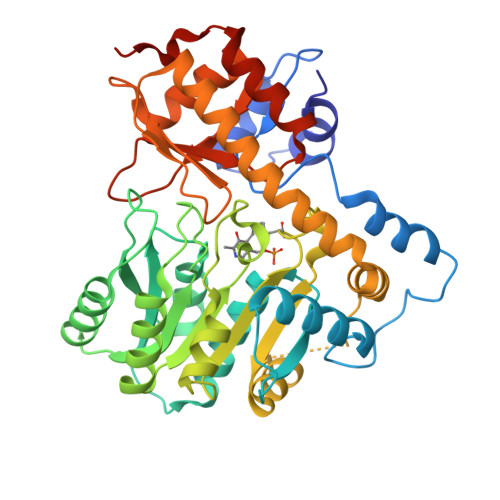
Crystal structure of CcbF in complex with PLP


Experimental Data Snapshot

  • Method: X-RAY DIFFRACTION
  • Resolution: 1.80 Å
  • R-Value Free: 
    0.247 (Depositor), 0.247 (DCC) 
  • R-Value Work: 
    0.203 (Depositor), 0.203 (DCC) 
  • R-Value Observed: 
    0.204 (Depositor) 

Starting Model: in silico
View more details

wwPDB Validation 3D Report Full Report

Validation slider image for 8KDK

This is version 1.1 of the entry. See complete history

Literature

Molecular basis for the diversification of lincosamide biosynthesis by pyridoxal phosphate-dependent enzymes.

Mori, T.Moriwaki, Y.Sakurada, K.Lyu, S.Kadlcik, S.Janata, J.Mazumdar, A.Koberska, M.Terada, T.Kamenik, Z.Abe, I.

(2025) Nat Chem 17: 256-264

  • DOI: https://doi.org/10.1038/s41557-024-01687-7
  • Primary Citation Related Structures: 
    8KDK, 8KDL

  • PubMed Abstract: 

    The biosynthesis of the lincosamide antibiotics lincomycin A and celesticetin involves the pyridoxal-5'-phosphate (PLP)-dependent enzymes LmbF and CcbF, which are responsible for bifurcation of the biosynthetic pathways. Despite recognizing the same S-glycosyl-L-cysteine structure of the substrates, LmbF catalyses thiol formation through β-elimination, whereas CcbF produces S-acetaldehyde through decarboxylation-coupled oxidative deamination. The structural basis for the diversification mechanism remains largely unexplored. Here we conduct structure-function analyses of LmbF and CcbF. X-ray crystal structures, docking and molecular dynamics simulations reveal that active-site aromatic residues play important roles in controlling the substrate binding mode and the reaction outcome. Furthermore, the reaction selectivity and oxygen-utilization of LmbF and CcbF were rationally engineered through structure- and calculation-based mutagenesis. Thus, the catalytic function of CcbF was switched to that of LmbF, and, remarkably, both LmbF and CcbF variants gained the oxidative-amidation activity to produce an unnatural S-acetamide derivative of lincosamide.


  • Organizational Affiliation
    • Graduate School of Pharmaceutical Sciences, The University of Tokyo, Tokyo, Japan. tmori@mol.f.u-tokyo.ac.jp.

Macromolecule Content 

  • Total Structure Weight: 193.18 kDa 
  • Atom Count: 13,815 
  • Modeled Residue Count: 1,607 
  • Deposited Residue Count: 1,704 
  • Unique protein chains: 1

Macromolecules

Find similar proteins by:|  3D Structure
Entity ID: 1
MoleculeChains  Sequence LengthOrganismDetailsImage
CcbFA [auth D],
B [auth A],
C [auth B],
D [auth C]
426Streptomyces caelestisMutation(s): 0 
Gene Names: HDA41_002770
EC: 2.6.1.17
UniProt
Find proteins for E9JES7 (Streptomyces caelestis)
Explore E9JES7 
Go to UniProtKB:  E9JES7
Entity Groups
Sequence Clusters30% Identity50% Identity70% Identity90% Identity95% Identity100% Identity
UniProt GroupE9JES7
Sequence Annotations
Expand
Reference Sequence

Small Molecules

Modified Residues  1 Unique
IDChains TypeFormula2D DiagramParent
LLP
Query on LLP
A [auth D],
B [auth A],
C [auth B],
D [auth C]
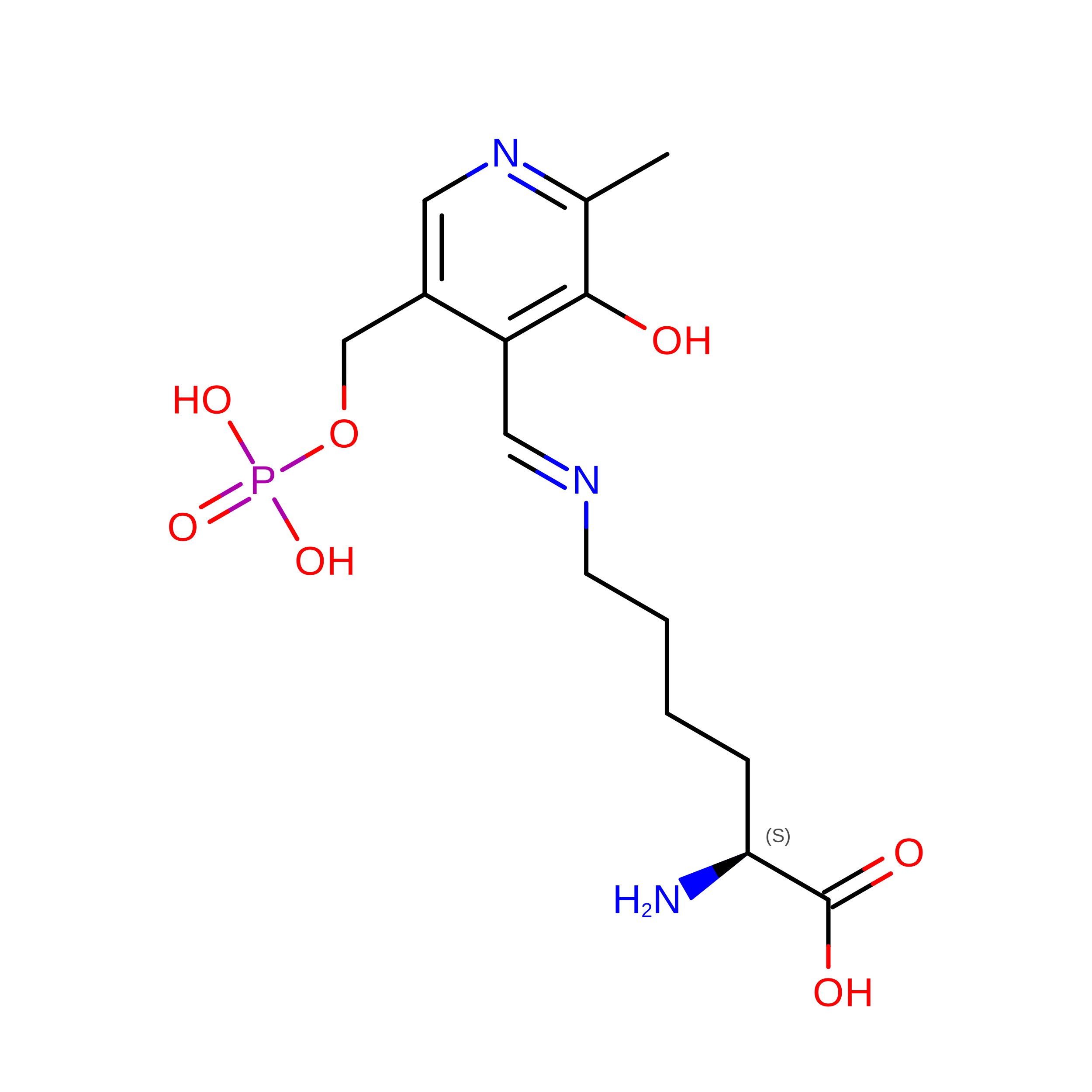
L-PEPTIDE LINKINGC14 H22 N3 O7 PLYS

Experimental Data & Validation

Experimental Data

  • Method: X-RAY DIFFRACTION
  • Resolution: 1.80 Å
  • R-Value Free:  0.247 (Depositor), 0.247 (DCC) 
  • R-Value Work:  0.203 (Depositor), 0.203 (DCC) 
  • R-Value Observed: 0.204 (Depositor) 
Space Group: P 1 21 1
Unit Cell:
Length ( Å )Angle ( ˚ )
a = 75.391α = 90
b = 102.7β = 92.44
c = 102.954γ = 90
Software Package:
Software NamePurpose
PHENIXrefinement
XDSdata reduction
Aimlessdata scaling
PHASERphasing

Structure Validation

View Full Validation Report


Entry History 

& Funding Information

Deposition Data


Funding OrganizationLocationGrant Number
Not funded--

Revision History  (Full details and data files)

  • Version 1.0: 2024-08-14
    Type: Initial release
  • Version 1.1: 2025-02-26
    Changes: Database references, Structure summary