8GJW | pdb_00008gjw

Structure of a cGAS-like receptor Cv-cGLR1 from C. virginica


Experimental Data Snapshot

  • Method: X-RAY DIFFRACTION
  • Resolution: 1.93 Å
  • R-Value Free: 
    0.247 (Depositor), 0.260 (DCC) 
  • R-Value Work: 
    0.228 (Depositor), 0.227 (DCC) 
  • R-Value Observed: 
    0.229 (Depositor) 

wwPDB Validation 3D Report Full Report

Validation slider image for 8GJW

This is version 1.3 of the entry. See complete history

Literature

cGLRs are a diverse family of pattern recognition receptors in innate immunity.

Li, Y.Slavik, K.M.Toyoda, H.C.Morehouse, B.R.de Oliveira Mann, C.C.Elek, A.Levy, S.Wang, Z.Mears, K.S.Liu, J.Kashin, D.Guo, X.Mass, T.Sebe-Pedros, A.Schwede, F.Kranzusch, P.J.

(2023) Cell 186: 3261-3276.e20

  • DOI: https://doi.org/10.1016/j.cell.2023.05.038
  • Primary Citation Related Structures: 
    8EFM, 8EFN, 8GJW, 8GJX, 8GJY, 8GJZ

  • PubMed Abstract: 

    Cyclic GMP-AMP synthase (cGAS) is an enzyme in human cells that controls an immune response to cytosolic DNA. Upon binding DNA, cGAS synthesizes a nucleotide signal 2'3'-cGAMP that activates STING-dependent downstream immunity. Here, we discover that cGAS-like receptors (cGLRs) constitute a major family of pattern recognition receptors in innate immunity. Building on recent analysis in Drosophila, we identify >3,000 cGLRs present in nearly all metazoan phyla. A forward biochemical screening of 150 animal cGLRs reveals a conserved mechanism of signaling including response to dsDNA and dsRNA ligands and synthesis of isomers of the nucleotide signals cGAMP, c-UMP-AMP, and c-di-AMP. Combining structural biology and in vivo analysis in coral and oyster animals, we explain how synthesis of distinct nucleotide signals enables cells to control discrete cGLR-STING signaling pathways. Our results reveal cGLRs as a widespread family of pattern recognition receptors and establish molecular rules that govern nucleotide signaling in animal immunity.


  • Organizational Affiliation
    • Department of Microbiology, Harvard Medical School, Boston, MA 02115, USA; Department of Cancer Immunology and Virology, Dana-Farber Cancer Institute, Boston, MA 02115, USA; Parker Institute for Cancer Immunotherapy at Dana-Farber Cancer Institute, Boston, MA 02115, USA.

Macromolecule Content 

  • Total Structure Weight: 41.79 kDa 
  • Atom Count: 2,916 
  • Modeled Residue Count: 346 
  • Deposited Residue Count: 355 
  • Unique protein chains: 1

Macromolecules

Find similar proteins by:|  3D Structure
Entity ID: 1
MoleculeChains  Sequence LengthOrganismDetailsImage
cGAS-like receptor 1355Crassostrea virginicaMutation(s): 0 
EC: 2.7.7
UniProt
Find proteins for A0A8B8BQ58 (Crassostrea virginica)
Explore A0A8B8BQ58 
Go to UniProtKB:  A0A8B8BQ58
Entity Groups
Sequence Clusters30% Identity50% Identity70% Identity90% Identity95% Identity100% Identity
UniProt GroupA0A8B8BQ58
Sequence Annotations
Expand
Reference Sequence

Small Molecules

Ligands 1 Unique
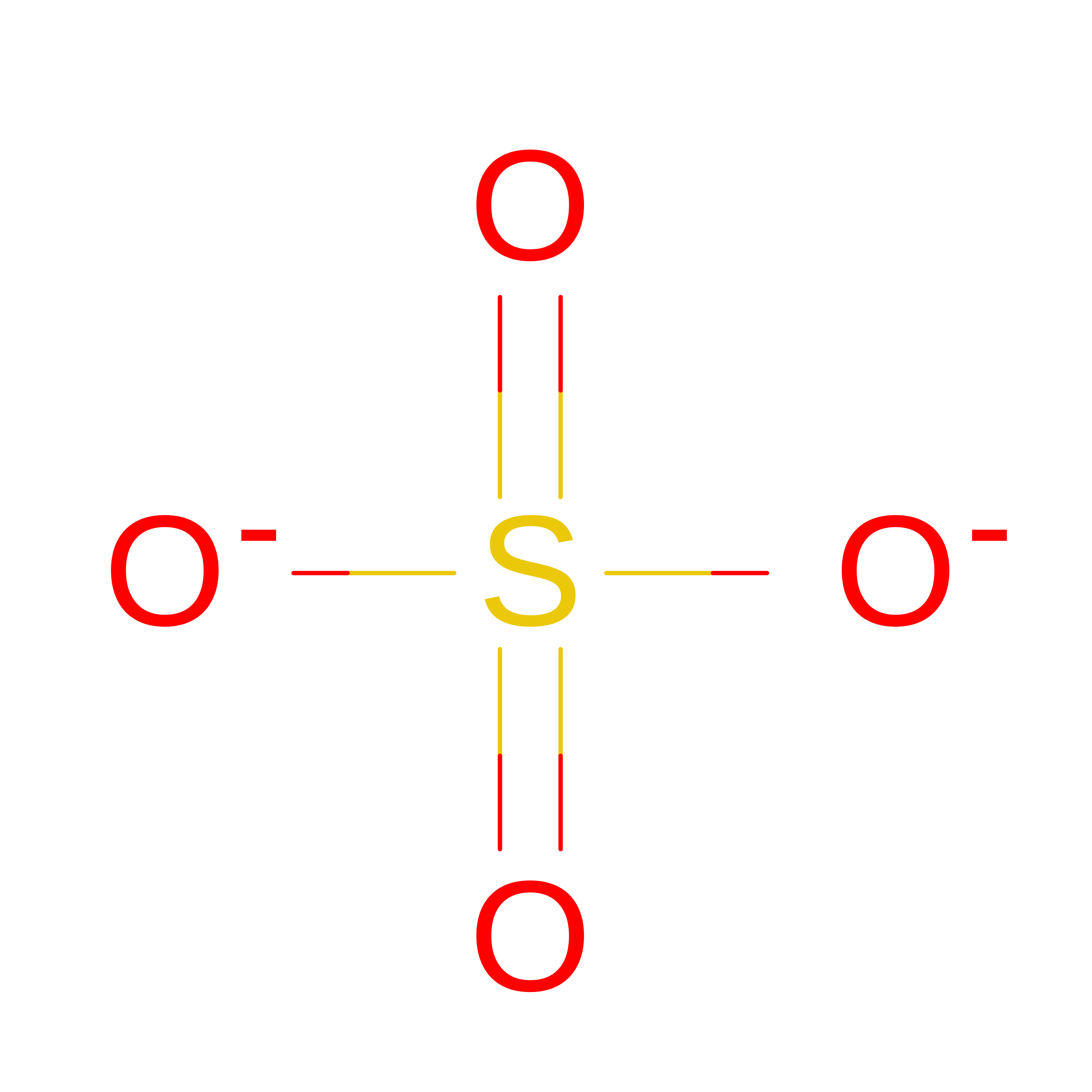
IDChains Name / Formula / InChI Key2D Diagram3D Interactions
SO4

Query on SO4


Download:Ideal Coordinates CCD File
B [auth A]SULFATE ION
O4 S
QAOWNCQODCNURD-UHFFFAOYSA-L

Experimental Data & Validation

Experimental Data

  • Method: X-RAY DIFFRACTION
  • Resolution: 1.93 Å
  • R-Value Free:  0.247 (Depositor), 0.260 (DCC) 
  • R-Value Work:  0.228 (Depositor), 0.227 (DCC) 
  • R-Value Observed: 0.229 (Depositor) 
Space Group: P 65 2 2
Unit Cell:
Length ( Å )Angle ( ˚ )
a = 68.602α = 90
b = 68.602β = 90
c = 325.851γ = 120
Software Package:
Software NamePurpose
PHENIXrefinement
XDSdata reduction
Aimlessdata scaling
AutoSolphasing

Structure Validation

View Full Validation Report


Entry History 

& Funding Information

Deposition Data


Funding OrganizationLocationGrant Number
National Institutes of Health/National Institute of General Medical Sciences (NIH/NIGMS)United States1DP2GM146250-01

Revision History  (Full details and data files)

  • Version 1.0: 2023-07-05
    Type: Initial release
  • Version 1.1: 2023-07-12
    Changes: Database references
  • Version 1.2: 2023-08-02
    Changes: Database references
  • Version 1.3: 2024-05-22
    Changes: Data collection