8EFN | pdb_00008efn

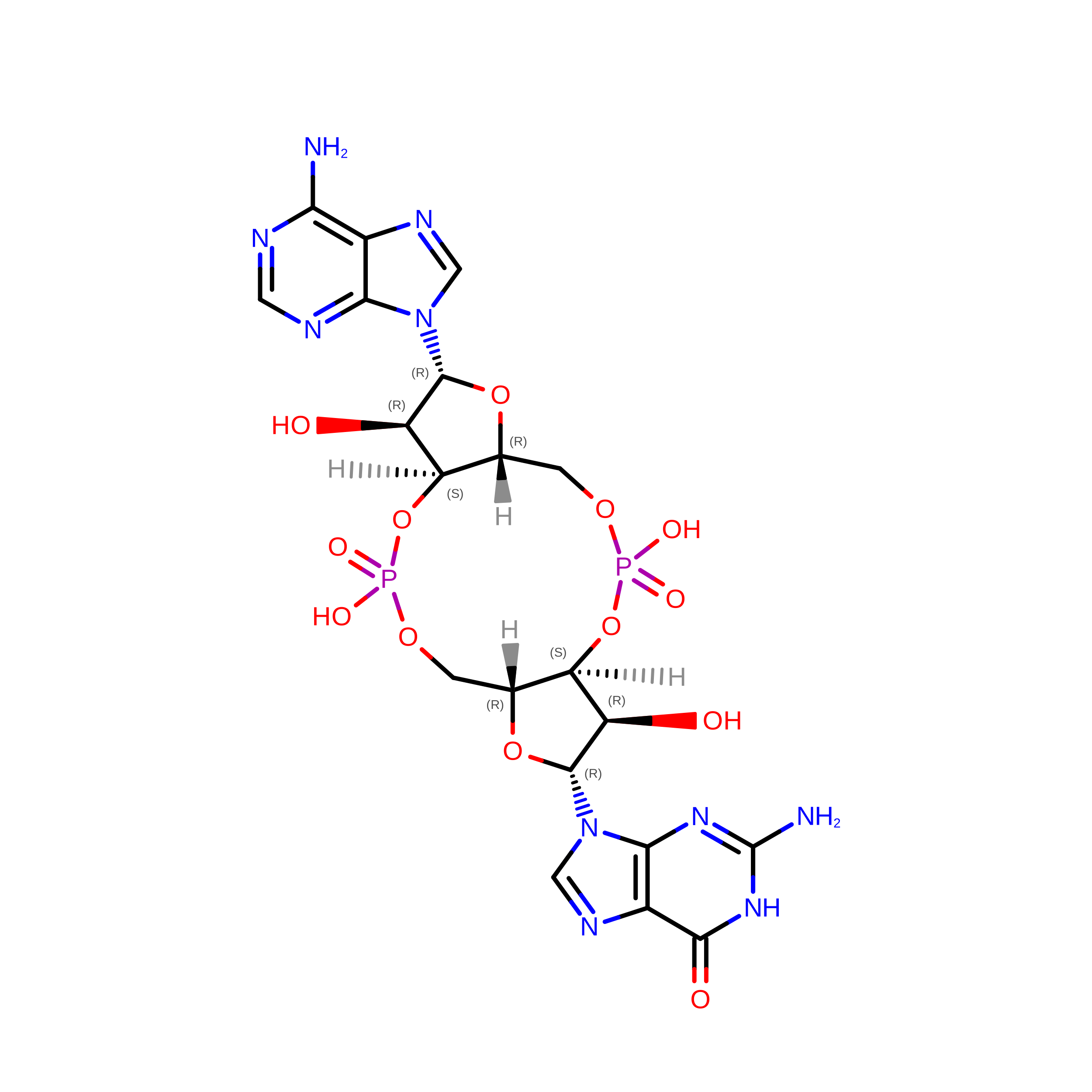
Structure of Sp-STING3 from Stylophora pistillata coral in complex with 3',3'-cGAMP


Experimental Data Snapshot

  • Method: X-RAY DIFFRACTION
  • Resolution: 1.73 Å
  • R-Value Free: 
    0.195 (Depositor), 0.196 (DCC) 
  • R-Value Work: 
    0.171 (Depositor), 0.171 (DCC) 
  • R-Value Observed: 
    0.172 (Depositor) 

Starting Model: experimental
View more details

wwPDB Validation 3D Report Full Report

Validation slider image for 8EFN

Ligand Structure Quality Assessment 


This is version 1.3 of the entry. See complete history

Literature

cGLRs are a diverse family of pattern recognition receptors in innate immunity.

Li, Y.Slavik, K.M.Toyoda, H.C.Morehouse, B.R.de Oliveira Mann, C.C.Elek, A.Levy, S.Wang, Z.Mears, K.S.Liu, J.Kashin, D.Guo, X.Mass, T.Sebe-Pedros, A.Schwede, F.Kranzusch, P.J.

(2023) Cell 186: 3261-3276.e20

  • DOI: https://doi.org/10.1016/j.cell.2023.05.038
  • Primary Citation Related Structures: 
    8EFM, 8EFN, 8GJW, 8GJX, 8GJY, 8GJZ

  • PubMed Abstract: 

    Cyclic GMP-AMP synthase (cGAS) is an enzyme in human cells that controls an immune response to cytosolic DNA. Upon binding DNA, cGAS synthesizes a nucleotide signal 2'3'-cGAMP that activates STING-dependent downstream immunity. Here, we discover that cGAS-like receptors (cGLRs) constitute a major family of pattern recognition receptors in innate immunity. Building on recent analysis in Drosophila, we identify >3,000 cGLRs present in nearly all metazoan phyla. A forward biochemical screening of 150 animal cGLRs reveals a conserved mechanism of signaling including response to dsDNA and dsRNA ligands and synthesis of isomers of the nucleotide signals cGAMP, c-UMP-AMP, and c-di-AMP. Combining structural biology and in vivo analysis in coral and oyster animals, we explain how synthesis of distinct nucleotide signals enables cells to control discrete cGLR-STING signaling pathways. Our results reveal cGLRs as a widespread family of pattern recognition receptors and establish molecular rules that govern nucleotide signaling in animal immunity.


  • Organizational Affiliation
    • Department of Microbiology, Harvard Medical School, Boston, MA 02115, USA; Department of Cancer Immunology and Virology, Dana-Farber Cancer Institute, Boston, MA 02115, USA; Parker Institute for Cancer Immunotherapy at Dana-Farber Cancer Institute, Boston, MA 02115, USA.

Macromolecule Content 

  • Total Structure Weight: 43.7 kDa 
  • Atom Count: 3,181 
  • Modeled Residue Count: 350 
  • Deposited Residue Count: 370 
  • Unique protein chains: 1

Macromolecules

Find similar proteins by:|  3D Structure
Entity ID: 1
MoleculeChains  Sequence LengthOrganismDetailsImage
Stimulator of interferon genes proteinA,
B [auth D]
185Stylophora pistillataMutation(s): 0 
Gene Names: Tmem173AWC38_SpisGene6026
UniProt
Find proteins for A0A2B4SES9 (Stylophora pistillata)
Explore A0A2B4SES9 
Go to UniProtKB:  A0A2B4SES9
Entity Groups
Sequence Clusters30% Identity50% Identity70% Identity90% Identity95% Identity100% Identity
UniProt GroupA0A2B4SES9
Sequence Annotations
Expand
Reference Sequence

Experimental Data & Validation

Experimental Data

  • Method: X-RAY DIFFRACTION
  • Resolution: 1.73 Å
  • R-Value Free:  0.195 (Depositor), 0.196 (DCC) 
  • R-Value Work:  0.171 (Depositor), 0.171 (DCC) 
  • R-Value Observed: 0.172 (Depositor) 
Space Group: P 21 21 21
Unit Cell:
Length ( Å )Angle ( ˚ )
a = 51.469α = 90
b = 82.702β = 90
c = 84.796γ = 90
Software Package:
Software NamePurpose
PHENIXrefinement
XDSdata reduction
Aimlessdata scaling
AutoSolphasing

Structure Validation

View Full Validation Report


Ligand Structure Quality Assessment 


Entry History 

& Funding Information

Deposition Data


Funding OrganizationLocationGrant Number
National Institutes of Health/National Institute of General Medical Sciences (NIH/NIGMS)United States1DP2GM146250-01

Revision History  (Full details and data files)

  • Version 1.0: 2023-07-05
    Type: Initial release
  • Version 1.1: 2023-07-12
    Changes: Database references
  • Version 1.2: 2023-08-02
    Changes: Database references
  • Version 1.3: 2023-10-25
    Changes: Data collection, Refinement description