8GAC | pdb_00008gac

Crystal structure of a high affinity CTLA-4 binder


Experimental Data Snapshot

  • Method: X-RAY DIFFRACTION
  • Resolution: 1.85 Å
  • R-Value Free: 
    0.219 (Depositor), 0.218 (DCC) 
  • R-Value Work: 
    0.191 (Depositor), 0.191 (DCC) 

Starting Model: in silico
View more details

wwPDB Validation 3D Report Full Report

Validation slider image for 8GAC

This is version 1.3 of the entry. See complete history

Literature

Design of High Affinity Binders to Convex Protein Target Sites.

Yang, W.Hicks, D.R.Ghosh, A.Schwartze, T.A.Conventry, B.Goreshnik, I.Allen, A.Halabiya, S.F.Kim, C.J.Hinck, C.S.Lee, D.S.Bera, A.K.Li, Z.Wang, Y.Schlichthaerle, T.Cao, L.Huang, B.Garrett, S.Gerben, S.R.Rettie, S.Heine, P.Murray, A.Edman, N.Carter, L.Stewart, L.Almo, S.Hinck, A.P.Baker, D.

(2024) bioRxiv 

  • DOI: https://doi.org/10.1101/2024.05.01.592114
  • Primary Citation Related Structures: 
    8GAB, 8GAC, 8GAD

  • PubMed Abstract: 

    While there has been progress in the de novo design of small globular miniproteins (50-65 residues) to bind to primarily concave regions of a target protein surface, computational design of minibinders to convex binding sites remains an outstanding challenge due to low level of overall shape complementarity. Here, we describe a general approach to generate computationally designed proteins which bind to convex target sites that employ geometrically matching concave scaffolds. We used this approach to design proteins binding to TGFβRII, CTLA-4 and PD-L1 which following experimental optimization have low nanomolar to picomolar affinities and potent biological activity. Co-crystal structures of the TGFβRII and CTLA-4 binders in complex with the receptors are in close agreement with the design models. Our approach provides a general route to generating very high affinity binders to convex protein target sites.


  • Organizational Affiliation
    • Department of Biochemistry, University of Washington, Seattle, WA 98195, USA.

Macromolecule Content 

  • Total Structure Weight: 12.7 kDa 
  • Atom Count: 942 
  • Modeled Residue Count: 103 
  • Deposited Residue Count: 106 
  • Unique protein chains: 1

Macromolecules

Find similar proteins by:|  3D Structure
Entity ID: 1
MoleculeChains  Sequence LengthOrganismDetailsImage
CTLA-4 binder106synthetic constructMutation(s): 0 

Small Molecules

Ligands 1 Unique
IDChains Name / Formula / InChI Key2D Diagram3D Interactions
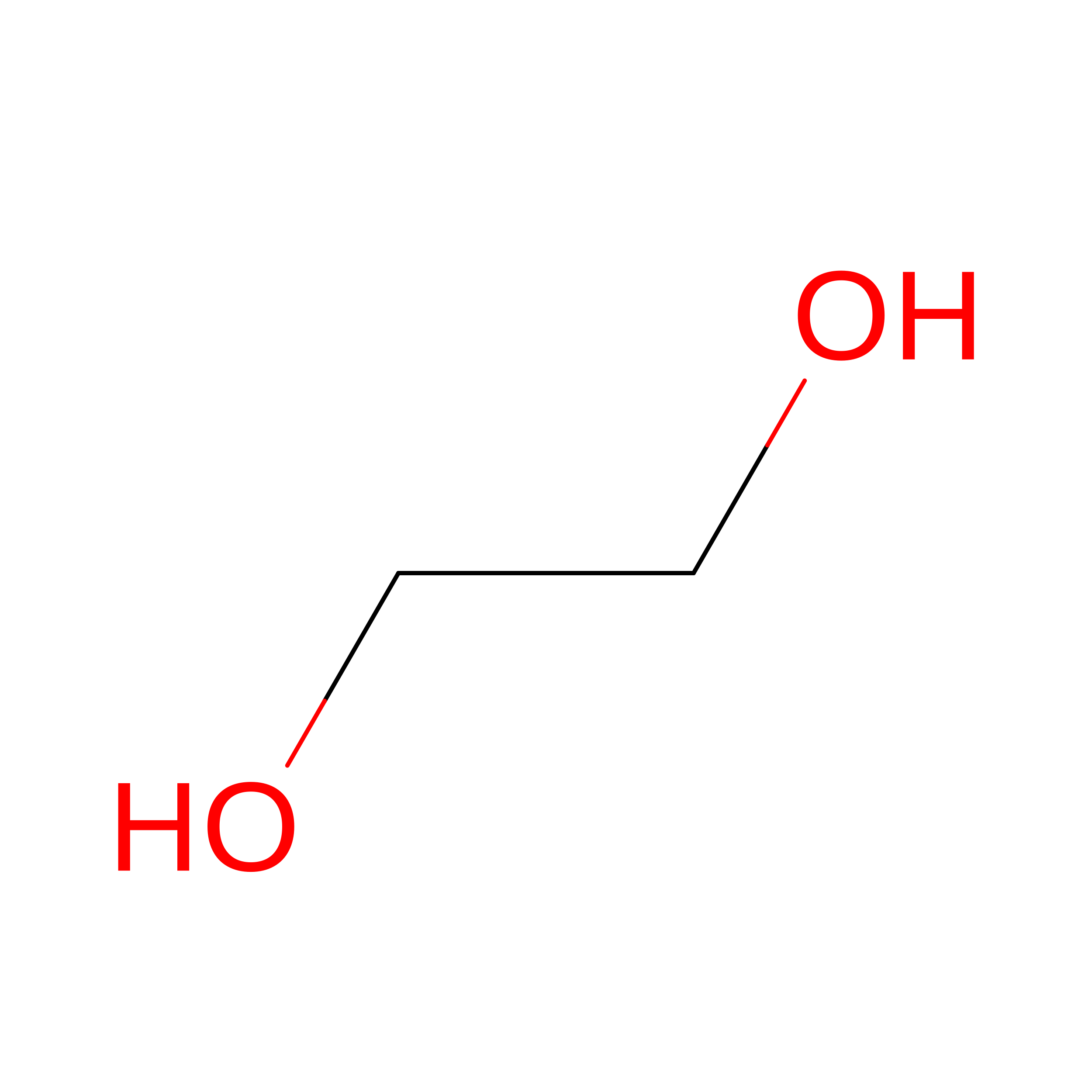
EDO

Query on EDO


Download:Ideal Coordinates CCD File
B [auth A]1,2-ETHANEDIOL
C2 H6 O2
LYCAIKOWRPUZTN-UHFFFAOYSA-N

Experimental Data & Validation

Experimental Data

  • Method: X-RAY DIFFRACTION
  • Resolution: 1.85 Å
  • R-Value Free:  0.219 (Depositor), 0.218 (DCC) 
  • R-Value Work:  0.191 (Depositor), 0.191 (DCC) 
Space Group: P 21 21 21
Unit Cell:
Length ( Å )Angle ( ˚ )
a = 39.865α = 90
b = 52.037β = 90
c = 53.524γ = 90
Software Package:
Software NamePurpose
PHENIXrefinement
Aimlessdata scaling
autoPROCdata reduction
PHASERphasing

Structure Validation

View Full Validation Report


Entry History 

& Funding Information

Deposition Data


Funding OrganizationLocationGrant Number
National Institutes of Health/National Institute of General Medical Sciences (NIH/NIGMS)United StatesS10 OD020068

Revision History  (Full details and data files)

  • Version 1.0: 2024-08-21
    Type: Initial release
  • Version 1.1: 2024-08-28
    Changes: Database references
  • Version 1.2: 2024-10-16
    Changes: Structure summary
  • Version 1.3: 2024-10-23
    Changes: Structure summary