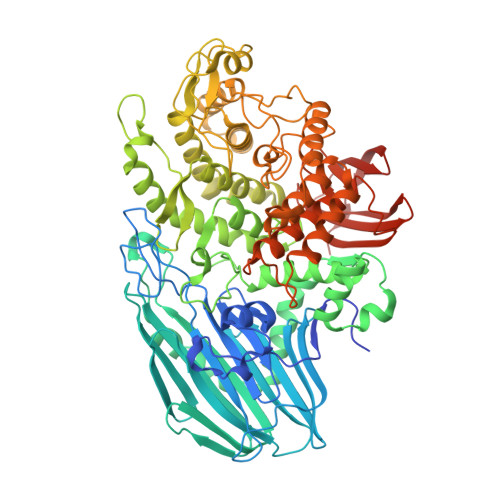
7ZO0 | pdb_00007zo0

Crystal structure of catalytic inactive unliganded form of FucOB, a GH95 family alpha-1,2-fucosidase from Akkermansia muciniphila


Experimental Data Snapshot

  • Method: X-RAY DIFFRACTION
  • Resolution: 1.95 Å
  • R-Value Free: 
    0.214 (Depositor), 0.214 (DCC) 
  • R-Value Work: 
    0.204 (Depositor), 0.203 (DCC) 
  • R-Value Observed: 
    0.204 (Depositor) 

Starting Model: experimental
View more details

wwPDB Validation 3D Report Full Report

Validation slider image for 7ZO0

Ligand Structure Quality Assessment 


This is version 1.1 of the entry. See complete history

Literature

Turning universal O into rare Bombay type blood.

Anso, I.Naegeli, A.Cifuente, J.O.Orrantia, A.Andersson, E.Zenarruzabeitia, O.Moraleda-Montoya, A.Garcia-Alija, M.Corzana, F.Del Orbe, R.A.Borrego, F.Trastoy, B.Sjogren, J.Guerin, M.E.

(2023) Nat Commun 14: 1765-1765

  • DOI: https://doi.org/10.1038/s41467-023-37324-z
  • Primary Citation Related Structures: 
    7ZNZ, 7ZO0

  • PubMed Abstract: 

    Red blood cell antigens play critical roles in blood transfusion since donor incompatibilities can be lethal. Recipients with the rare total deficiency in H antigen, the O h Bombay phenotype, can only be transfused with group O h blood to avoid serious transfusion reactions. We discover FucOB from the mucin-degrading bacteria Akkermansia muciniphila as an α-1,2-fucosidase able to hydrolyze Type I, Type II, Type III and Type V H antigens to obtain the afucosylated Bombay phenotype in vitro. X-ray crystal structures of FucOB show a three-domain architecture, including a GH95 glycoside hydrolase. The structural data together with site-directed mutagenesis, enzymatic activity and computational methods provide molecular insights into substrate specificity and catalysis. Furthermore, using agglutination tests and flow cytometry-based techniques, we demonstrate the ability of FucOB to convert universal O type into rare Bombay type blood, providing exciting possibilities to facilitate transfusion in recipients/patients with Bombay phenotype.


  • Organizational Affiliation
    • Structural Glycobiology Laboratory, Biocruces Bizkaia Health Research Institute, Cruces University Hospital, 48903, Barakaldo, Bizkaia, Spain.

Macromolecule Content 

  • Total Structure Weight: 87.84 kDa 
  • Atom Count: 6,012 
  • Modeled Residue Count: 761 
  • Deposited Residue Count: 790 
  • Unique protein chains: 1

Macromolecules

Find similar proteins by:|  3D Structure
Entity ID: 1
MoleculeChains  Sequence LengthOrganismDetailsImage
GH95 family alpha-1,2-fucosidase790Akkermansia muciniphila ATCC BAA-835Mutation(s): 1 
Gene Names: Amuc_1120
UniProt
Find proteins for B2UR61 (Akkermansia muciniphila (strain ATCC BAA-835 / DSM 22959 / JCM 33894 / BCRC 81048 / CCUG 64013 / CIP 107961 / Muc))
Explore B2UR61 
Go to UniProtKB:  B2UR61
Entity Groups
Sequence Clusters30% Identity50% Identity70% Identity90% Identity95% Identity100% Identity
UniProt GroupB2UR61
Sequence Annotations
Expand
Reference Sequence

Experimental Data & Validation

Experimental Data

  • Method: X-RAY DIFFRACTION
  • Resolution: 1.95 Å
  • R-Value Free:  0.214 (Depositor), 0.214 (DCC) 
  • R-Value Work:  0.204 (Depositor), 0.203 (DCC) 
  • R-Value Observed: 0.204 (Depositor) 
Space Group: P 1 21 1
Unit Cell:
Length ( Å )Angle ( ˚ )
a = 53.582α = 90
b = 87.507β = 102.86
c = 95.586γ = 90
Software Package:
Software NamePurpose
PHENIXrefinement
XDSdata reduction
XSCALEdata scaling
PHASERphasing

Structure Validation

View Full Validation Report


Ligand Structure Quality Assessment 


Entry History 

& Funding Information

Deposition Data


Funding OrganizationLocationGrant Number
Ministry of Economy and Competitiveness (MINECO)Spain--

Revision History  (Full details and data files)

  • Version 1.0: 2023-04-19
    Type: Initial release
  • Version 1.1: 2024-02-07
    Changes: Data collection, Refinement description