7SIB | pdb_00007sib

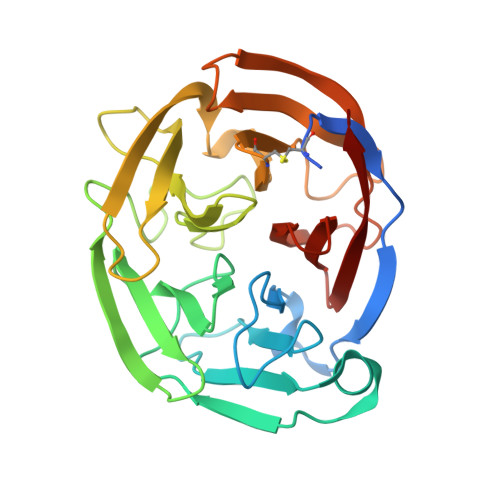
Myocilin OLF mutant K500R


Experimental Data Snapshot

  • Method: X-RAY DIFFRACTION
  • Resolution: 1.78 Å
  • R-Value Free: 
    0.182 (Depositor), 0.183 (DCC) 
  • R-Value Work: 
    0.147 (Depositor), 0.148 (DCC) 
  • R-Value Observed: 
    0.150 (Depositor) 

Starting Model: experimental
View more details

wwPDB Validation 3D Report Full Report

Validation slider image for 7SIB

This is version 1.3 of the entry. See complete history

Literature

Quantitative differentiation of benign and misfolded glaucoma-causing myocilin variants on the basis of protein thermal stability.

Scelsi, H.F.Hill, K.R.Barlow, B.M.Martin, M.D.Lieberman, R.L.

(2023) Dis Model Mech 16

  • DOI: https://doi.org/10.1242/dmm.049816
  • Primary Citation Related Structures: 
    7SIB, 7SIJ, 7SJT, 7SJU, 7SJV, 7SJW, 7SKD, 7SKE, 7SKF, 7SKG, 7T8D

  • PubMed Abstract: 

    Accurate predictions of the pathogenicity of mutations associated with genetic diseases are key to the success of precision medicine. Inherited missense mutations in the myocilin (MYOC) gene, within its olfactomedin (OLF) domain, constitute the strongest genetic link to primary open-angle glaucoma via a toxic gain of function, and thus MYOC is an attractive precision-medicine target. However, not all mutations in MYOC cause glaucoma, and common variants are expected to be neutral polymorphisms. The Genome Aggregation Database (gnomAD) lists ∼100 missense variants documented within OLF, all of which are relatively rare (allele frequency <0.001%) and nearly all are of unknown pathogenicity. To distinguish disease-causing OLF variants from benign OLF variants, we first characterized the most prevalent population-based variants using a suite of cellular and biophysical assays, and identified two variants with features of aggregation-prone familial disease variants. Next, we considered all available biochemical and clinical data to demonstrate that pathogenic and benign variants can be differentiated statistically based on a single metric: the thermal stability of OLF. Our results motivate genotyping MYOC in patients for clinical monitoring of this widespread, painless and irreversible ocular disease.


  • Organizational Affiliation
    • School of Chemistry & Biochemistry, Georgia Institute of Technology, 901 Atlantic Dr. NW, Atlanta, GA 30332-0400, USA.

Macromolecule Content 

  • Total Structure Weight: 31.38 kDa 
  • Atom Count: 2,383 
  • Modeled Residue Count: 259 
  • Deposited Residue Count: 277 
  • Unique protein chains: 1

Macromolecules

Find similar proteins by:|  3D Structure
Entity ID: 1
MoleculeChains  Sequence LengthOrganismDetailsImage
Myocilin, C-terminal fragment277Homo sapiensMutation(s): 1 
Gene Names: MYOCGLC1ATIGR
UniProt & NIH Common Fund Data Resources
Find proteins for Q99972 (Homo sapiens)
Explore Q99972 
Go to UniProtKB:  Q99972
PHAROS:  Q99972
GTEx:  ENSG00000034971 
Entity Groups
Sequence Clusters30% Identity50% Identity70% Identity90% Identity95% Identity100% Identity
UniProt GroupQ99972
Sequence Annotations
Expand
Reference Sequence

Experimental Data & Validation

Experimental Data

  • Method: X-RAY DIFFRACTION
  • Resolution: 1.78 Å
  • R-Value Free:  0.182 (Depositor), 0.183 (DCC) 
  • R-Value Work:  0.147 (Depositor), 0.148 (DCC) 
  • R-Value Observed: 0.150 (Depositor) 
Space Group: P 1 21 1
Unit Cell:
Length ( Å )Angle ( ˚ )
a = 49.301α = 90
b = 50.776β = 96.313
c = 50.651γ = 90
Software Package:
Software NamePurpose
PHENIXrefinement
HKL-2000data reduction
HKL-2000data scaling
PHENIXphasing

Structure Validation

View Full Validation Report


Entry History 

& Funding Information

Deposition Data


Funding OrganizationLocationGrant Number
National Institutes of Health/National Eye Institute (NIH/NEI)United States--

Revision History  (Full details and data files)

  • Version 1.0: 2023-01-11
    Type: Initial release
  • Version 1.1: 2023-01-25
    Changes: Database references
  • Version 1.2: 2023-10-25
    Changes: Data collection, Refinement description
  • Version 1.3: 2024-10-23
    Changes: Structure summary