Download Mendeley
Spatiotemporal Landscape for the Sophisticated Transformation of Protein Assemblies Defined by Multiple Supramolecular Interactions.
Li, L., Li, Z., Wang, Z., Chen, S., Liu, R., Xu, X., Zhang, Z., Ye, L., Ding, Y., Luo, Q., Cao, S., Zhang, L., Imberty, A., Chen, G.(2023) ACS Nano 17: 15001-15011
- PubMed: 37459282 Search on PubMed
- DOI: https://doi.org/10.1021/acsnano.3c04029
- Primary Citation Related Structures:
7E7N, 7E7R, 7E7T, 7E7U, 7E7V, 7E7W - PubMed Abstract:
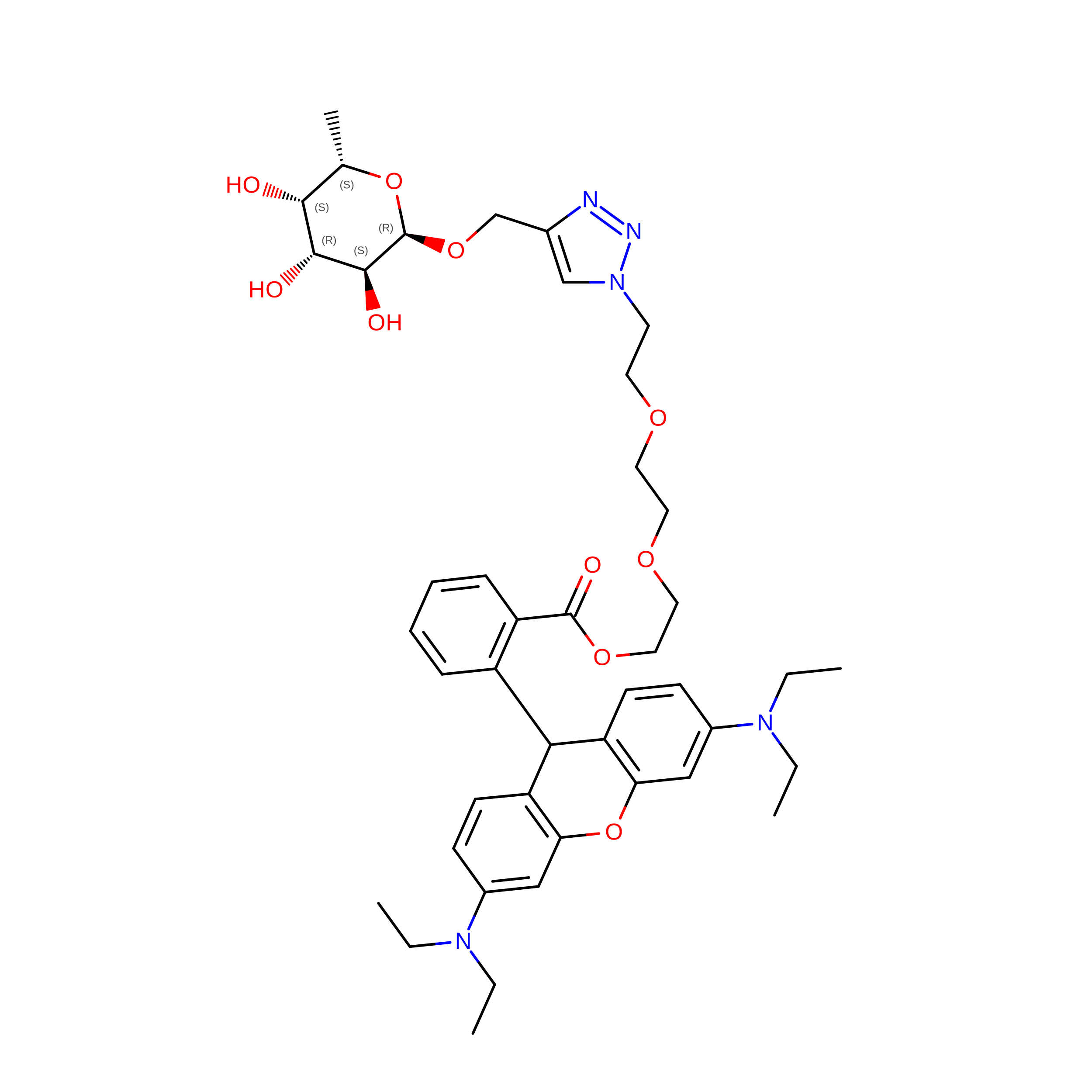
Precise protein assemblies not only constitute a series of living machineries but also provide an advanced class of biomaterials. Previously, we developed the inducing ligand strategy to generate various fixed protein assemblies, without the formation of noncovalent interactions between proteins. Here, we demonstrated that controlling the symmetry and number of supramolecular interactions introduced on protein surfaces could direct the formation of unspecific interactions between proteins and induce various nanoscale assemblies, including coiling nanowires, nanotubes, and nanosheets, without manipulation of the protein's native surfaces. More importantly, these nanoscale assemblies could spontaneously evolve into more ordered architectures, crystals. We further showed that the transformation from the introduced supramolecular interactions to the interactions formed between proteins was crucial for pathway selection and outcomes of evolution. These findings reveal a transformation mechanism of protein self-assembly that has not been exploited before and may provide an approach to generate complex and transformable biomacromolecular self-assemblies.
- The State Key Laboratory of Molecular Engineering of Polymers and Department of Macromolecular Science, Fudan University, Shanghai 200433, China.
Organizational Affiliation: