7E7R | pdb_00007e7r

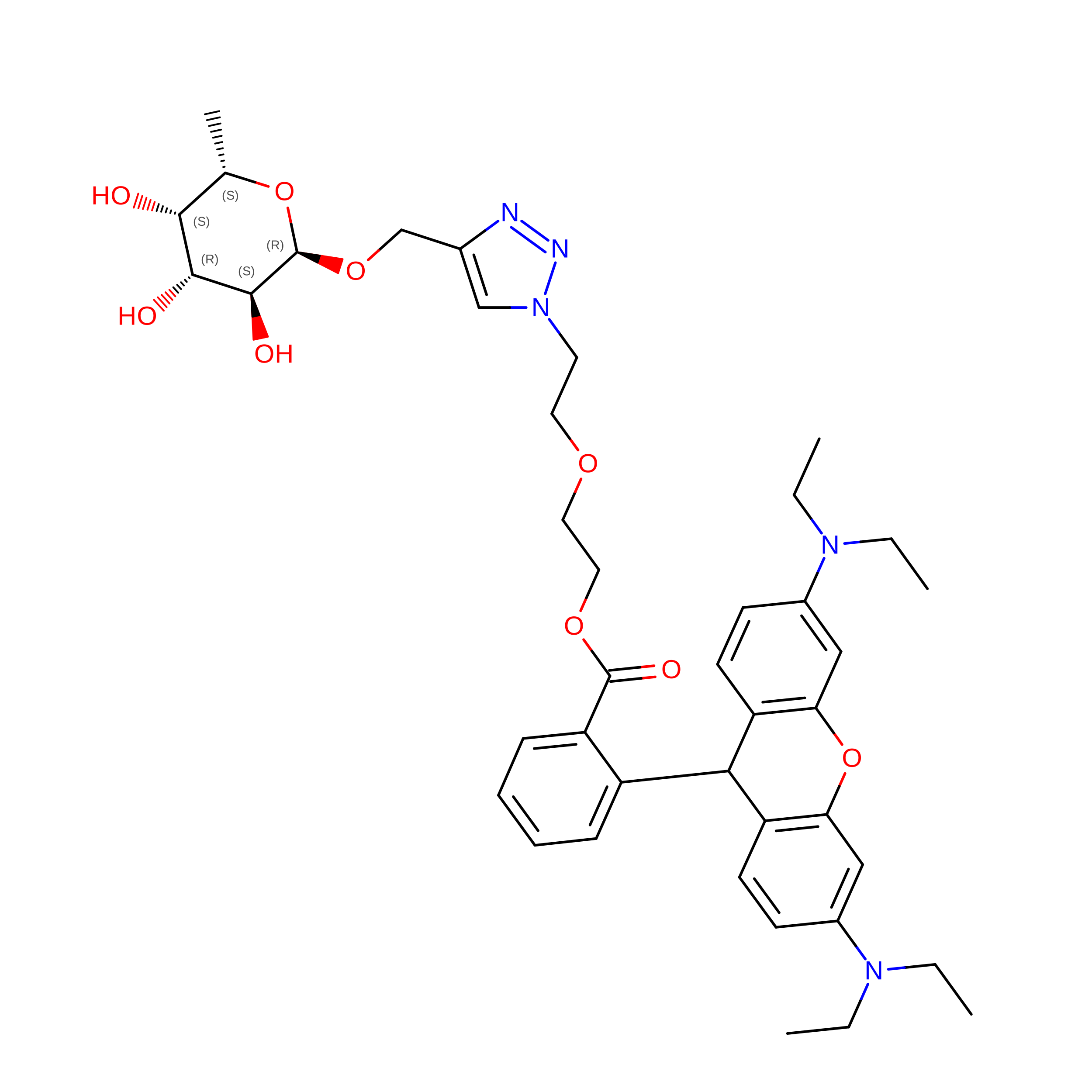
Crystal structure of RSL mutant in complex with Ligand


Experimental Data Snapshot

  • Method: X-RAY DIFFRACTION
  • Resolution: 1.82 Å
  • R-Value Free: 
    0.285 (Depositor), 0.286 (DCC) 
  • R-Value Work: 
    0.250 (Depositor), 0.250 (DCC) 
  • R-Value Observed: 
    0.252 (Depositor) 

Starting Model: experimental
View more details

wwPDB Validation 3D Report Full Report

Validation slider image for 7E7R

Ligand Structure Quality Assessment 


This is version 1.2 of the entry. See complete history

Literature

Spatiotemporal Landscape for the Sophisticated Transformation of Protein Assemblies Defined by Multiple Supramolecular Interactions.

Li, L.Li, Z.Wang, Z.Chen, S.Liu, R.Xu, X.Zhang, Z.Ye, L.Ding, Y.Luo, Q.Cao, S.Zhang, L.Imberty, A.Chen, G.

(2023) ACS Nano 17: 15001-15011

  • DOI: https://doi.org/10.1021/acsnano.3c04029
  • Primary Citation Related Structures: 
    7E7N, 7E7R, 7E7T, 7E7U, 7E7V, 7E7W

  • PubMed Abstract: 

    Precise protein assemblies not only constitute a series of living machineries but also provide an advanced class of biomaterials. Previously, we developed the inducing ligand strategy to generate various fixed protein assemblies, without the formation of noncovalent interactions between proteins. Here, we demonstrated that controlling the symmetry and number of supramolecular interactions introduced on protein surfaces could direct the formation of unspecific interactions between proteins and induce various nanoscale assemblies, including coiling nanowires, nanotubes, and nanosheets, without manipulation of the protein's native surfaces. More importantly, these nanoscale assemblies could spontaneously evolve into more ordered architectures, crystals. We further showed that the transformation from the introduced supramolecular interactions to the interactions formed between proteins was crucial for pathway selection and outcomes of evolution. These findings reveal a transformation mechanism of protein self-assembly that has not been exploited before and may provide an approach to generate complex and transformable biomacromolecular self-assemblies.


  • Organizational Affiliation
    • The State Key Laboratory of Molecular Engineering of Polymers and Department of Macromolecular Science, Fudan University, Shanghai 200433, China.

Macromolecule Content 

  • Total Structure Weight: 62.74 kDa 
  • Atom Count: 4,641 
  • Modeled Residue Count: 514 
  • Deposited Residue Count: 544 
  • Unique protein chains: 1

Macromolecules

Find similar proteins by:|  3D Structure
Entity ID: 1
MoleculeChains  Sequence LengthOrganismDetailsImage
Fucose-binding lectin protein,Fucose-binding lectin protein,Fucose-binding lectin protein
A, B
272Ralstonia solanacearumMutation(s): 3 
Gene Names: E7Z57_08365RSP795_21825RSP822_19650RUN39_v1_50103
UniProt
Find proteins for A0A0S4WQH1 (Ralstonia solanacearum)
Explore A0A0S4WQH1 
Go to UniProtKB:  A0A0S4WQH1
Entity Groups
Sequence Clusters30% Identity50% Identity70% Identity90% Identity95% Identity100% Identity
UniProt GroupA0A0S4WQH1
Sequence Annotations
Expand
Reference Sequence

Experimental Data & Validation

Experimental Data

  • Method: X-RAY DIFFRACTION
  • Resolution: 1.82 Å
  • R-Value Free:  0.285 (Depositor), 0.286 (DCC) 
  • R-Value Work:  0.250 (Depositor), 0.250 (DCC) 
  • R-Value Observed: 0.252 (Depositor) 
Space Group: P 21 21 21
Unit Cell:
Length ( Å )Angle ( ˚ )
a = 67.427α = 90
b = 81.959β = 90
c = 97.116γ = 90
Software Package:
Software NamePurpose
PHENIXrefinement
Aimlessdata scaling
PDB_EXTRACTdata extraction
autoPROCdata reduction
PHASERphasing

Structure Validation

View Full Validation Report


Ligand Structure Quality Assessment 


Entry History 

Deposition Data

Revision History  (Full details and data files)

  • Version 1.0: 2021-04-14
    Type: Initial release
  • Version 1.1: 2023-11-29
    Changes: Data collection, Database references, Refinement description
  • Version 1.2: 2026-07-29
    Changes: Database references, Structure summary