7AWF | pdb_00007awf

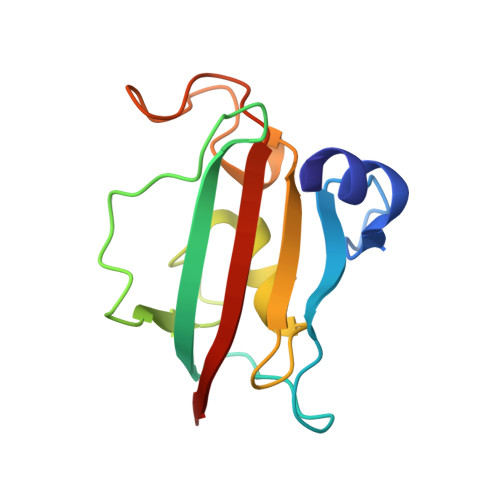
The Fk1 domain of FKBP51 in complex with (2R,5S,12R)-12-cyclohexyl-2-[2-(3,4-dimethoxyphenyl)ethyl]-15,15,16-trimethyl-3,19-dioxa-10,13,16-triazatricyclo[18.3.1.0^5,^10]tetracosa-1(24),20,22-triene-4,11,14,17-tetrone


Experimental Data Snapshot

  • Method: X-RAY DIFFRACTION
  • Resolution: 1.40 Å
  • R-Value Free: 
    0.243 (Depositor), 0.248 (DCC) 
  • R-Value Work: 
    0.194 (Depositor), 0.195 (DCC) 

Starting Model: experimental
View more details

wwPDB Validation 3D Report Full Report

Validation slider image for 7AWF

Ligand Structure Quality Assessment 


This is version 1.2 of the entry. See complete history

Literature

Macrocyclic FKBP51 Ligands Define a Transient Binding Mode with Enhanced Selectivity.

Voll, A.M.Meyners, C.Taubert, M.C.Bajaj, T.Heymann, T.Merz, S.Charalampidou, A.Kolos, J.Purder, P.L.Geiger, T.M.Wessig, P.Gassen, N.C.Bracher, A.Hausch, F.

(2021) Angew Chem Int Ed Engl 60: 13257-13263

  • DOI: https://doi.org/10.1002/anie.202017352
  • Primary Citation Related Structures: 
    7AOT, 7AOU, 7AWF

  • PubMed Abstract: 

    Subtype selectivity represents a challenge in many drug discovery campaigns. A typical example is the FK506 binding protein 51 (FKBP51), which has emerged as an attractive drug target. The most advanced FKBP51 ligands of the SAFit class are highly selective vs. FKBP52 but poorly discriminate against the homologs and off-targets FKBP12 and FKBP12.6. During a macrocyclization pilot study, we observed that many of these macrocyclic analogs have unanticipated and unprecedented preference for FKBP51 over FKBP12 and FKBP12.6. Structural studies revealed that these macrocycles bind with a new binding mode featuring a transient conformation, which is disfavored for the small FKBPs. Using a conformation-sensitive assay we show that this binding mode occurs in solution and is characteristic for this new class of compounds. The discovered macrocycles are non-immunosuppressive, engage FKBP51 in cells, and block the cellular effect of FKBP51 on IKKα. Our findings provide a new chemical scaffold for improved FKBP51 ligands and the structural basis for enhanced selectivity.


  • Organizational Affiliation
    • Department Chemistry and Biochemistry, Clemens-Schöpf-Institute, Technical University Darmstadt, Alarich-Weiss Strasse 4, 64287, Darmstadt, Germany.

Macromolecule Content 

  • Total Structure Weight: 14.68 kDa 
  • Atom Count: 1,133 
  • Modeled Residue Count: 127 
  • Deposited Residue Count: 128 
  • Unique protein chains: 1

Macromolecules

Find similar proteins by:|  3D Structure
Entity ID: 1
MoleculeChains  Sequence LengthOrganismDetailsImage
Peptidyl-prolyl cis-trans isomerase FKBP5128Homo sapiensMutation(s): 3 
Gene Names: FKBP5AIG6FKBP51
EC: 5.2.1.8
UniProt & NIH Common Fund Data Resources
Find proteins for Q13451 (Homo sapiens)
Explore Q13451 
Go to UniProtKB:  Q13451
PHAROS:  Q13451
GTEx:  ENSG00000096060 
Entity Groups
Sequence Clusters30% Identity50% Identity70% Identity90% Identity95% Identity100% Identity
UniProt GroupQ13451
Sequence Annotations
Expand
Reference Sequence

Small Molecules

Ligands 1 Unique
IDChains Name / Formula / InChI Key2D Diagram3D Interactions
S8N
(Subject of Investigation/LOI)

Query on S8N


Download:Ideal Coordinates CCD File
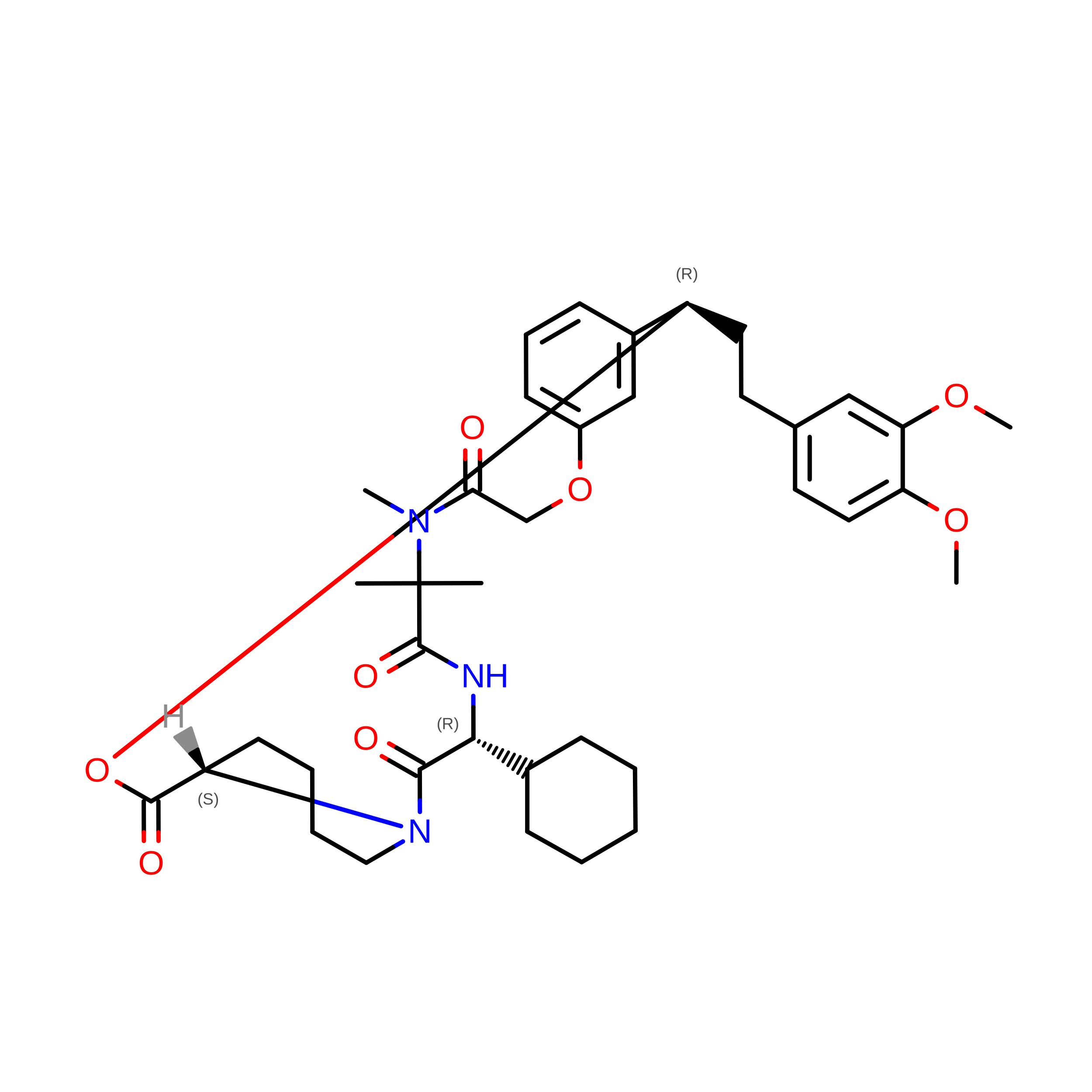
B [auth A](2~{R},5~{S},12~{R})-12-cyclohexyl-2-[2-(3,4-dimethoxyphenyl)ethyl]-15,15,16-trimethyl-3,19-dioxa-10,13,16-triazatricyclo[18.3.1.0^{5,10}]tetracosa-1(24),20,22-triene-4,11,14,17-tetrone
C38 H51 N3 O8
NZPKRKKGZFFBRG-YIQDYSAESA-N

Experimental Data & Validation

Experimental Data

  • Method: X-RAY DIFFRACTION
  • Resolution: 1.40 Å
  • R-Value Free:  0.243 (Depositor), 0.248 (DCC) 
  • R-Value Work:  0.194 (Depositor), 0.195 (DCC) 
Space Group: P 21 21 21
Unit Cell:
Length ( Å )Angle ( ˚ )
a = 42.46α = 90
b = 50.066β = 90
c = 58.781γ = 90
Software Package:
Software NamePurpose
REFMACrefinement
REFMACrefinement
XDSdata reduction
Aimlessdata scaling
PHASERphasing

Structure Validation

View Full Validation Report


Ligand Structure Quality Assessment 


Entry History 

Deposition Data

Revision History  (Full details and data files)

  • Version 1.0: 2021-04-21
    Type: Initial release
  • Version 1.1: 2021-06-09
    Changes: Database references
  • Version 1.2: 2024-01-31
    Changes: Data collection, Database references, Refinement description