7A9H | pdb_00007a9h

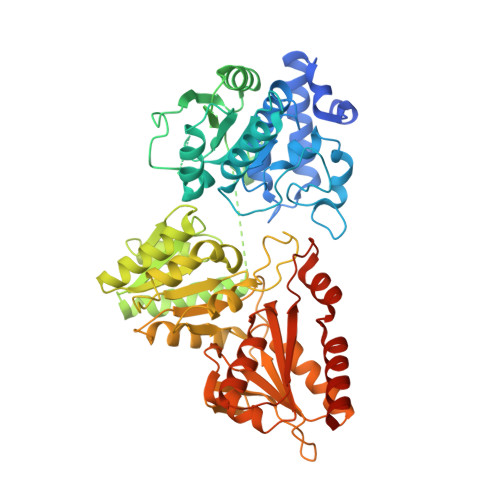
Truncated 1-deoxy-D-xylulose 5-phosphate synthase (DXS) from Mycobacterium tuberculosis


Experimental Data Snapshot

  • Method: X-RAY DIFFRACTION
  • Resolution: 1.85 Å
  • R-Value Free: 
    0.174 (Depositor), 0.173 (DCC) 
  • R-Value Work: 
    0.151 (Depositor), 0.151 (DCC) 

Starting Model: experimental
View more details

wwPDB Validation 3D Report Full Report

Validation slider image for 7A9H

Ligand Structure Quality Assessment 


This is version 1.2 of the entry. See complete history

Literature

First crystal structures of 1-deoxy-D-xylulose 5-phosphate synthase (DXPS) from Mycobacterium tuberculosis indicate a distinct mechanism of intermediate stabilization.

Gierse, R.M.Oerlemans, R.Reddem, E.R.Gawriljuk, V.O.Alhayek, A.Baitinger, D.Jakobi, H.Laber, B.Lange, G.Hirsch, A.K.H.Groves, M.R.

(2022) Sci Rep 12: 7221-7221

  • DOI: https://doi.org/10.1038/s41598-022-11205-9
  • Primary Citation Related Structures: 
    7A9G, 7A9H

  • PubMed Abstract: 

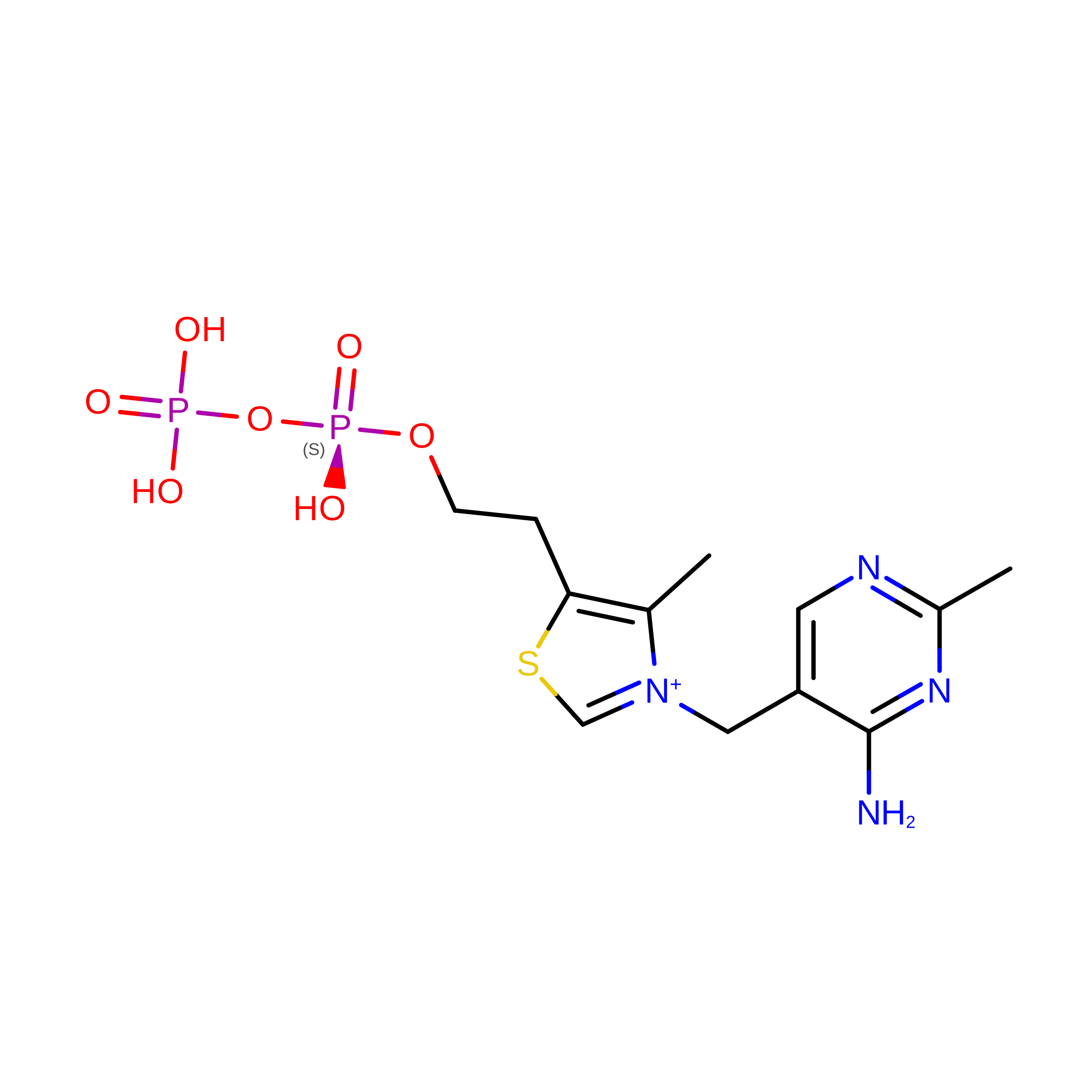
    The development of drug resistance by Mycobacterium tuberculosis and other pathogenic bacteria emphasizes the need for new antibiotics. Unlike animals, most bacteria synthesize isoprenoid precursors through the MEP pathway. 1-Deoxy-D-xylulose 5-phosphate synthase (DXPS) catalyzes the first reaction of the MEP pathway and is an attractive target for the development of new antibiotics. We report here the successful use of a loop truncation to crystallize and solve the first DXPS structures of a pathogen, namely M. tuberculosis (MtDXPS). The main difference found to other DXPS structures is in the active site where a highly coordinated water was found, showing a new mechanism for the enamine-intermediate stabilization. Unlike other DXPS structures, a "fork-like" motif could be identified in the enamine structure, using a different residue for the interaction with the cofactor, potentially leading to a decrease in the stability of the intermediate. In addition, electron density suggesting a phosphate group could be found close to the active site, provides new evidence for the D-GAP binding site. These results provide the opportunity to improve or develop new inhibitors specific for MtDXPS through structure-based drug design.


  • Organizational Affiliation
    • Helmholtz Institute for Pharmaceutical Research Saarland (HIPS)-Helmholtz Centre for Infection Research (HZI), Campus Building E 8.1, 66123, Saarbrücken, Germany.

Macromolecule Content 

  • Total Structure Weight: 134.28 kDa 
  • Atom Count: 9,028 
  • Modeled Residue Count: 1,091 
  • Deposited Residue Count: 1,256 
  • Unique protein chains: 1

Macromolecules

Find similar proteins by:|  3D Structure
Entity ID: 1
MoleculeChains  Sequence LengthOrganismDetailsImage
1-deoxy-D-xylulose-5-phosphate synthase,1-deoxy-D-xylulose-5-phosphate synthaseA [auth AAA],
B [auth BBB]
628Mycobacterium tuberculosis H37RvMutation(s): 0 
Gene Names: dxsRv2682cMTCY05A6.03c
EC: 2.2.1.7
UniProt
Find proteins for P9WNS3 (Mycobacterium tuberculosis (strain ATCC 25618 / H37Rv))
Explore P9WNS3 
Go to UniProtKB:  P9WNS3
Entity Groups
Sequence Clusters30% Identity50% Identity70% Identity90% Identity95% Identity100% Identity
UniProt GroupP9WNS3
Sequence Annotations
Expand
Reference Sequence

Experimental Data & Validation

Experimental Data

  • Method: X-RAY DIFFRACTION
  • Resolution: 1.85 Å
  • R-Value Free:  0.174 (Depositor), 0.173 (DCC) 
  • R-Value Work:  0.151 (Depositor), 0.151 (DCC) 
Space Group: P 1
Unit Cell:
Length ( Å )Angle ( ˚ )
a = 62.987α = 108.956
b = 76.1β = 106.53
c = 79.148γ = 107.594
Software Package:
Software NamePurpose
REFMACrefinement
XDSdata reduction
XDSdata scaling
MOLREPphasing
Cootmodel building

Structure Validation

View Full Validation Report


Ligand Structure Quality Assessment 


Entry History 

& Funding Information

Deposition Data


Funding OrganizationLocationGrant Number
Netherlands Organisation for Scientific Research (NWO)Netherlands731.015.414

Revision History  (Full details and data files)

  • Version 1.0: 2022-03-23
    Type: Initial release
  • Version 1.1: 2022-10-05
    Changes: Database references, Derived calculations
  • Version 1.2: 2024-01-31
    Changes: Data collection, Refinement description