6Q1L | pdb_00006q1l

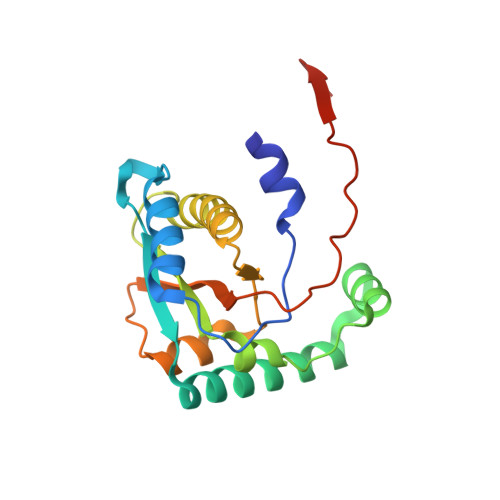
Crystal structure of oxidized iodotyrosine deiodinase (IYD) bound to FMN and 3-iodo-L-tyrosine


Experimental Data Snapshot

  • Method: X-RAY DIFFRACTION
  • Resolution: 1.60 Å
  • R-Value Free: 
    0.203 (Depositor), 0.203 (DCC) 
  • R-Value Work: 
    0.171 (Depositor), 0.171 (DCC) 
  • R-Value Observed: 
    0.172 (Depositor) 

wwPDB Validation 3D Report Full Report

Validation slider image for 6Q1L

Ligand Structure Quality Assessment 


This is version 2.2 of the entry. See complete history

Literature

The minimal structure for iodotyrosine deiodinase function is defined by an outlier protein from the thermophilic bacterium Thermotoga neapolitana.

Sun, Z.Xu, B.Spisak, S.Kavran, J.M.Rokita, S.E.

(2021) J Biological Chem 297: 101385-101385

  • DOI: https://doi.org/10.1016/j.jbc.2021.101385
  • Primary Citation Related Structures: 
    6PZ0, 6Q1L

  • PubMed Abstract: 

    The nitroreductase superfamily of enzymes encompasses many flavin mononucleotide (FMN)-dependent catalysts promoting a wide range of reactions. All share a common core consisting of an FMN-binding domain, and individual subgroups additionally contain one to three sequence extensions radiating from defined positions within this core to support their unique catalytic properties. To identify the minimum structure required for activity in the iodotyrosine deiodinase subgroup of this superfamily, attention was directed to a representative from the thermophilic organism Thermotoga neapolitana (TnIYD). This representative was selected based on its status as an outlier of the subgroup arising from its deficiency in certain standard motifs evident in all homologues from mesophiles. We found that TnIYD lacked a typical N-terminal sequence and one of its two characteristic sequence extensions, neither of which was found to be necessary for activity. We also show that TnIYD efficiently promotes dehalogenation of iodo-, bromo-, and chlorotyrosine, analogous to related deiodinases (IYDs) from humans and other mesophiles. In addition, 2-iodophenol is a weak substrate for TnIYD as it was for all other IYDs characterized to date. Consistent with enzymes from thermophilic organisms, we observed that TnIYD adopts a compact fold and low surface area compared with IYDs from mesophilic organisms. The insights gained from our investigations on TnIYD demonstrate the advantages of focusing on sequences that diverge from conventional standards to uncover the minimum essentials for activity. We conclude that TnIYD now represents a superior starting structure for future efforts to engineer a stable dehalogenase targeting halophenols of environmental concern.


  • Organizational Affiliation
    • Department of Chemistry, Johns Hopkins University, Baltimore, Maryland, USA.

Macromolecule Content 

  • Total Structure Weight: 47.52 kDa 
  • Atom Count: 3,517 
  • Modeled Residue Count: 368 
  • Deposited Residue Count: 384 
  • Unique protein chains: 1

Macromolecules

Find similar proteins by:|  3D Structure
Entity ID: 1
MoleculeChains  Sequence LengthOrganismDetailsImage
iodotyrosine deiodinase
A, B
192Thermotoga neapolitana DSM 4359Mutation(s): 0 
Gene Names: CTN_0569
EC: 1.21.1.1
UniProt
Find proteins for B9K712 (Thermotoga neapolitana (strain ATCC 49049 / DSM 4359 / NBRC 107923 / NS-E))
Explore B9K712 
Go to UniProtKB:  B9K712
Entity Groups
Sequence Clusters30% Identity50% Identity70% Identity90% Identity95% Identity100% Identity
UniProt GroupB9K712
Sequence Annotations
Expand
Reference Sequence

Small Molecules

Ligands 3 Unique
IDChains Name / Formula / InChI Key2D Diagram3D Interactions
FMN
(Subject of Investigation/LOI)

Query on FMN


Download:Ideal Coordinates CCD File
C [auth A],
I [auth B]
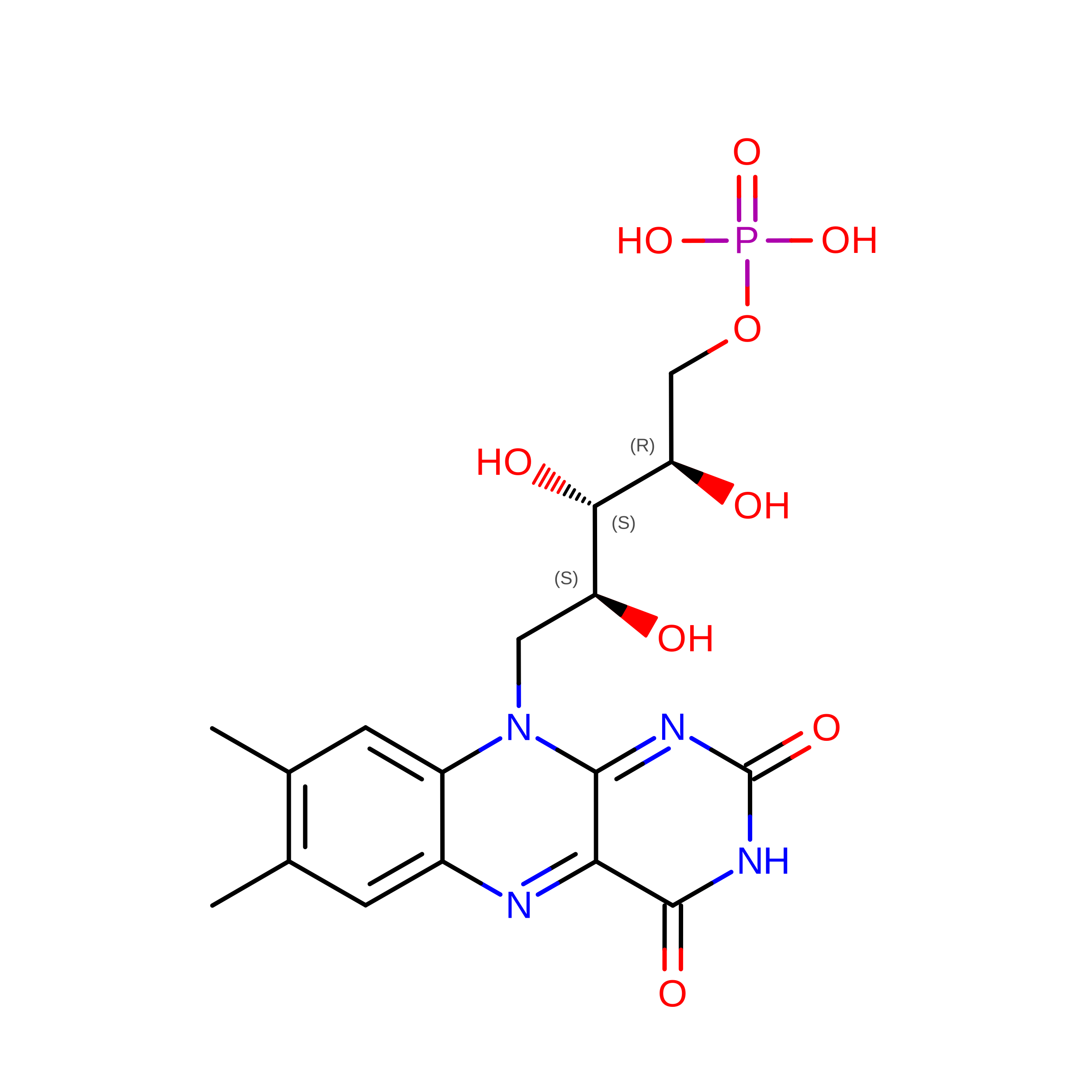
FLAVIN MONONUCLEOTIDE
C17 H21 N4 O9 P
FVTCRASFADXXNN-SCRDCRAPSA-N
IYR
(Subject of Investigation/LOI)

Query on IYR


Download:Ideal Coordinates CCD File
D [auth A],
J [auth B]
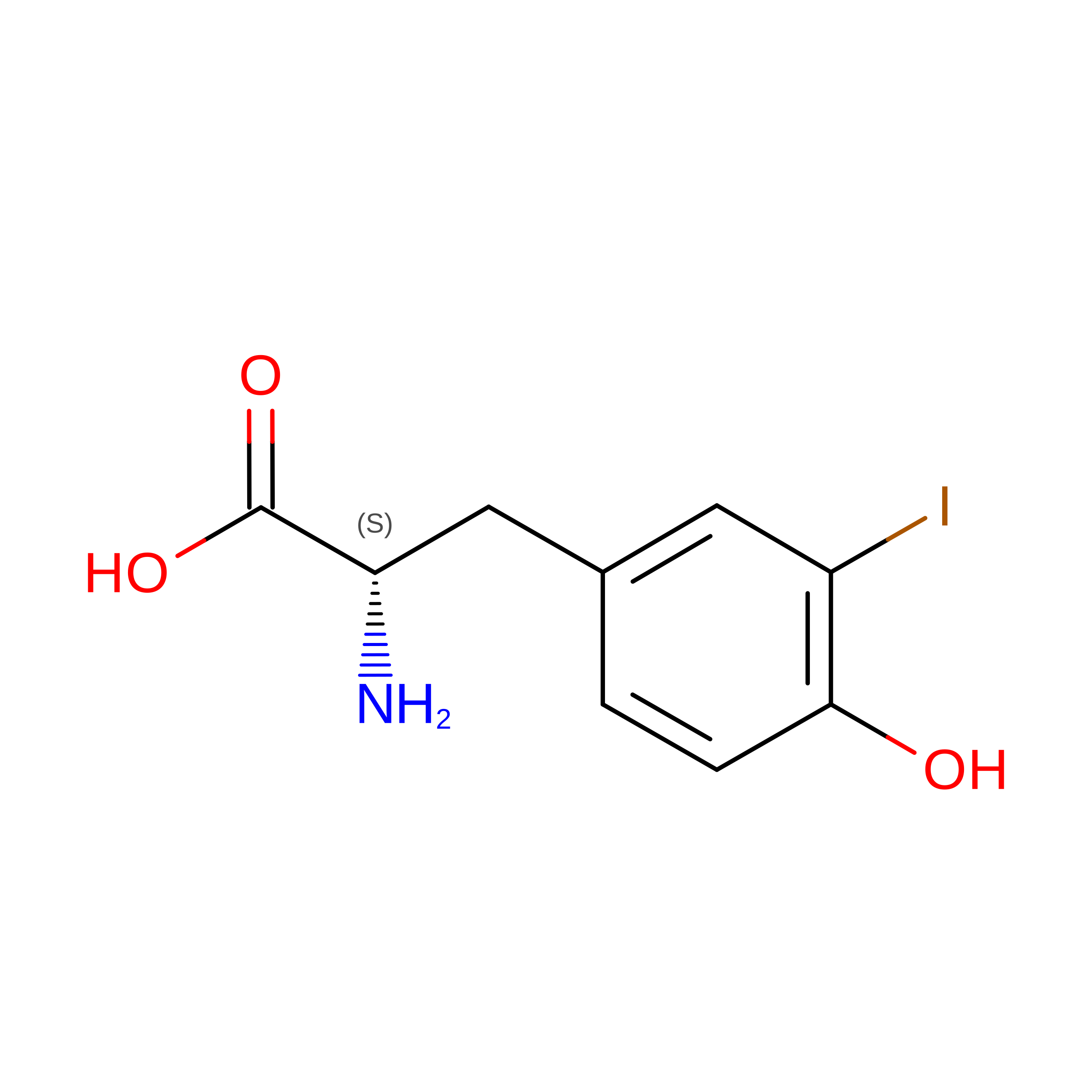
3-IODO-TYROSINE
C9 H10 I N O3
UQTZMGFTRHFAAM-ZETCQYMHSA-N
CL

Query on CL


Download:Ideal Coordinates CCD File
E [auth A]
F [auth A]
G [auth A]
H [auth A]
K [auth B]
E [auth A],
F [auth A],
G [auth A],
H [auth A],
K [auth B],
L [auth B]
CHLORIDE ION
Cl
VEXZGXHMUGYJMC-UHFFFAOYSA-M

Experimental Data & Validation

Experimental Data

  • Method: X-RAY DIFFRACTION
  • Resolution: 1.60 Å
  • R-Value Free:  0.203 (Depositor), 0.203 (DCC) 
  • R-Value Work:  0.171 (Depositor), 0.171 (DCC) 
  • R-Value Observed: 0.172 (Depositor) 
Space Group: P 21 21 21
Unit Cell:
Length ( Å )Angle ( ˚ )
a = 42.861α = 90
b = 81.232β = 90
c = 103.9γ = 90
Software Package:
Software NamePurpose
PHENIXrefinement
PHENIXrefinement
Aimlessdata scaling
PDB_EXTRACTdata extraction
XDSdata reduction
PHENIXphasing

Structure Validation

View Full Validation Report


Ligand Structure Quality Assessment 


Entry History 

& Funding Information

Deposition Data


Funding OrganizationLocationGrant Number
National Science Foundation (NSF, United States)United States--

Revision History  (Full details and data files)

  • Version 1.0: 2021-04-07
    Type: Initial release
  • Version 2.0: 2021-10-20
    Type: Coordinate replacement
    Reason: Model completeness
    Changes: Advisory, Atomic model, Author supporting evidence, Data collection, Database references, Derived calculations, Other, Refinement description, Structure summary
  • Version 2.1: 2022-04-20
    Changes: Database references
  • Version 2.2: 2024-05-22
    Changes: Data collection