6O6J | pdb_00006o6j

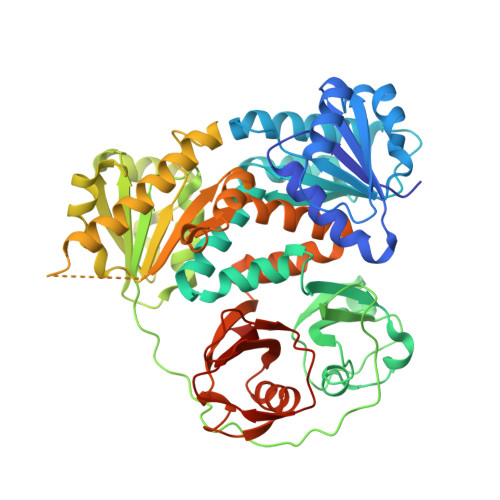
Crystal structure of the LjCASTOR gating ring in the Ca2+ and Na+ condition

  • Classification: TRANSPORT PROTEIN
  • Organism(s): Lotus japonicus
  • Expression System: Escherichia coli
  • Mutation(s): No 

  • Deposited: 2019-03-06 Released: 2019-09-11 
  • Deposition Author(s): Jiang, Y., Kim, S.
  • Funding Organization(s): Howard Hughes Medical Institute (HHMI), National Institutes of Health/National Institute of General Medical Sciences (NIH/NIGMS), Welch Foundation

Experimental Data Snapshot

  • Method: X-RAY DIFFRACTION
  • Resolution: 1.60 Å
  • R-Value Free: 
    0.188 (Depositor), 0.187 (DCC) 
  • R-Value Work: 
    0.166 (Depositor), 0.166 (DCC) 
  • R-Value Observed: 
    0.167 (Depositor) 

wwPDB Validation 3D Report Full Report

Validation slider image for 6O6J

This is version 1.2 of the entry. See complete history

Literature

Ca2+-regulated Ca2+channels with an RCK gating ring control plant symbiotic associations.

Kim, S.Zeng, W.Bernard, S.Liao, J.Venkateshwaran, M.Ane, J.M.Jiang, Y.

(2019) Nat Commun 10: 3703-3703

  • DOI: https://doi.org/10.1038/s41467-019-11698-5
  • Primary Citation Related Structures: 
    6O6J, 6O7A, 6O7C

  • PubMed Abstract: 

    A family of plant nuclear ion channels, including DMI1 (Does not Make Infections 1) and its homologs CASTOR and POLLUX, are required for the establishment of legume-microbe symbioses by generating nuclear and perinuclear Ca 2+ spiking. Here we show that CASTOR from Lotus japonicus is a highly selective Ca 2+ channel whose activation requires cytosolic/nucleosolic Ca 2+ , contrary to the previous suggestion of it being a K + channel. Structurally, the cytosolic/nucleosolic ligand-binding soluble region of CASTOR contains two tandem RCK (Regulator of Conductance for K + ) domains, and four subunits assemble into the gating ring architecture, similar to that of large conductance, Ca 2+ -gated K + (BK) channels despite the lack of sequence similarity. Multiple ion binding sites are clustered at two locations within each subunit, and three of them are identified to be Ca 2+ sites. Our in vitro and in vivo assays also demonstrate the importance of these gating-ring Ca 2+ binding sites to the physiological function of CASTOR as well as DMI1.


  • Organizational Affiliation
    • Howard Hughes Medical Institute and Department of Physiology, University of Texas Southwestern Medical Center, Dallas, TX, USA.

Macromolecule Content 

  • Total Structure Weight: 62.15 kDa 
  • Atom Count: 4,524 
  • Modeled Residue Count: 505 
  • Deposited Residue Count: 554 
  • Unique protein chains: 1

Macromolecules

Find similar proteins by:|  3D Structure
Entity ID: 1
MoleculeChains  Sequence LengthOrganismDetailsImage
Ion channel CASTOR554Lotus japonicusMutation(s): 0 
Gene Names: CASTOR
UniProt
Find proteins for Q5H8A6 (Lotus japonicus)
Explore Q5H8A6 
Go to UniProtKB:  Q5H8A6
Entity Groups
Sequence Clusters30% Identity50% Identity70% Identity90% Identity95% Identity100% Identity
UniProt GroupQ5H8A6
Sequence Annotations
Expand
Reference Sequence

Small Molecules

Experimental Data & Validation

Experimental Data

  • Method: X-RAY DIFFRACTION
  • Resolution: 1.60 Å
  • R-Value Free:  0.188 (Depositor), 0.187 (DCC) 
  • R-Value Work:  0.166 (Depositor), 0.166 (DCC) 
  • R-Value Observed: 0.167 (Depositor) 
Space Group: I 4
Unit Cell:
Length ( Å )Angle ( ˚ )
a = 125.234α = 90
b = 125.234β = 90
c = 81.512γ = 90
Software Package:
Software NamePurpose
PHENIXrefinement
HKL-2000data collection
HKL-2000data reduction
HKL-2000data scaling
PHASERphasing

Structure Validation

View Full Validation Report


Entry History 

& Funding Information

Deposition Data


Funding OrganizationLocationGrant Number
Howard Hughes Medical Institute (HHMI)United StatesY.J.
National Institutes of Health/National Institute of General Medical Sciences (NIH/NIGMS)United StatesGM079179
Welch FoundationUnited StatesI-1578

Revision History  (Full details and data files)

  • Version 1.0: 2019-09-11
    Type: Initial release
  • Version 1.1: 2019-11-20
    Changes: Author supporting evidence
  • Version 1.2: 2024-03-13
    Changes: Data collection, Database references, Derived calculations