6DTQ | pdb_00006dtq

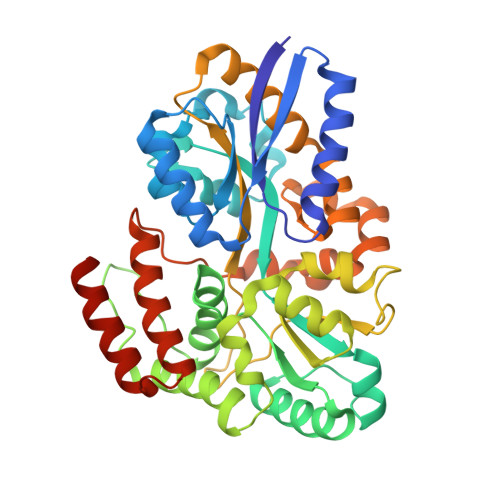
Maltose bound T. maritima MalE3


Experimental Data Snapshot

  • Method: X-RAY DIFFRACTION
  • Resolution: 2.15 Å
  • R-Value Free: 
    0.205 (Depositor), 0.204 (DCC) 
  • R-Value Work: 
    0.174 (Depositor), 0.174 (DCC) 
  • R-Value Observed: 
    0.175 (Depositor) 

Starting Model: experimental
View more details

wwPDB Validation 3D Report Full Report

Validation slider image for 6DTQ

This is version 2.1 of the entry. See complete history

Literature

Differential Substrate Recognition by Maltose Binding Proteins Influenced by Structure and Dynamics.

Shukla, S.Bafna, K.Gullett, C.Myles, D.A.A.Agarwal, P.K.Cuneo, M.J.

(2018) Biochemistry 57: 5864-5876

  • DOI: https://doi.org/10.1021/acs.biochem.8b00783
  • Primary Citation Related Structures: 
    6DTQ, 6DTR, 6DTS, 6DTT, 6DTU

  • PubMed Abstract: 

    The genome of the hyperthermophile Thermotoga maritima contains three isoforms of maltose binding protein (MBP) that are high-affinity receptors for di-, tri-, and tetrasaccharides. Two of these proteins (tmMBP1 and tmMBP2) share significant sequence identity, approximately 90%, while the third (tmMBP3) shares less than 40% identity. MBP from Escherichia coli (ecMBP) shares 35% sequence identity with the tmMBPs. This subset of MBP isoforms offers an interesting opportunity to investigate the mechanisms underlying the evolution of substrate specificity and affinity profiles in a genome where redundant MBP genes are present. In this study, the X-ray crystal structures of tmMBP1, tmMBP2, and tmMBP3 are reported in the absence and presence of oligosaccharides. tmMBP1 and tmMBP2 have binding pockets that are larger than that of tmMBP3, enabling them to bind to larger substrates, while tmMBP1 and tmMBP2 also undergo substrate-induced hinge bending motions (∼52°) that are larger than that of tmMBP3 (∼35°). Small-angle X-ray scattering was used to compare protein behavior in solution, and computer simulations provided insights into dynamics of these proteins. Comparing quantitative protein-substrate interactions and dynamical properties of tmMBPs with those of the promiscuous ecMBP and disaccharide selective Thermococcus litoralis MBP provides insights into the features that enable selective binding. Collectively, the results provide insights into how the structure and dynamics of tmMBP homologues enable them to differentiate between a myriad of chemical entities while maintaining their common fold.


  • Organizational Affiliation
    • Graduate School of Genome Science & Technology , The University of Tennessee , Knoxville , Tennessee 37996-0840 , United States.

Macromolecule Content 

  • Total Structure Weight: 182.24 kDa 
  • Atom Count: 13,136 
  • Modeled Residue Count: 1,564 
  • Deposited Residue Count: 1,600 
  • Unique protein chains: 1

Macromolecules

Find similar proteins by:|  3D Structure
Entity ID: 1
MoleculeChains  Sequence LengthOrganismDetailsImage
maltose-binding protein MalE3
A, B, C, D
400Thermotoga maritima MSB8Mutation(s): 0 
UniProt
Find proteins for G4FGN8 (Thermotoga maritima (strain ATCC 43589 / DSM 3109 / JCM 10099 / NBRC 100826 / MSB8))
Explore G4FGN8 
Go to UniProtKB:  G4FGN8
Entity Groups
Sequence Clusters30% Identity50% Identity70% Identity90% Identity95% Identity100% Identity
UniProt GroupG4FGN8
Sequence Annotations
Expand
Reference Sequence

Oligosaccharides

Help  
Entity ID: 2
MoleculeChains Length2D Diagram GlycosylationD Interactions
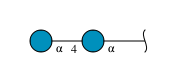
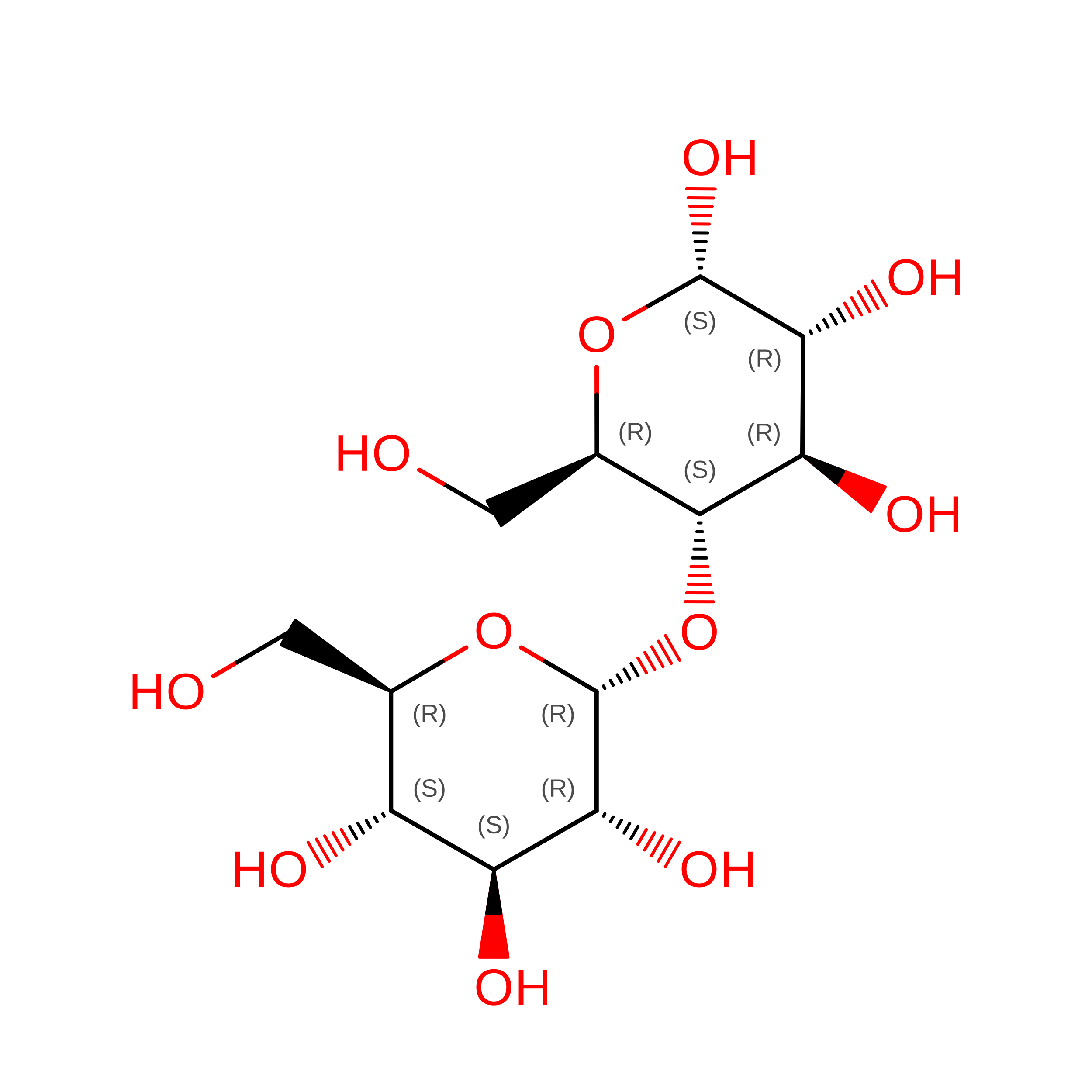
alpha-D-glucopyranose-(1-4)-alpha-D-glucopyranose
E, F, G, H
2N/A
Glycosylation Resources
GlyTouCan: G07411ON
GlyCosmos: G07411ON

Experimental Data & Validation

Experimental Data

  • Method: X-RAY DIFFRACTION
  • Resolution: 2.15 Å
  • R-Value Free:  0.205 (Depositor), 0.204 (DCC) 
  • R-Value Work:  0.174 (Depositor), 0.174 (DCC) 
  • R-Value Observed: 0.175 (Depositor) 
Space Group: P 21 21 21
Unit Cell:
Length ( Å )Angle ( ˚ )
a = 82.37α = 90
b = 124.034β = 90
c = 174.847γ = 90
Software Package:
Software NamePurpose
HKL-2000data scaling
PHENIXrefinement
PDB_EXTRACTdata extraction
HKL-3000data reduction
PHASERphasing

Structure Validation

View Full Validation Report


Entry History 

Deposition Data

Revision History  (Full details and data files)

  • Version 1.0: 2018-09-19
    Type: Initial release
  • Version 1.1: 2019-04-03
    Changes: Data collection, Database references
  • Version 2.0: 2020-07-29
    Type: Remediation
    Reason: Carbohydrate remediation
    Changes: Atomic model, Data collection, Derived calculations, Non-polymer description, Structure summary
  • Version 2.1: 2023-10-11
    Changes: Data collection, Database references, Refinement description, Structure summary