6CD3 | pdb_00006cd3

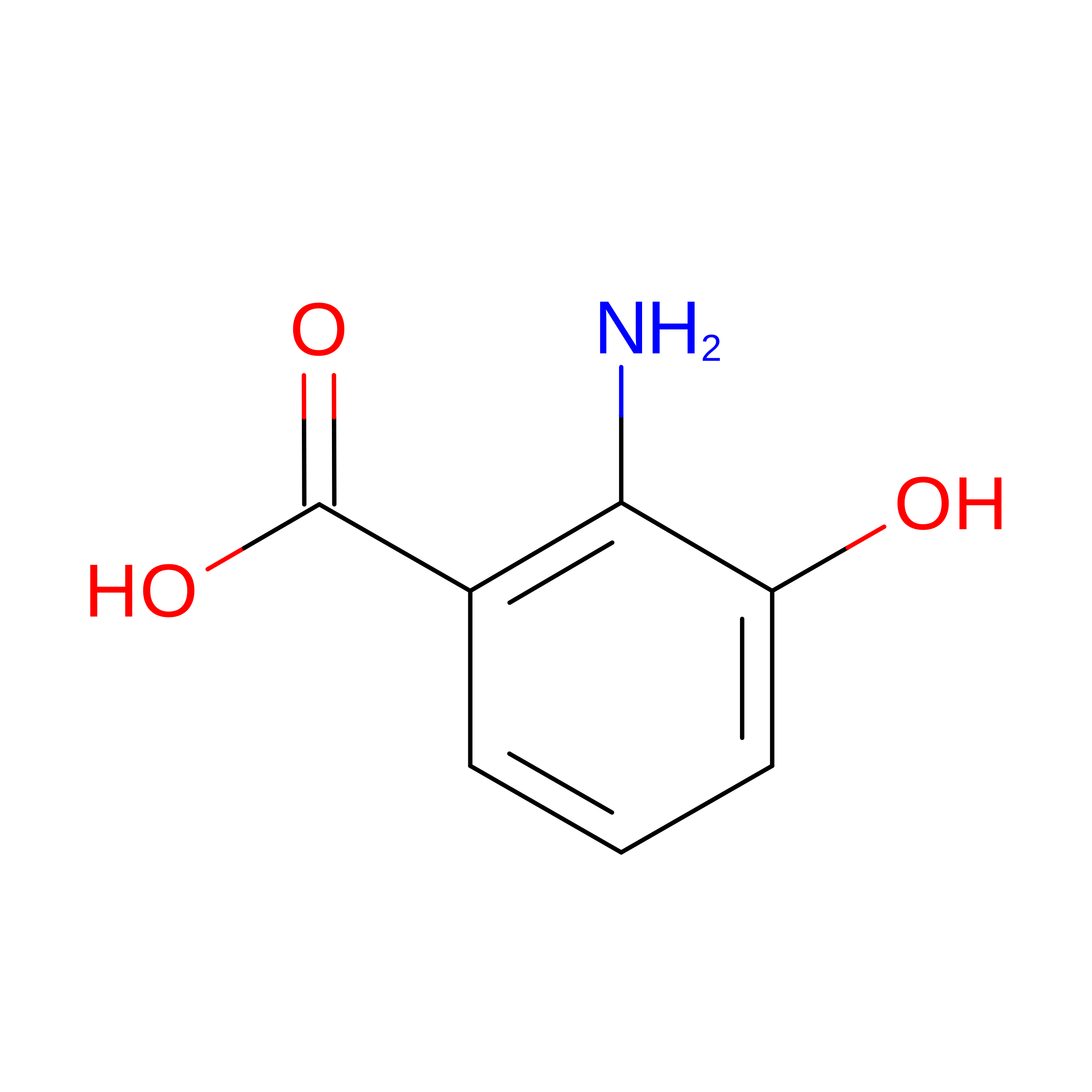
Crystal structure of 3-hydroxyanthranilate-3,4-dioxygenase I142A from Cupriavidus metallidurans in complex with 3-HAA

  • Classification: OXIDOREDUCTASE
  • Organism(s): Cupriavidus metallidurans
  • Expression System: Escherichia coli BL21(DE3)
  • Mutation(s): Yes 

  • Deposited: 2018-02-07 Released: 2018-06-06 
  • Deposition Author(s): Yang, Y., Liu, F., Liu, A.
  • Funding Organization(s): National Institutes of Health/National Institute of General Medical Sciences (NIH/NIGMS), National Institutes of Health/National Institute of Mental Health (NIH/NIMH), National Science Foundation (NSF, United States)

Experimental Data Snapshot

  • Method: X-RAY DIFFRACTION
  • Resolution: 2.61 Å
  • R-Value Free: 
    0.249 (Depositor), 0.249 (DCC) 
  • R-Value Work: 
    0.192 (Depositor), 0.191 (DCC) 
  • R-Value Observed: 
    0.198 (Depositor) 

Starting Model: experimental
View more details

wwPDB Validation 3D Report Full Report

Validation slider image for 6CD3

Ligand Structure Quality Assessment 


This is version 1.4 of the entry. See complete history

Literature

Adapting to oxygen: 3-Hydroxyanthrinilate 3,4-dioxygenase employs loop dynamics to accommodate two substrates with disparate polarities.

Yang, Y.Liu, F.Liu, A.

(2018) J Biological Chem 293: 10415-10424

  • DOI: https://doi.org/10.1074/jbc.RA118.002698
  • Primary Citation Related Structures: 
    6BVP, 6BVQ, 6BVR, 6BVS, 6CD3, 6D60, 6D61, 6D62

  • PubMed Abstract: 

    3-Hydroxyanthranilate 3,4-dioxygenase (HAO) is an iron-dependent protein that activates O 2 and inserts both oxygen atoms into 3-hydroxyanthranilate (3-HAA). An intriguing question is how HAO can rapidly bind O 2 , even though local O 2 concentrations and diffusion rates are relatively low. Here, a close inspection of the HAO structures revealed that substrate- and inhibitor-bound structures exhibit a closed conformation with three hydrophobic loop regions moving toward the catalytic iron center, whereas the ligand-free structure is open. We hypothesized that these loop movements enhance O 2 binding to the binary complex of HAO and 3-HAA. We found that the carboxyl end of 3-HAA triggers changes in two loop regions and that the third loop movement appears to be driven by an H-bond interaction between Asn 27 and Ile 142 Mutational analyses revealed that N27A, I142A, and I142P variants cannot form a closed conformation, and steady-state kinetic assays indicated that these variants have a substantially higher K m for O 2 than WT HAO. This observation suggested enhanced hydrophobicity at the iron center resulting from the concerted loop movements after the binding of the primary substrate, which is hydrophilic. Given that O 2 is nonpolar, the increased hydrophobicity at the iron center of the binary complex appears to be essential for rapid O 2 binding and activation, explaining the reason for the 3-HAA-induced loop movements. Because substrate binding-induced open-to-closed conformational changes are common, the results reported here may help further our understanding of how oxygen is enriched in nonheme iron-dependent dioxygenases.


  • Organizational Affiliation
    • From the Department of Chemistry, University of Texas at San Antonio, San Antonio, Texas 78249 and.

Macromolecule Content 

  • Total Structure Weight: 22.81 kDa 
  • Atom Count: 1,453 
  • Modeled Residue Count: 170 
  • Deposited Residue Count: 195 
  • Unique protein chains: 1

Macromolecules

Find similar proteins by:|  3D Structure
Entity ID: 1
MoleculeChains  Sequence LengthOrganismDetailsImage
3-hydroxyanthranilate 3,4-dioxygenase195Cupriavidus metalliduransMutation(s): 1 
Gene Names: nbaCRmet_5193
EC: 1.13.11.6
UniProt
Find proteins for Q1LCS4 (Cupriavidus metallidurans (strain ATCC 43123 / DSM 2839 / NBRC 102507 / CH34))
Explore Q1LCS4 
Go to UniProtKB:  Q1LCS4
Entity Groups
Sequence Clusters30% Identity50% Identity70% Identity90% Identity95% Identity100% Identity
UniProt GroupQ1LCS4
Sequence Annotations
Expand
Reference Sequence

Experimental Data & Validation

Experimental Data

  • Method: X-RAY DIFFRACTION
  • Resolution: 2.61 Å
  • R-Value Free:  0.249 (Depositor), 0.249 (DCC) 
  • R-Value Work:  0.192 (Depositor), 0.191 (DCC) 
  • R-Value Observed: 0.198 (Depositor) 
Space Group: P 65 2 2
Unit Cell:
Length ( Å )Angle ( ˚ )
a = 58.41α = 90
b = 58.41β = 90
c = 230.814γ = 120
Software Package:
Software NamePurpose
DENZOdata reduction
HKL-2000data scaling
PHENIXrefinement
PDB_EXTRACTdata extraction
PHENIXphasing

Structure Validation

View Full Validation Report


Ligand Structure Quality Assessment 


Entry History 

& Funding Information

Deposition Data


Funding OrganizationLocationGrant Number
National Institutes of Health/National Institute of General Medical Sciences (NIH/NIGMS)United StatesR01GM108988
National Institutes of Health/National Institute of Mental Health (NIH/NIMH)United StatesR21MH10798
National Science Foundation (NSF, United States)United StatesCHE-1623856

Revision History  (Full details and data files)

  • Version 1.0: 2018-06-06
    Type: Initial release
  • Version 1.1: 2018-07-18
    Changes: Data collection, Database references
  • Version 1.2: 2019-02-20
    Changes: Author supporting evidence, Data collection
  • Version 1.3: 2019-11-27
    Changes: Author supporting evidence
  • Version 1.4: 2023-10-04
    Changes: Data collection, Database references, Refinement description