6AZW | pdb_00006azw

IDO1/FXB-001116 crystal structure


Experimental Data Snapshot

  • Method: X-RAY DIFFRACTION
  • Resolution: 2.78 Å
  • R-Value Free: 
    0.299 (Depositor), 0.305 (DCC) 
  • R-Value Work: 
    0.217 (Depositor), 0.224 (DCC) 
  • R-Value Observed: 
    0.219 (Depositor) 

wwPDB Validation 3D Report Full Report

Validation slider image for 6AZW

Ligand Structure Quality Assessment 


This is version 1.3 of the entry. See complete history

Literature

Immune-modulating enzyme indoleamine 2,3-dioxygenase is effectively inhibited by targeting its apo-form.

Nelp, M.T.Kates, P.A.Hunt, J.T.Newitt, J.A.Balog, A.Maley, D.Zhu, X.Abell, L.Allentoff, A.Borzilleri, R.Lewis, H.A.Lin, Z.Seitz, S.P.Yan, C.Groves, J.T.

(2018) Proc Natl Acad Sci U S A 115: 3249-3254

  • DOI: https://doi.org/10.1073/pnas.1719190115
  • Primary Citation Related Structures: 
    6AZU, 6AZV, 6AZW

  • PubMed Abstract: 

    For cancer cells to survive and proliferate, they must escape normal immune destruction. One mechanism by which this is accomplished is through immune suppression effected by up-regulation of indoleamine 2,3-dioxygenase (IDO1), a heme enzyme that catalyzes the oxidation of tryptophan to N -formylkynurenine. On deformylation, kynurenine and downstream metabolites suppress T cell function. The importance of this immunosuppressive mechanism has spurred intense interest in the development of clinical IDO1 inhibitors. Herein, we describe the mechanism by which a class of compounds effectively and specifically inhibits IDO1 by targeting its apo-form. We show that the in vitro kinetics of inhibition coincide with an unusually high rate of intrinsic enzyme-heme dissociation, especially in the ferric form. X-ray crystal structures of the inhibitor-enzyme complexes show that heme is displaced from the enzyme and blocked from rebinding by these compounds. The results reveal that apo-IDO1 serves as a unique target for inhibition and that heme lability plays an important role in posttranslational regulation.


  • Organizational Affiliation
    • Department of Chemistry, Princeton University, Princeton, NJ 08544.

Macromolecule Content 

  • Total Structure Weight: 89.48 kDa 
  • Atom Count: 5,713 
  • Modeled Residue Count: 748 
  • Deposited Residue Count: 788 
  • Unique protein chains: 1

Macromolecules

Find similar proteins by:|  3D Structure
Entity ID: 1
MoleculeChains  Sequence LengthOrganismDetailsImage
Indoleamine 2,3-dioxygenase 1
A, B
394Homo sapiensMutation(s): 0 
Gene Names: IDO1IDOINDO
EC: 1.13.11.52
UniProt & NIH Common Fund Data Resources
Find proteins for P14902 (Homo sapiens)
Explore P14902 
Go to UniProtKB:  P14902
PHAROS:  P14902
GTEx:  ENSG00000131203 
Entity Groups
Sequence Clusters30% Identity50% Identity70% Identity90% Identity95% Identity100% Identity
UniProt GroupP14902
Sequence Annotations
Expand
Reference Sequence

Small Molecules

Ligands 1 Unique
IDChains Name / Formula / InChI Key2D Diagram3D Interactions
C51

Query on C51


Download:Ideal Coordinates CCD File
C [auth A],
D [auth B]
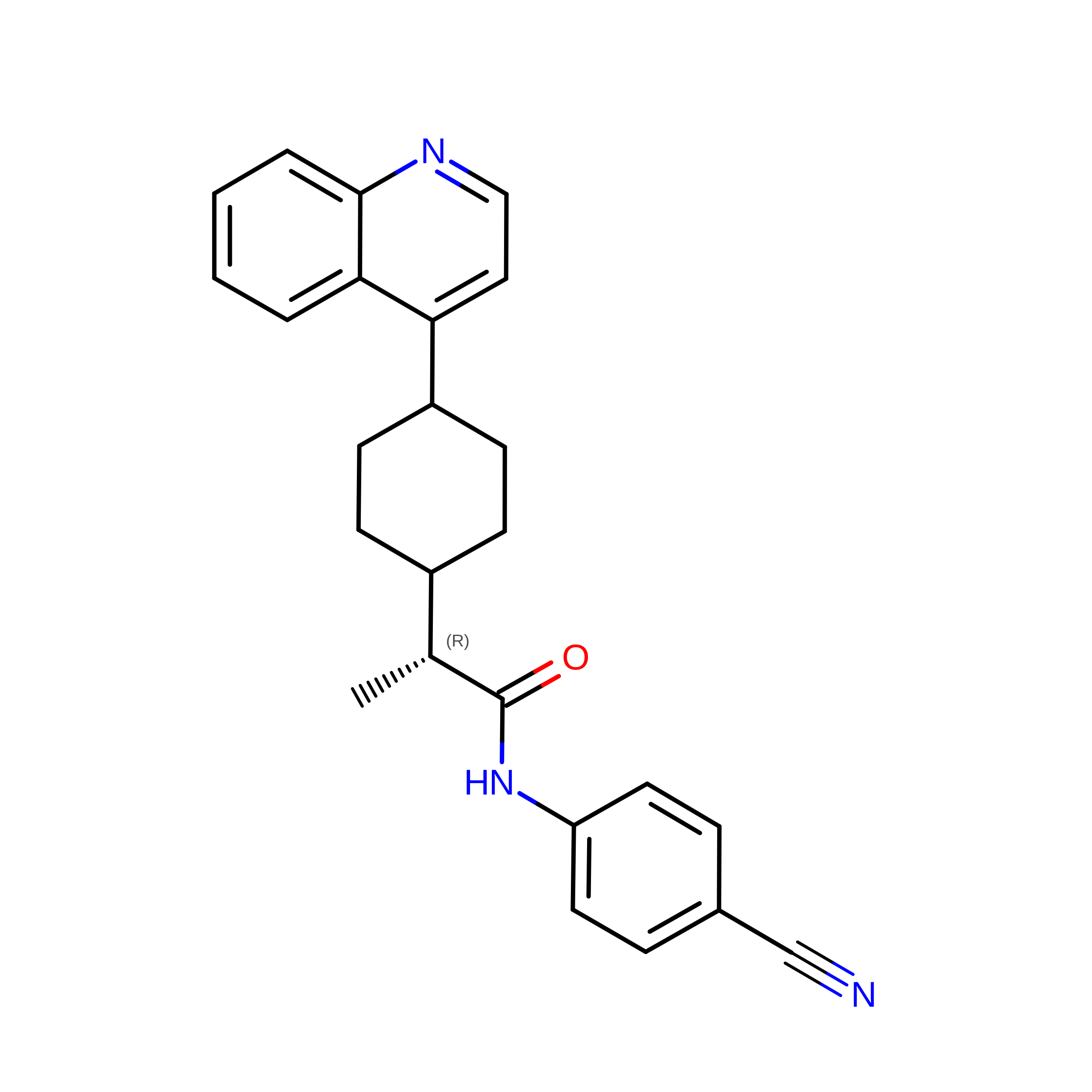
(2R)-N-(4-cyanophenyl)-2-[cis-4-(quinolin-4-yl)cyclohexyl]propanamide
C25 H25 N3 O
GDSGPUWADCUKPY-RLLQIKCJSA-N

Experimental Data & Validation

Experimental Data

  • Method: X-RAY DIFFRACTION
  • Resolution: 2.78 Å
  • R-Value Free:  0.299 (Depositor), 0.305 (DCC) 
  • R-Value Work:  0.217 (Depositor), 0.224 (DCC) 
  • R-Value Observed: 0.219 (Depositor) 
Space Group: P 21 21 21
Unit Cell:
Length ( Å )Angle ( ˚ )
a = 85.206α = 90
b = 92.555β = 90
c = 128.698γ = 90
Software Package:
Software NamePurpose
PHENIXrefinement
XSCALEdata scaling
PDB_EXTRACTdata extraction
XDSdata reduction
PHENIXphasing

Structure Validation

View Full Validation Report


Ligand Structure Quality Assessment 


Entry History 

Deposition Data

Revision History  (Full details and data files)

  • Version 1.0: 2018-03-21
    Type: Initial release
  • Version 1.1: 2018-04-11
    Changes: Data collection, Database references
  • Version 1.2: 2023-08-16
    Changes: Data collection, Database references, Other
  • Version 1.3: 2024-11-13
    Changes: Structure summary