6AZV | pdb_00006azv

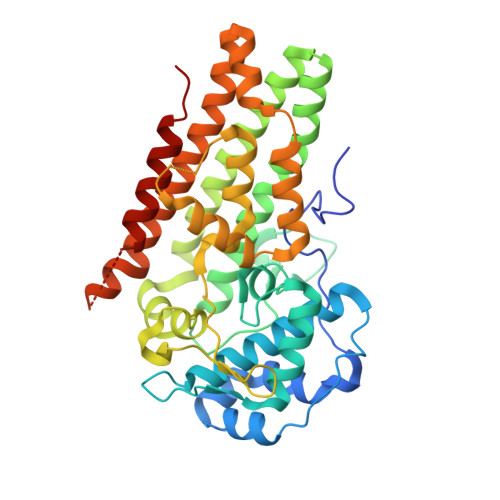
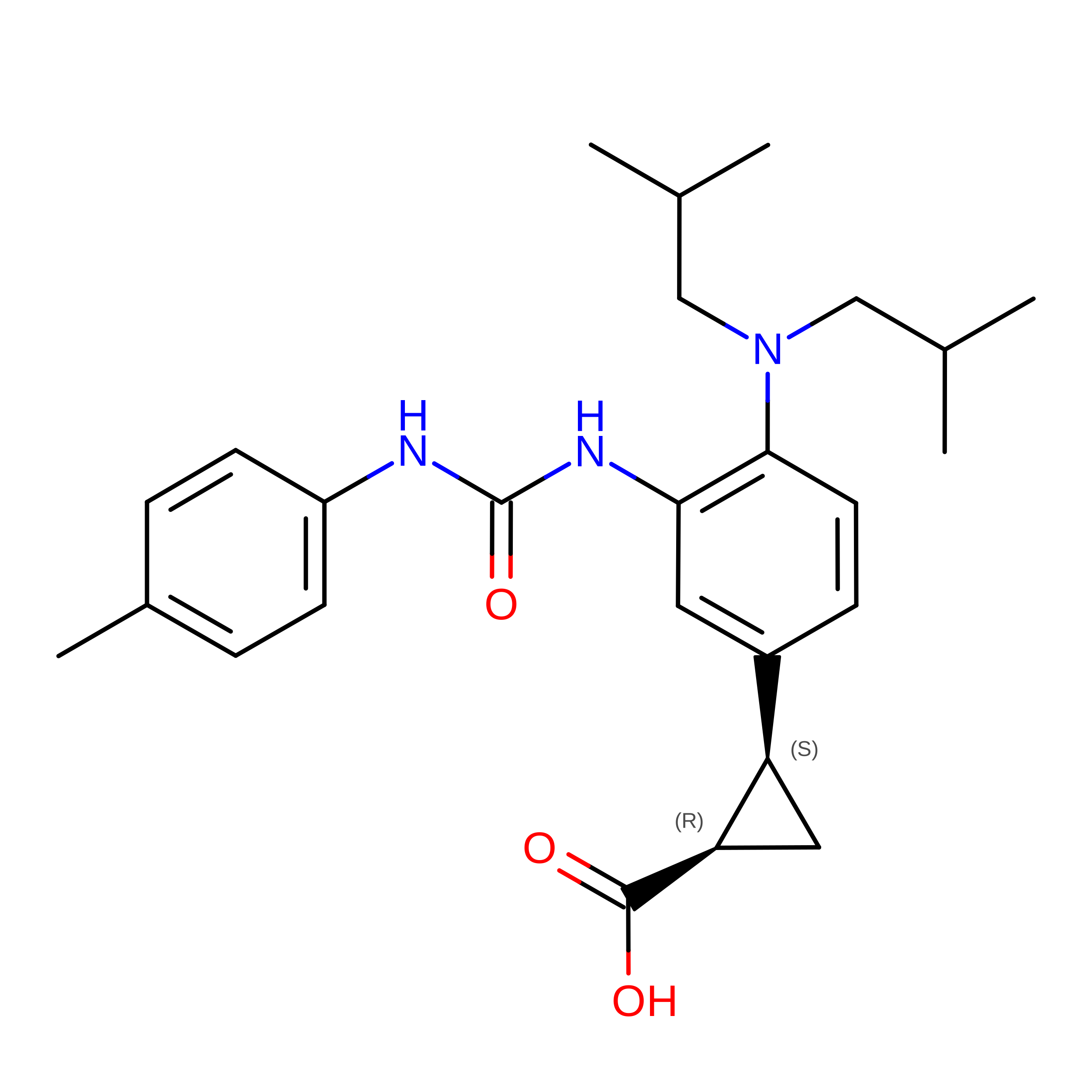
IDO1/BMS-978587 crystal structure


Experimental Data Snapshot

  • Method: X-RAY DIFFRACTION
  • Resolution: 2.75 Å
  • R-Value Free: 
    0.272 (Depositor), 0.279 (DCC) 
  • R-Value Work: 
    0.195 (Depositor), 0.204 (DCC) 
  • R-Value Observed: 
    0.199 (Depositor) 

Starting Model: experimental
View more details

wwPDB Validation 3D Report Full Report

Validation slider image for 6AZV

Ligand Structure Quality Assessment 


This is version 1.3 of the entry. See complete history

Literature

Immune-modulating enzyme indoleamine 2,3-dioxygenase is effectively inhibited by targeting its apo-form.

Nelp, M.T.Kates, P.A.Hunt, J.T.Newitt, J.A.Balog, A.Maley, D.Zhu, X.Abell, L.Allentoff, A.Borzilleri, R.Lewis, H.A.Lin, Z.Seitz, S.P.Yan, C.Groves, J.T.

(2018) Proc Natl Acad Sci U S A 115: 3249-3254

  • DOI: https://doi.org/10.1073/pnas.1719190115
  • Primary Citation Related Structures: 
    6AZU, 6AZV, 6AZW

  • PubMed Abstract: 

    For cancer cells to survive and proliferate, they must escape normal immune destruction. One mechanism by which this is accomplished is through immune suppression effected by up-regulation of indoleamine 2,3-dioxygenase (IDO1), a heme enzyme that catalyzes the oxidation of tryptophan to N -formylkynurenine. On deformylation, kynurenine and downstream metabolites suppress T cell function. The importance of this immunosuppressive mechanism has spurred intense interest in the development of clinical IDO1 inhibitors. Herein, we describe the mechanism by which a class of compounds effectively and specifically inhibits IDO1 by targeting its apo-form. We show that the in vitro kinetics of inhibition coincide with an unusually high rate of intrinsic enzyme-heme dissociation, especially in the ferric form. X-ray crystal structures of the inhibitor-enzyme complexes show that heme is displaced from the enzyme and blocked from rebinding by these compounds. The results reveal that apo-IDO1 serves as a unique target for inhibition and that heme lability plays an important role in posttranslational regulation.


  • Organizational Affiliation
    • Department of Chemistry, Princeton University, Princeton, NJ 08544.

Macromolecule Content 

  • Total Structure Weight: 182.77 kDa 
  • Atom Count: 11,312 
  • Modeled Residue Count: 1,462 
  • Deposited Residue Count: 1,608 
  • Unique protein chains: 1

Macromolecules

Find similar proteins by:|  3D Structure
Entity ID: 1
MoleculeChains  Sequence LengthOrganismDetailsImage
Indoleamine 2,3-dioxygenase 1
A, B, C, D
402Homo sapiensMutation(s): 0 
Gene Names: IDO1IDOINDO
EC: 1.13.11.52
UniProt & NIH Common Fund Data Resources
Find proteins for P14902 (Homo sapiens)
Explore P14902 
Go to UniProtKB:  P14902
PHAROS:  P14902
GTEx:  ENSG00000131203 
Entity Groups
Sequence Clusters30% Identity50% Identity70% Identity90% Identity95% Identity100% Identity
UniProt GroupP14902
Sequence Annotations
Expand
Reference Sequence

Small Molecules

Experimental Data & Validation

Experimental Data

  • Method: X-RAY DIFFRACTION
  • Resolution: 2.75 Å
  • R-Value Free:  0.272 (Depositor), 0.279 (DCC) 
  • R-Value Work:  0.195 (Depositor), 0.204 (DCC) 
  • R-Value Observed: 0.199 (Depositor) 
Space Group: C 1 2 1
Unit Cell:
Length ( Å )Angle ( ˚ )
a = 203.392α = 90
b = 120.868β = 119.11
c = 101.527γ = 90
Software Package:
Software NamePurpose
SCALAdata scaling
PHENIXrefinement
PDB_EXTRACTdata extraction
XDSdata reduction
PHENIXphasing

Structure Validation

View Full Validation Report


Ligand Structure Quality Assessment 


Entry History 

Deposition Data

  • Released Date: 2018-03-21 
  • Deposition Author(s): Lewis, H.A.

Revision History  (Full details and data files)

  • Version 1.0: 2018-03-21
    Type: Initial release
  • Version 1.1: 2018-04-11
    Changes: Data collection, Database references
  • Version 1.2: 2023-10-04
    Changes: Data collection, Database references, Refinement description
  • Version 1.3: 2024-10-23
    Changes: Structure summary