5WJO | pdb_00005wjo

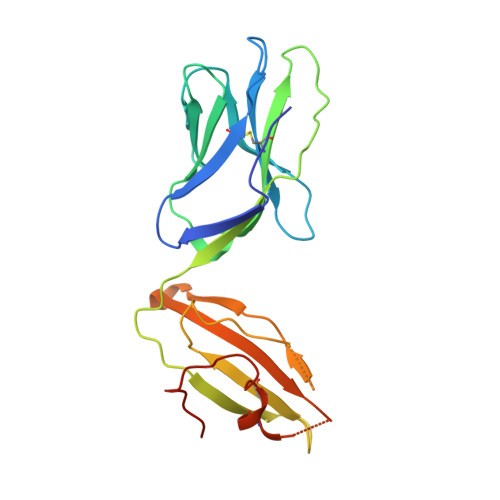
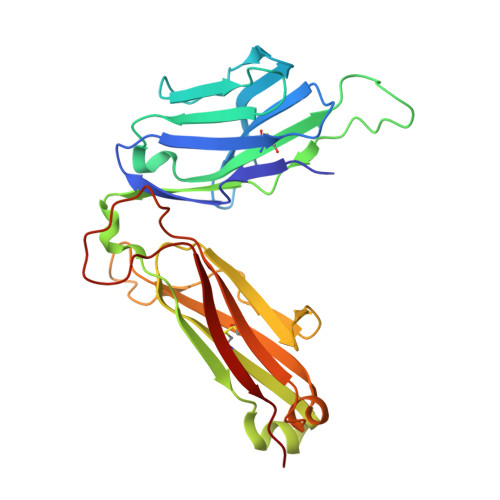
Crystal structure of the unliganded PG90 TCR


Experimental Data Snapshot

  • Method: X-RAY DIFFRACTION
  • Resolution: 2.50 Å
  • R-Value Free: 
    0.230 (Depositor), 0.243 (DCC) 
  • R-Value Work: 
    0.208 (Depositor), 0.219 (DCC) 
  • R-Value Observed: 
    0.209 (Depositor) 

Starting Models: experimental
View more details

wwPDB Validation 3D Report Full Report

Validation slider image for 5WJO

This is version 1.3 of the entry. See complete history

Literature

A molecular basis of human T cell receptor autoreactivity toward self-phospholipids.

Shahine, A.Van Rhijn, I.Cheng, T.Y.Iwany, S.Gras, S.Moody, D.B.Rossjohn, J.

(2017) Sci Immunol 2

  • DOI: https://doi.org/10.1126/sciimmunol.aao1384
  • Primary Citation Related Structures: 
    5WJO, 5WKE, 5WKG, 5WKI, 5WL1

  • PubMed Abstract: 

    Human T cell autoreactivity toward lipid antigens presented by CD1 proteins can manifest in numerous diseases, including psoriasis, contact hypersensitivities, and allergies. However, the molecular mechanisms for regulating T cell autoreactivity toward lipid antigens remain unclear. We determined the basis for T cell receptor (TCR) autoreactivity toward CD1b bound to self-phospholipids. The spectrum of self-antigens captured by CD1b skews toward abundant membrane phospholipids such as phosphatidylcholine and phosphatidylethanolamine. However, TCRs can specifically recognize rare phospholipids, including phosphatidylglycerol (PG). The structure of an autoreactive TCR bound to CD1b-PG shows that discrimination occurs through a marked induced fit movement of PG so that its polar head group fits snugly into the cationic cup of the TCR. Conversely, TCR binding toward ubiquitous self-phospholipids was sterically or electrostatically repelled. Accordingly, we describe a mechanism of TCR autoreactivity toward rare phospholipids and avoidance of autoreactivity to the most abundant self-phospholipids.


  • Organizational Affiliation
    • Infection and Immunity Program and Department of Biochemistry and Molecular Biology, Biomedicine Discovery Institute, Monash University, Clayton, Victoria 3800, Australia.

Macromolecule Content 

  • Total Structure Weight: 101.9 kDa 
  • Atom Count: 7,251 
  • Modeled Residue Count: 872 
  • Deposited Residue Count: 906 
  • Unique protein chains: 2

Macromolecules

Find similar proteins by:|  3D Structure
Entity ID: 1
MoleculeChains  Sequence LengthOrganismDetailsImage
PG90 TCR alpha chain
A, C
204Homo sapiensMutation(s): 0 
Find similar proteins by:|  3D Structure
Entity ID: 2
MoleculeChains  Sequence LengthOrganismDetailsImage
PG90 TCR beta chain
B, D
249Homo sapiensMutation(s): 0 

Small Molecules

Ligands 3 Unique
IDChains Name / Formula / InChI Key2D Diagram3D Interactions
EDO

Query on EDO


Download:Ideal Coordinates CCD File
G [auth A],
H [auth A],
M [auth C],
Q [auth D]
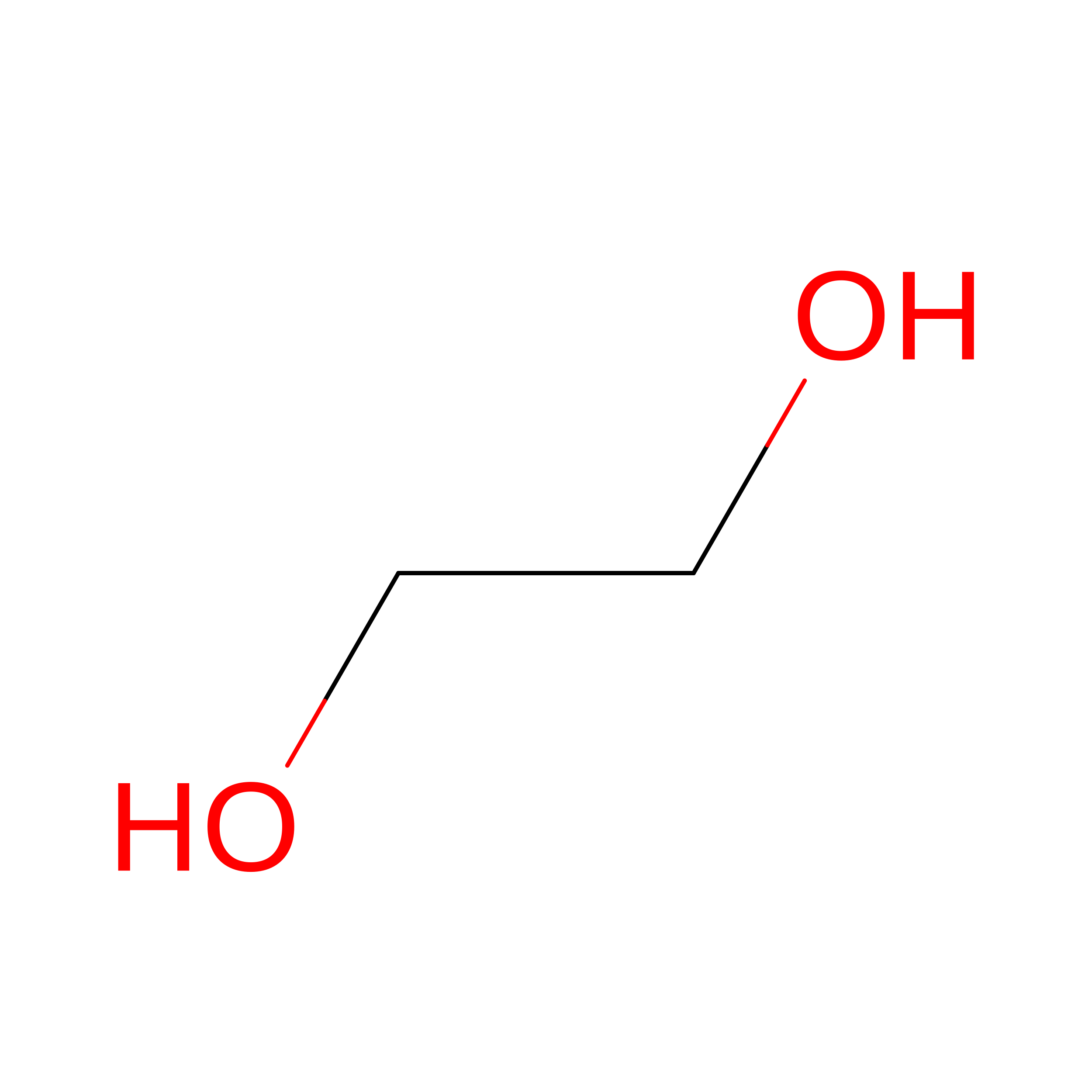
1,2-ETHANEDIOL
C2 H6 O2
LYCAIKOWRPUZTN-UHFFFAOYSA-N
CL

Query on CL


Download:Ideal Coordinates CCD File
I [auth B]
J [auth B]
K [auth B]
L [auth B]
N [auth C]
I [auth B],
J [auth B],
K [auth B],
L [auth B],
N [auth C],
O [auth C],
R [auth D],
S [auth D],
T [auth D]
CHLORIDE ION
Cl
VEXZGXHMUGYJMC-UHFFFAOYSA-M
NA

Query on NA


Download:Ideal Coordinates CCD File
E [auth A],
F [auth A],
P [auth D]
SODIUM ION
Na
FKNQFGJONOIPTF-UHFFFAOYSA-N

Experimental Data & Validation

Experimental Data

  • Method: X-RAY DIFFRACTION
  • Resolution: 2.50 Å
  • R-Value Free:  0.230 (Depositor), 0.243 (DCC) 
  • R-Value Work:  0.208 (Depositor), 0.219 (DCC) 
  • R-Value Observed: 0.209 (Depositor) 
Space Group: P 21 21 21
Unit Cell:
Length ( Å )Angle ( ˚ )
a = 41.15α = 90
b = 128.08β = 90
c = 169.68γ = 90
Software Package:
Software NamePurpose
BUSTERrefinement
iMOSFLMdata reduction
Aimlessdata scaling
PHASERphasing

Structure Validation

View Full Validation Report


Entry History 

Deposition Data

Revision History  (Full details and data files)

  • Version 1.0: 2017-10-25
    Type: Initial release
  • Version 1.1: 2017-11-08
    Changes: Database references
  • Version 1.2: 2023-10-04
    Changes: Advisory, Data collection, Database references, Refinement description
  • Version 1.3: 2024-10-30
    Changes: Structure summary