5SWI | pdb_00005swi

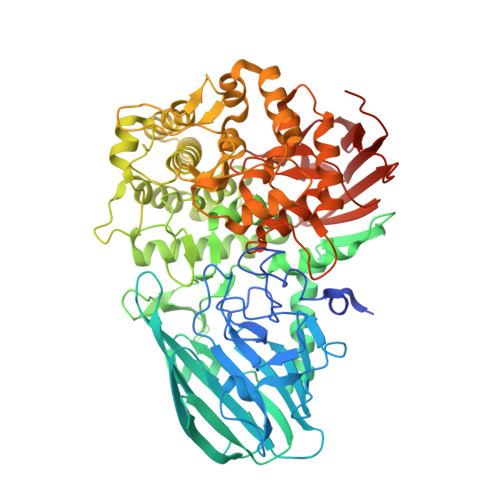
Crystal structure of SpGH92 in complex with mannose


Experimental Data Snapshot

  • Method: X-RAY DIFFRACTION
  • Resolution: 2.15 Å
  • R-Value Free: 
    0.221 (Depositor), 0.228 (DCC) 
  • R-Value Work: 
    0.197 (Depositor), 0.203 (DCC) 
  • R-Value Observed: 
    0.198 (Depositor) 

Starting Model: experimental
View more details

wwPDB Validation 3D Report Full Report

Validation slider image for 5SWI

Ligand Structure Quality Assessment 


This is version 1.5 of the entry. See complete history

Literature

Molecular Characterization of N-glycan Degradation and Transport in Streptococcus pneumoniae and Its Contribution to Virulence.

Robb, M.Hobbs, J.K.Woodiga, S.A.Shapiro-Ward, S.Suits, M.D.McGregor, N.Brumer, H.Yesilkaya, H.King, S.J.Boraston, A.B.

(2017) PLoS Pathog 13: e1006090-e1006090

  • DOI: https://doi.org/10.1371/journal.ppat.1006090
  • Primary Citation Related Structures: 
    5SUO, 5SWA, 5SWB, 5SWI

  • PubMed Abstract: 

    The carbohydrate-rich coating of human tissues and cells provide a first point of contact for colonizing and invading bacteria. Commensurate with N-glycosylation being an abundant form of protein glycosylation that has critical functional roles in the host, some host-adapted bacteria possess the machinery to process N-linked glycans. The human pathogen Streptococcus pneumoniae depolymerizes complex N-glycans with enzymes that sequentially trim a complex N-glycan down to the Man3GlcNAc2 core prior to the release of the glycan from the protein by endo-β-N-acetylglucosaminidase (EndoD), which cleaves between the two GlcNAc residues. Here we examine the capacity of S. pneumoniae to process high-mannose N-glycans and transport the products. Through biochemical and structural analyses we demonstrate that S. pneumoniae also possesses an α-(1,2)-mannosidase (SpGH92). This enzyme has the ability to trim the terminal α-(1,2)-linked mannose residues of high-mannose N-glycans to generate Man5GlcNAc2. Through this activity SpGH92 is able to produce a substrate for EndoD, which is not active on high-mannose glycans with α-(1,2)-linked mannose residues. Binding studies and X-ray crystallography show that NgtS, the solute binding protein of an ABC transporter (ABCNG), is able to bind Man5GlcNAc, a product of EndoD activity, with high affinity. Finally, we evaluated the contribution of EndoD and ABCNG to growth of S. pneumoniae on a model N-glycosylated glycoprotein, and the contribution of these enzymes and SpGH92 to virulence in a mouse model. We found that both EndoD and ABCNG contribute to growth of S. pneumoniae, but that only SpGH92 and EndoD contribute to virulence. Therefore, N-glycan processing, but not transport of the released glycan, is required for full virulence in S. pneumoniae. To conclude, we synthesize our findings into a model of N-glycan processing by S. pneumoniae in which both complex and high-mannose N-glycans are targeted, and in which the two arms of this degradation pathway converge at ABCNG.


  • Organizational Affiliation
    • Department of Biochemistry and Microbiology, University of Victoria, Victoria, British Columbia, Canada.

Macromolecule Content 

  • Total Structure Weight: 328.66 kDa 
  • Atom Count: 23,499 
  • Modeled Residue Count: 2,746 
  • Deposited Residue Count: 2,868 
  • Unique protein chains: 1

Macromolecules

Find similar proteins by:|  3D Structure
Entity ID: 1
MoleculeChains  Sequence LengthOrganismDetailsImage
Sugar hydrolaseA [auth B],
B [auth A],
C,
D
717Streptococcus pneumoniaeMutation(s): 0 
Gene Names: ERS003549_00384ERS409165_00851ERS409372_00266ERS455085_01031ERS515225_01644

Small Molecules

Ligands 3 Unique
IDChains Name / Formula / InChI Key2D Diagram3D Interactions
BMA

Query on BMA


Download:Ideal Coordinates CCD File
AA [auth D],
J [auth B],
R [auth A],
V [auth C]
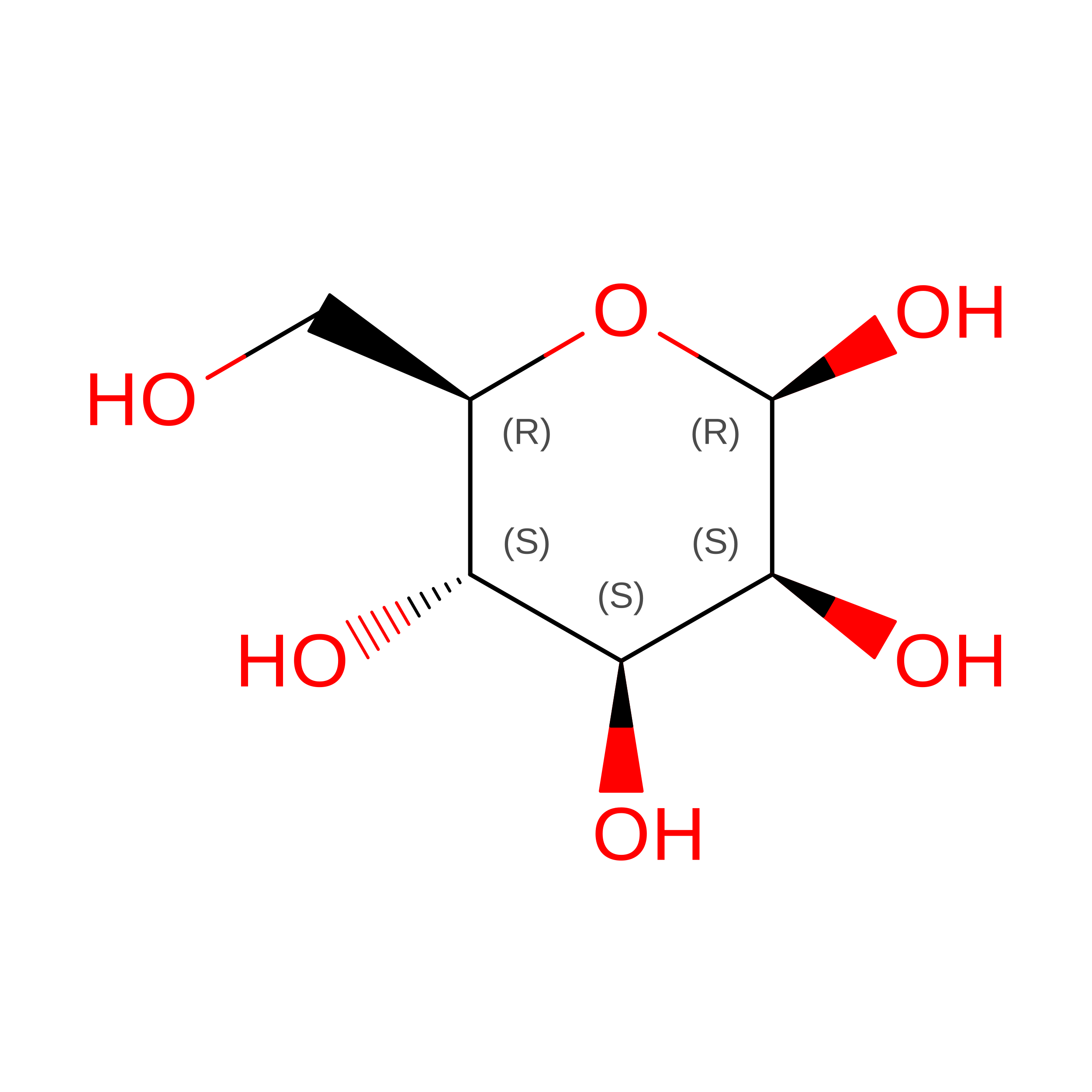
beta-D-mannopyranose
C6 H12 O6
WQZGKKKJIJFFOK-RWOPYEJCSA-N
GOL

Query on GOL


Download:Ideal Coordinates CCD File
F [auth B]
G [auth B]
H [auth B]
I [auth B]
K [auth A]
F [auth B],
G [auth B],
H [auth B],
I [auth B],
K [auth A],
L [auth A],
M [auth A],
N [auth A],
O [auth A],
P [auth A],
Q [auth A],
T [auth C],
U [auth C],
X [auth D],
Y [auth D],
Z [auth D]
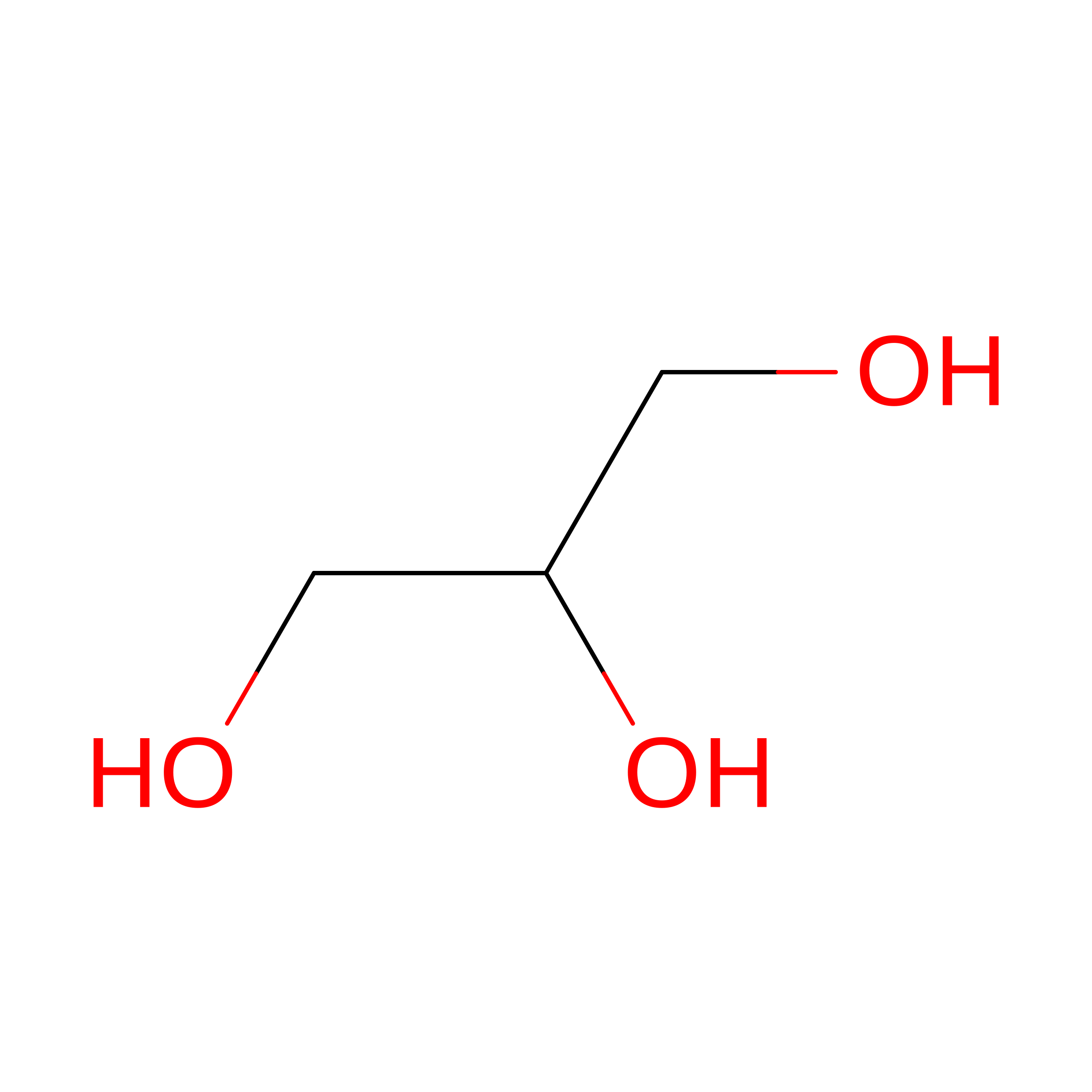
GLYCEROL
C3 H8 O3
PEDCQBHIVMGVHV-UHFFFAOYSA-N
CA

Query on CA


Download:Ideal Coordinates CCD File
BA [auth D],
E [auth B],
S [auth A],
W [auth C]
CALCIUM ION
Ca
BHPQYMZQTOCNFJ-UHFFFAOYSA-N

Experimental Data & Validation

Experimental Data

  • Method: X-RAY DIFFRACTION
  • Resolution: 2.15 Å
  • R-Value Free:  0.221 (Depositor), 0.228 (DCC) 
  • R-Value Work:  0.197 (Depositor), 0.203 (DCC) 
  • R-Value Observed: 0.198 (Depositor) 
Space Group: P 21 21 21
Unit Cell:
Length ( Å )Angle ( ˚ )
a = 130.003α = 90
b = 161.711β = 90
c = 208.404γ = 90
Software Package:
Software NamePurpose
REFMACrefinement
SCALAdata scaling
PHASERphasing
PDB_EXTRACTdata extraction
XDSdata reduction

Structure Validation

View Full Validation Report


Ligand Structure Quality Assessment 


Entry History 

& Funding Information

Deposition Data


Funding OrganizationLocationGrant Number
Canadian Institutes of Health Research (CIHR)CanadaMOP 130305

Revision History  (Full details and data files)

  • Version 1.0: 2016-12-14
    Type: Initial release
  • Version 1.1: 2017-01-18
    Changes: Database references
  • Version 1.2: 2017-09-20
    Changes: Author supporting evidence
  • Version 1.3: 2020-01-08
    Changes: Author supporting evidence
  • Version 1.4: 2020-07-29
    Type: Remediation
    Reason: Carbohydrate remediation
    Changes: Data collection, Derived calculations, Structure summary
  • Version 1.5: 2023-10-04
    Changes: Data collection, Database references, Refinement description, Structure summary