5NML | pdb_00005nml

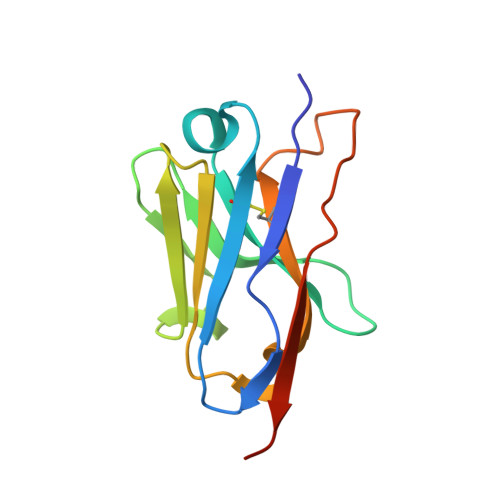
Nb36 Ser85Cys with Hg bound


Experimental Data Snapshot

  • Method: X-RAY DIFFRACTION
  • Resolution: 2.50 Å
  • R-Value Free: 
    0.265 (Depositor), 0.267 (DCC) 
  • R-Value Work: 
    0.238 (Depositor), 0.242 (DCC) 
  • R-Value Observed: 
    0.239 (Depositor) 

wwPDB Validation 3D Report Full Report

Validation slider image for 5NML

This is version 1.4 of the entry. See complete history

Literature

Introducing site-specific cysteines into nanobodies for mercury labelling allows de novo phasing of their crystal structures.

Hansen, S.B.Laursen, N.S.Andersen, G.R.Andersen, K.R.

(2017) Acta Crystallogr D Struct Biol 73: 804-813

  • DOI: https://doi.org/10.1107/S2059798317013171
  • Primary Citation Related Structures: 
    5NLU, 5NLW, 5NM0, 5NML

  • PubMed Abstract: 

    The generation of high-quality protein crystals and the loss of phase information during an X-ray crystallography diffraction experiment represent the major bottlenecks in the determination of novel protein structures. A generic method for introducing Hg atoms into any crystal independent of the presence of free cysteines in the target protein could considerably facilitate the process of obtaining unbiased experimental phases. Nanobodies (single-domain antibodies) have recently been shown to promote the crystallization and structure determination of flexible proteins and complexes. To extend the usability of nanobodies for crystallographic work, variants of the Nb36 nanobody with a single free cysteine at one of four framework-residue positions were developed. These cysteines could be labelled with fluorophores or Hg. For one cysteine variant (Nb36-C85) two nanobody structures were experimentally phased using single-wavelength anomalous dispersion (SAD) and single isomorphous replacement with anomalous signal (SIRAS), taking advantage of radiation-induced changes in Cys-Hg bonding. Importantly, Hg labelling influenced neither the interaction of Nb36 with its antigen complement C5 nor its structure. The results suggest that Cys-Hg-labelled nanobodies may become efficient tools for obtaining de novo phase information during the structure determination of nanobody-protein complexes.


  • Organizational Affiliation
    • Department of Molecular Biology and Genetics, Aarhus University, Gustav Wieds Vej 10C, 8000 Aarhus, Denmark.

Macromolecule Content 

  • Total Structure Weight: 138 kDa 
  • Atom Count: 8,490 
  • Modeled Residue Count: 1,128 
  • Deposited Residue Count: 1,250 
  • Unique protein chains: 1

Macromolecules

Find similar proteins by:|  3D Structure
Entity ID: 1
MoleculeChains  Sequence LengthOrganismDetailsImage
Nanobody Nb36 Ser85Cys
A, B, C, D, E
A, B, C, D, E, F, G, H, I, J
125Lama glamaMutation(s): 0 

Small Molecules

Ligands 2 Unique
IDChains Name / Formula / InChI Key2D Diagram3D Interactions
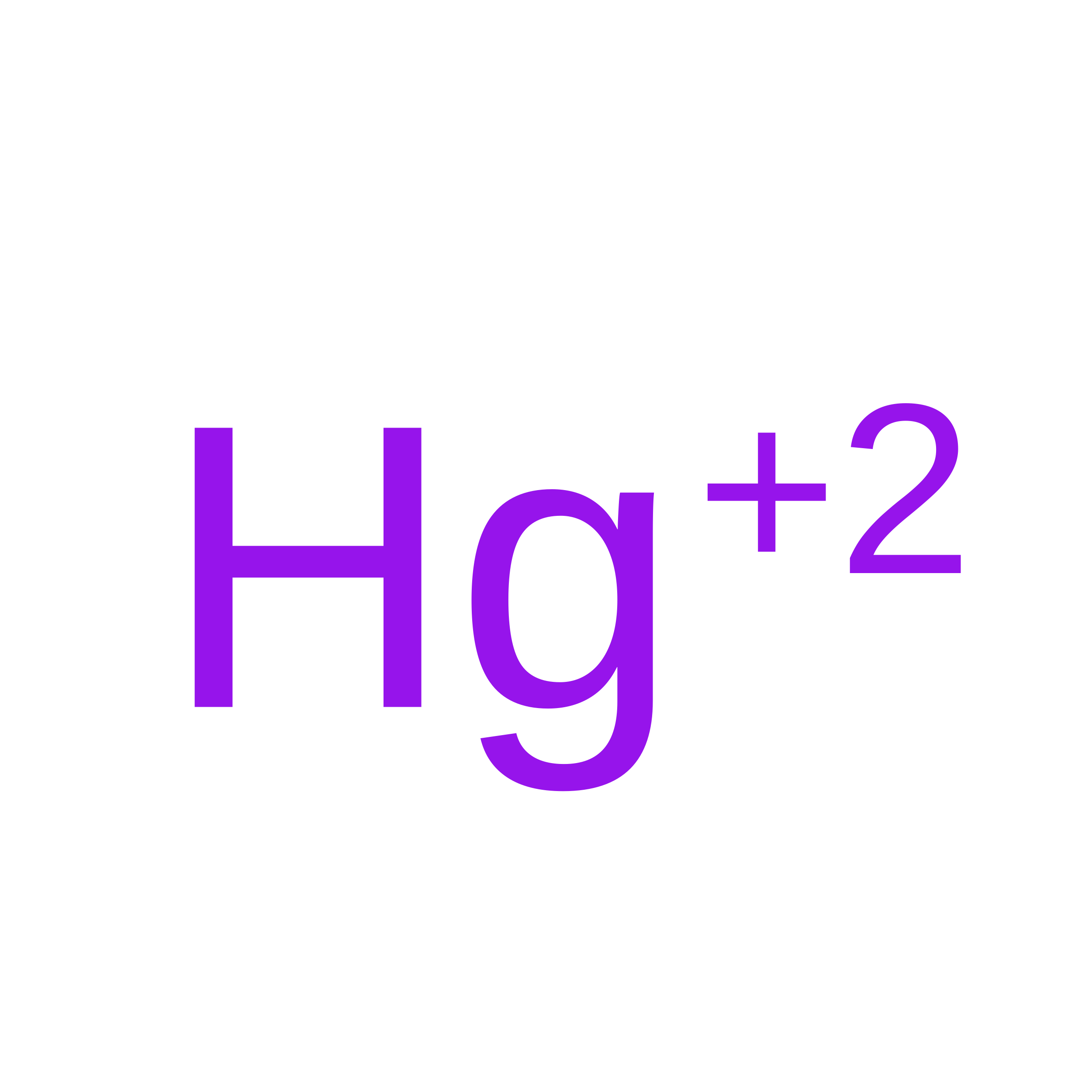
HG

Query on HG


Download:Ideal Coordinates CCD File
K [auth A]
M [auth B]
N [auth B]
P [auth C]
Q [auth C]
K [auth A],
M [auth B],
N [auth B],
P [auth C],
Q [auth C],
R [auth D],
S [auth D],
U [auth F],
W [auth H]
MERCURY (II) ION
Hg
BQPIGGFYSBELGY-UHFFFAOYSA-N
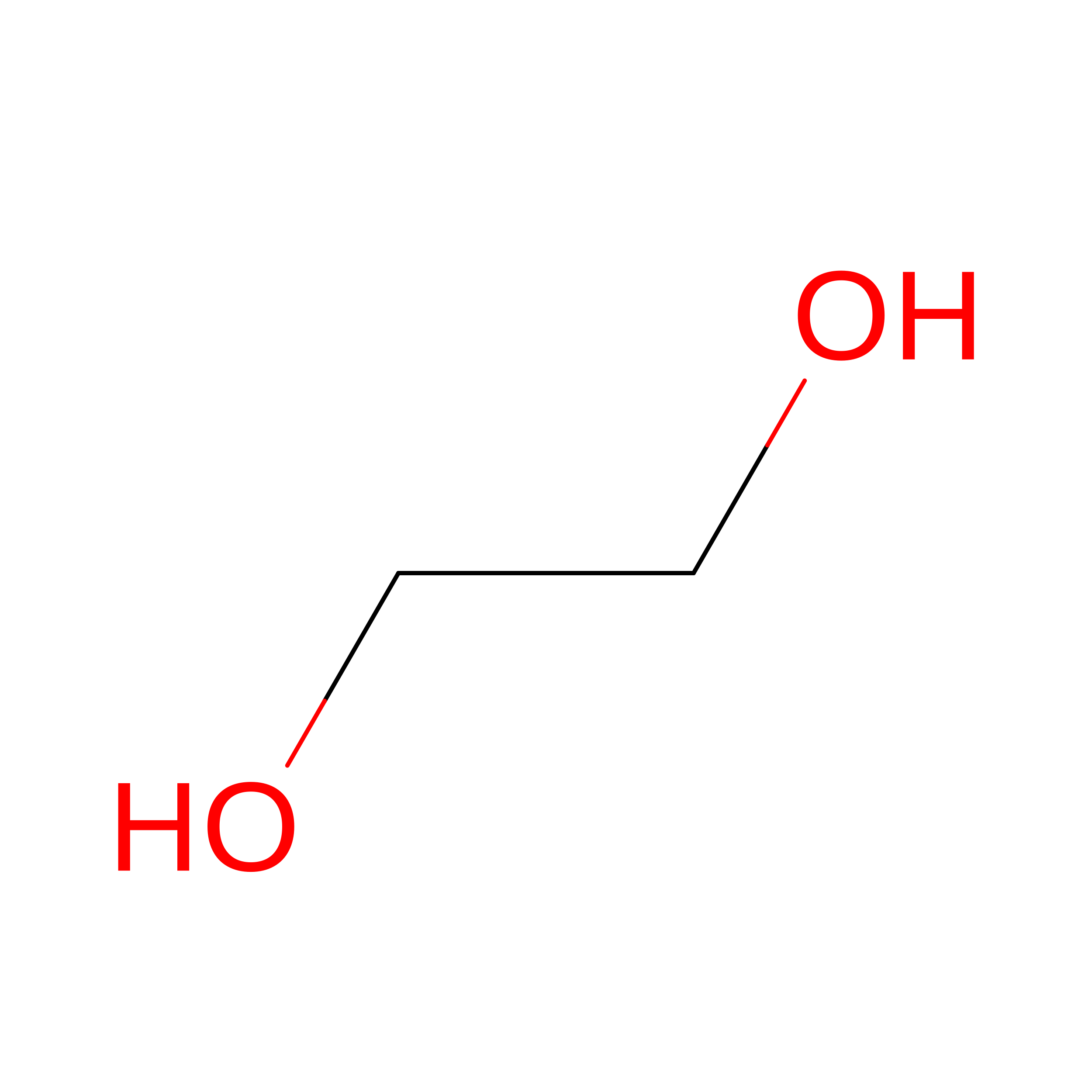
EDO

Query on EDO


Download:Ideal Coordinates CCD File
L [auth B],
O [auth C],
T [auth E],
V [auth H]
1,2-ETHANEDIOL
C2 H6 O2
LYCAIKOWRPUZTN-UHFFFAOYSA-N

Experimental Data & Validation

Experimental Data

  • Method: X-RAY DIFFRACTION
  • Resolution: 2.50 Å
  • R-Value Free:  0.265 (Depositor), 0.267 (DCC) 
  • R-Value Work:  0.238 (Depositor), 0.242 (DCC) 
  • R-Value Observed: 0.239 (Depositor) 
Space Group: P 1 21 1
Unit Cell:
Length ( Å )Angle ( ˚ )
a = 83.96α = 90
b = 99.11β = 105.77
c = 85.41γ = 90
Software Package:
Software NamePurpose
PHENIXrefinement
XSCALEdata scaling
SOLVEphasing
RESOLVEphasing
PDB_EXTRACTdata extraction
XDSdata reduction

Structure Validation

View Full Validation Report


Entry History 

& Funding Information

Deposition Data


Funding OrganizationLocationGrant Number
The Danish Research Council for Independent ResearchDenmarkDanscatt

Revision History  (Full details and data files)

  • Version 1.0: 2017-06-07
    Type: Initial release
  • Version 1.1: 2017-10-11
    Changes: Data collection, Database references
  • Version 1.2: 2017-11-01
    Changes: Database references
  • Version 1.3: 2023-11-29
    Changes: Data collection, Database references, Derived calculations, Refinement description
  • Version 1.4: 2024-11-20
    Changes: Structure summary