5L3W | pdb_00005l3w

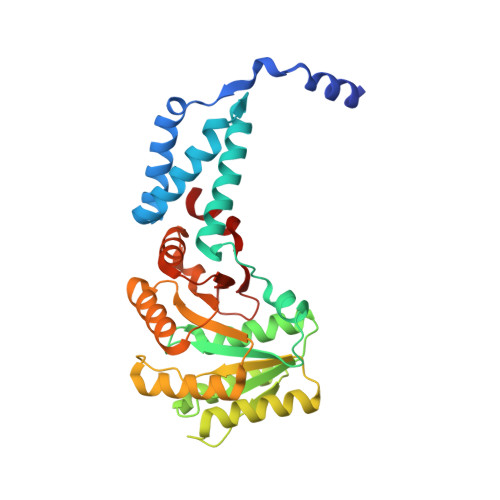
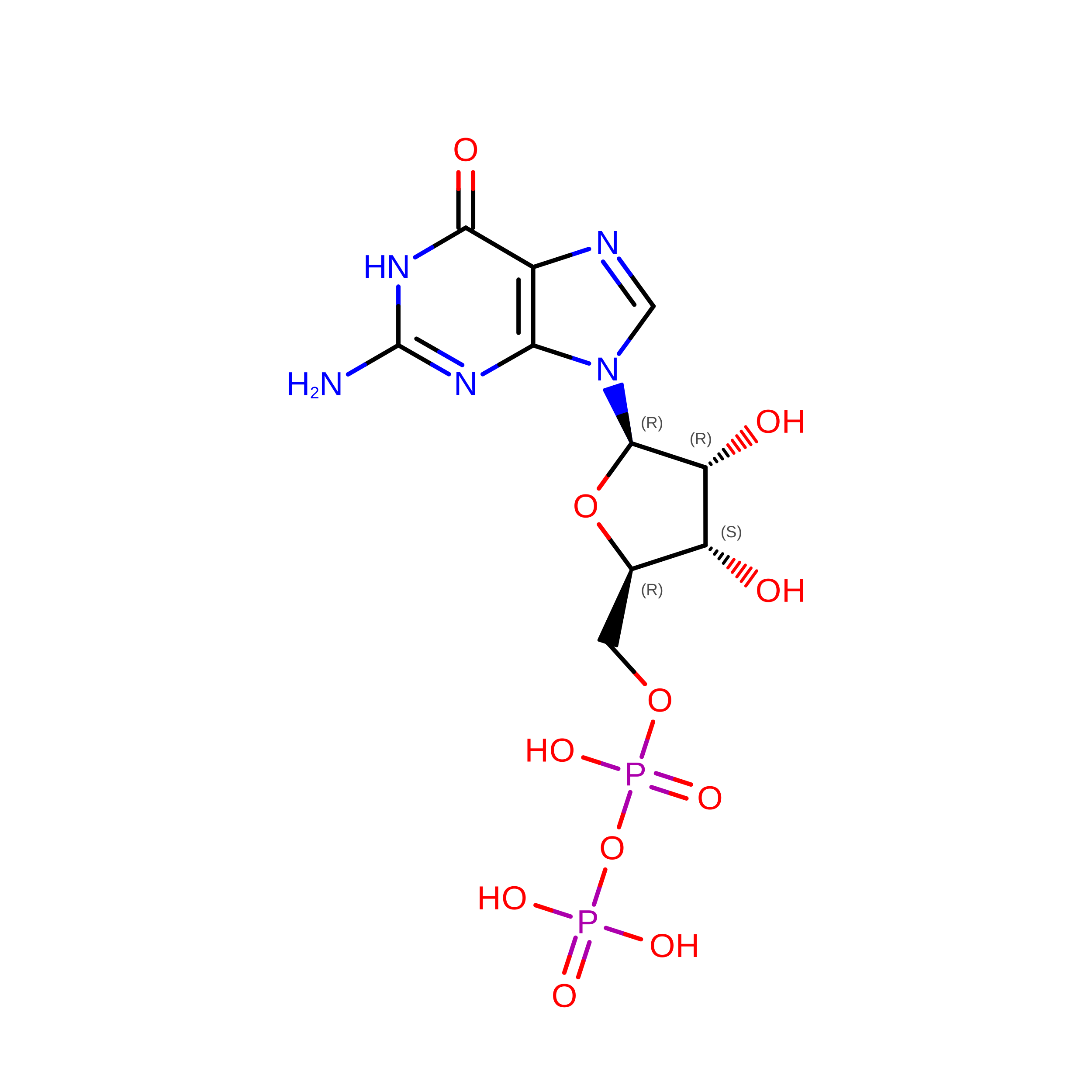
Structure of the crenarchaeal FtsY GTPase bound to GDP


Experimental Data Snapshot

  • Method: X-RAY DIFFRACTION
  • Resolution: 2.40 Å
  • R-Value Free: 
    0.217 (Depositor), 0.219 (DCC) 
  • R-Value Work: 
    0.171 (Depositor), 0.176 (DCC) 
  • R-Value Observed: 
    0.175 (Depositor) 

Starting Model: experimental
View more details

wwPDB Validation 3D Report Full Report

Validation slider image for 5L3W

Ligand Structure Quality Assessment 


This is version 1.2 of the entry. See complete history

Literature

Structural Basis for Conserved Regulation and Adaptation of the Signal Recognition Particle Targeting Complex.

Wild, K.Bange, G.Motiejunas, D.Kribelbauer, J.Hendricks, A.Segnitz, B.Wade, R.C.Sinning, I.

(2016) J Mol Biology 428: 2880-2897

  • DOI: https://doi.org/10.1016/j.jmb.2016.05.015
  • Primary Citation Related Structures: 
    5L3Q, 5L3R, 5L3S, 5L3V, 5L3W

  • PubMed Abstract: 

    The signal recognition particle (SRP) is a ribonucleoprotein complex with a key role in targeting and insertion of membrane proteins. The two SRP GTPases, SRP54 (Ffh in bacteria) and FtsY (SRα in eukaryotes), form the core of the targeting complex (TC) regulating the SRP cycle. The architecture of the TC and its stimulation by RNA has been described for the bacterial SRP system while this information is lacking for other domains of life. Here, we present the crystal structures of the GTPase heterodimers of archaeal (Sulfolobus solfataricus), eukaryotic (Homo sapiens), and chloroplast (Arabidopsis thaliana) SRP systems. The comprehensive structural comparison combined with Brownian dynamics simulations of TC formation allows for the description of the general blueprint and of specific adaptations of the quasi-symmetric heterodimer. Our work defines conserved external nucleotide-binding sites for SRP GTPase activation by RNA. Structural analyses of the GDP-bound, post-hydrolysis states reveal a conserved, magnesium-sensitive switch within the I-box. Overall, we provide a general model for SRP cycle regulation by RNA.


  • Organizational Affiliation
    • Heidelberg University Biochemistry Center (BZH), INF 328, D-69120 Heidelberg, Germany.

Macromolecule Content 

  • Total Structure Weight: 35.17 kDa 
  • Atom Count: 2,434 
  • Modeled Residue Count: 297 
  • Deposited Residue Count: 306 
  • Unique protein chains: 1

Macromolecules

Find similar proteins by:|  3D Structure
Entity ID: 1
MoleculeChains  Sequence LengthOrganismDetailsImage
Signal recognition particle receptor FtsY306Sulfolobus acidocaldariusMutation(s): 0 
Gene Names: ftsYATY89_10730ATZ20_02285
EC: 3.6.5.4
UniProt
Find proteins for P27414 (Sulfolobus acidocaldarius (strain ATCC 33909 / DSM 639 / JCM 8929 / NBRC 15157 / NCIMB 11770))
Explore P27414 
Go to UniProtKB:  P27414
Entity Groups
Sequence Clusters30% Identity50% Identity70% Identity90% Identity95% Identity100% Identity
UniProt GroupP27414
Sequence Annotations
Expand
Reference Sequence

Small Molecules

Experimental Data & Validation

Experimental Data

  • Method: X-RAY DIFFRACTION
  • Resolution: 2.40 Å
  • R-Value Free:  0.217 (Depositor), 0.219 (DCC) 
  • R-Value Work:  0.171 (Depositor), 0.176 (DCC) 
  • R-Value Observed: 0.175 (Depositor) 
Space Group: H 3
Unit Cell:
Length ( Å )Angle ( ˚ )
a = 144.906α = 90
b = 144.906β = 90
c = 49.723γ = 120
Software Package:
Software NamePurpose
PHENIXrefinement
iMOSFLMdata reduction
SCALAdata scaling
PHASERphasing

Structure Validation

View Full Validation Report


Ligand Structure Quality Assessment 


Entry History 

Deposition Data

Revision History  (Full details and data files)

  • Version 1.0: 2016-06-08
    Type: Initial release
  • Version 1.1: 2016-07-20
    Changes: Database references
  • Version 1.2: 2024-01-10
    Changes: Data collection, Database references, Refinement description