5KL8 | pdb_00005kl8

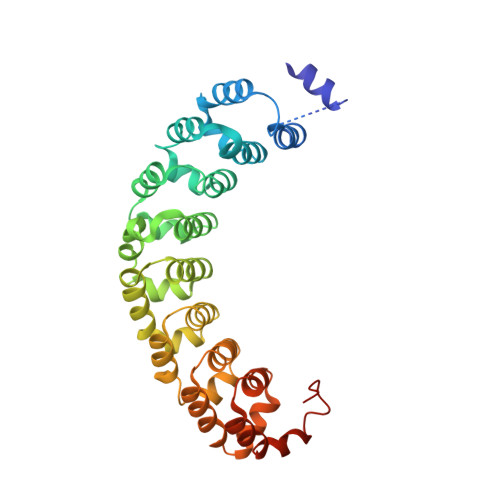
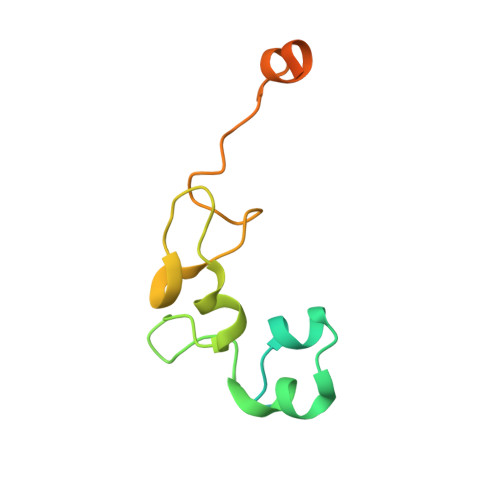
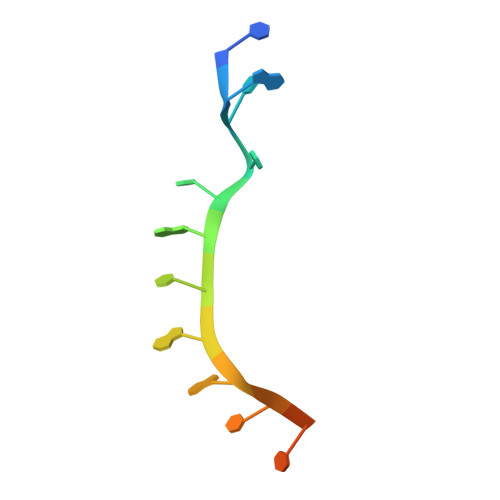
Crystal structure of the Pumilio-Nos-CyclinB RNA complex


Experimental Data Snapshot

  • Method: X-RAY DIFFRACTION
  • Resolution: 4.00 Å
  • R-Value Free: 
    0.312 (Depositor), 0.313 (DCC) 
  • R-Value Work: 
    0.283 (Depositor), 0.285 (DCC) 
  • R-Value Observed: 
    0.286 (Depositor) 

wwPDB Validation 3D Report Full Report

Validation slider image for 5KL8

This is version 1.2 of the entry. See complete history

Literature

Drosophila Nanos acts as a molecular clamp that modulates the RNA-binding and repression activities of Pumilio.

Weidmann, C.A.Qiu, C.Arvola, R.M.Lou, T.F.Killingsworth, J.Campbell, Z.T.Tanaka Hall, T.M.Goldstrohm, A.C.

(2016) Elife 5

  • DOI: https://doi.org/10.7554/eLife.17096
  • Primary Citation Related Structures: 
    5KL1, 5KL8, 5KLA

  • PubMed Abstract: 

    Collaboration among the multitude of RNA-binding proteins (RBPs) is ubiquitous, yet our understanding of these key regulatory complexes has been limited to single RBPs. We investigated combinatorial translational regulation by Drosophila Pumilio (Pum) and Nanos (Nos), which control development, fertility, and neuronal functions. Our results show how the specificity of one RBP (Pum) is modulated by cooperative RNA recognition with a second RBP (Nos) to synergistically repress mRNAs. Crystal structures of Nos-Pum-RNA complexes reveal that Nos embraces Pum and RNA, contributes sequence-specific contacts, and increases Pum RNA-binding affinity. Nos shifts the recognition sequence and promotes repression complex formation on mRNAs that are not stably bound by Pum alone, explaining the preponderance of sub-optimal Pum sites regulated in vivo. Our results illuminate the molecular mechanism of a regulatory switch controlling crucial gene expression programs, and provide a framework for understanding how the partnering of RBPs evokes changes in binding specificity that underlie regulatory network dynamics.


  • Organizational Affiliation
    • Department of Biological Chemistry, University of Michigan, Ann Arbor, United States.

Macromolecule Content 

  • Total Structure Weight: 56.29 kDa 
  • Atom Count: 3,247 
  • Modeled Residue Count: 389 
  • Deposited Residue Count: 466 
  • Unique protein chains: 2
  • Unique nucleic acid chains: 1

Macromolecules


Find similar proteins by:|  3D Structure
Entity ID: 1
MoleculeChains  Sequence LengthOrganismDetailsImage
Maternal protein pumilio337Drosophila melanogasterMutation(s): 0 
Gene Names: pumCG9755
UniProt
Find proteins for P25822 (Drosophila melanogaster)
Explore P25822 
Go to UniProtKB:  P25822
Entity Groups
Sequence Clusters30% Identity50% Identity70% Identity90% Identity95% Identity100% Identity
UniProt GroupP25822
Sequence Annotations
Expand
Reference Sequence
Find similar proteins by:|  3D Structure
Entity ID: 2
MoleculeChains  Sequence LengthOrganismDetailsImage
Protein nanos115Drosophila melanogasterMutation(s): 0 
Gene Names: nosCG5637
UniProt
Find proteins for P25724 (Drosophila melanogaster)
Explore P25724 
Go to UniProtKB:  P25724
Entity Groups
Sequence Clusters30% Identity50% Identity70% Identity90% Identity95% Identity100% Identity
UniProt GroupP25724
Sequence Annotations
Expand
Reference Sequence
Find similar nucleic acids by:  Sequence
Entity ID: 3
MoleculeChains LengthOrganismImage
RNA (5'-R(*UP*AP*UP*UP*UP*GP*UP*AP*AP*UP*U)-3')14Drosophila melanogaster
Sequence Annotations
Expand
Reference Sequence

Experimental Data & Validation

Experimental Data

  • Method: X-RAY DIFFRACTION
  • Resolution: 4.00 Å
  • R-Value Free:  0.312 (Depositor), 0.313 (DCC) 
  • R-Value Work:  0.283 (Depositor), 0.285 (DCC) 
  • R-Value Observed: 0.286 (Depositor) 
Space Group: P 65 2 2
Unit Cell:
Length ( Å )Angle ( ˚ )
a = 135.102α = 90
b = 135.102β = 90
c = 220.402γ = 120
Software Package:
Software NamePurpose
PHENIXrefinement
HKL-2000data reduction
HKL-2000data scaling
PHENIXphasing

Structure Validation

View Full Validation Report


Entry History 

Deposition Data

Revision History  (Full details and data files)

  • Version 1.0: 2016-08-17
    Type: Initial release
  • Version 1.1: 2016-08-24
    Changes: Database references
  • Version 1.2: 2024-03-06
    Changes: Data collection, Database references, Derived calculations