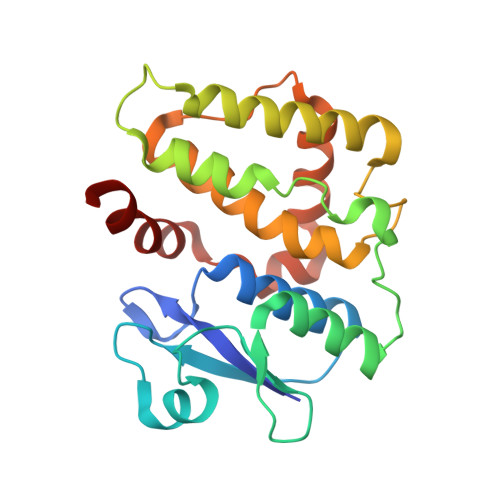
5IQY | pdb_00005iqy

Structure of apo-Dehydroascorbate Reductase from Pennisetum Glaucum phased by Iodide-SAD method


Experimental Data Snapshot

  • Method: X-RAY DIFFRACTION
  • Resolution: 2.40 Å
  • R-Value Free: 
    0.234 (Depositor), 0.249 (DCC) 
  • R-Value Work: 
    0.184 (Depositor), 0.191 (DCC) 
  • R-Value Observed: 
    0.188 (Depositor) 

wwPDB Validation 3D Report Full Report

Validation slider image for 5IQY

This is version 1.3 of the entry. See complete history. 

Literature

Non-native ligands define the active site of Pennisetum glaucum (L.) R. Br dehydroascorbate reductase

Das, B.K., Kumar, A., Maindola, P., Mahanty, S., Jain, S.K., Reddy, M.K., Arockiasamy, A.

(2016) Biochem Biophys Res Commun 473: 1152-1157

  • DOI: https://doi.org/10.1016/j.bbrc.2016.04.031
  • Primary Citation Related Structures: 
    5EVO, 5IQY

  • PubMed Abstract: 

    Dehydroascorbate reductase (DHAR), a member of the glutathione-S-transferase (GST) family, reduces dehydroascorbate (DHA) to ascorbate (AsA; Vitamin-C) in a glutathione (GSH)-dependent manner and in doing so, replenishes the critical AsA pool of the cell. To understand the enzyme mechanism in detail, we determined the crystal structure of a plant DHAR from Pennisetum glaucum (PgDHAR) using Iodide-Single Anomalous Dispersion (SAD) and Molecular replacement methods, in two different space groups. Here, we show PgDHAR in complex with two non-native ligands, viz. an acetate bound at the G-site, which resembles the γ-carboxyl moiety of GSH, and a glycerol at the H-site, which shares the backbone of AsA. We also show that, in the absence of bound native substrates, these non-native ligands help define the critical 'hook points' in the DHAR enzyme active site. Further, our data suggest that these non-native ligands can act as the logical bootstrapping points for iterative design of inhibitors/analogs for DHARs.


  • Organizational Affiliation: 
    • Membrane Protein Biology Group, ICGEB, Aruna Asaf Ali Marg, New Delhi, Delhi 110067, India; Department of Biotechnology, Jamia Hamdard University, New Delhi, Delhi, 110062, India.

Macromolecule Content 

  • Total Structure Weight: 27.03 kDa 
  • Atom Count: 1,719 
  • Modeled Residue Count: 211 
  • Deposited Residue Count: 216 
  • Unique protein chains: 1

Macromolecules

Find similar proteins by:|  3D Structure
Entity ID: 1
MoleculeChains  Sequence LengthOrganismDetailsImage
Dehydroascorbate reductase216Cenchrus americanusMutation(s): 0 
EC: 1.8.5.1
UniProt
Find proteins for U5XYA0 (Cenchrus americanus)
Explore U5XYA0 
Go to UniProtKB:  U5XYA0
Entity Groups
Sequence Clusters30% Identity50% Identity70% Identity90% Identity95% Identity100% Identity
UniProt GroupU5XYA0
Sequence Annotations
Expand
Reference Sequence

Small Molecules

Ligands 1 Unique
IDChains Name / Formula / InChI Key2D Diagram3D Interactions
IOD

Query on IOD


Download:Ideal Coordinates CCD File
AA [auth A]
B [auth A]
C [auth A]
D [auth A]
E [auth A]
AA [auth A],
B [auth A],
C [auth A],
D [auth A],
E [auth A],
F [auth A],
G [auth A],
H [auth A],
I [auth A],
J [auth A],
K [auth A],
L [auth A],
M [auth A],
N [auth A],
O [auth A],
P [auth A],
Q [auth A],
R [auth A],
S [auth A],
T [auth A],
U [auth A],
V [auth A],
W [auth A],
X [auth A],
Y [auth A],
Z [auth A]
IODIDE ION
I
XMBWDFGMSWQBCA-UHFFFAOYSA-M

Experimental Data & Validation

Experimental Data

  • Method: X-RAY DIFFRACTION
  • Resolution: 2.40 Å
  • R-Value Free:  0.234 (Depositor), 0.249 (DCC) 
  • R-Value Work:  0.184 (Depositor), 0.191 (DCC) 
  • R-Value Observed: 0.188 (Depositor) 
Space Group: C 2 2 21
Unit Cell:
Length ( Å )Angle ( ˚ )
a = 40.89α = 90
b = 132.08β = 90
c = 97.57γ = 90
Software Package:
Software NamePurpose
BUSTERrefinement
iMOSFLMdata reduction
Aimlessdata scaling
SHELXCDphasing

Structure Validation

View Full Validation Report


Entry History 

& Funding Information

Deposition Data


Funding OrganizationLocationGrant Number
DBTIndia--

Revision History  (Full details and data files)

  • Version 1.0: 2016-05-04
    Type: Initial release
  • Version 1.1: 2016-05-18
    Changes: Database references
  • Version 1.2: 2017-10-04
    Changes: Data collection, Database references, Derived calculations
  • Version 1.3: 2024-03-20
    Changes: Data collection, Database references