5EVO | pdb_00005evo

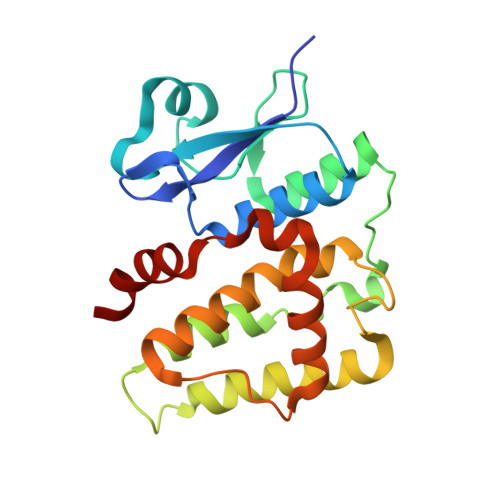
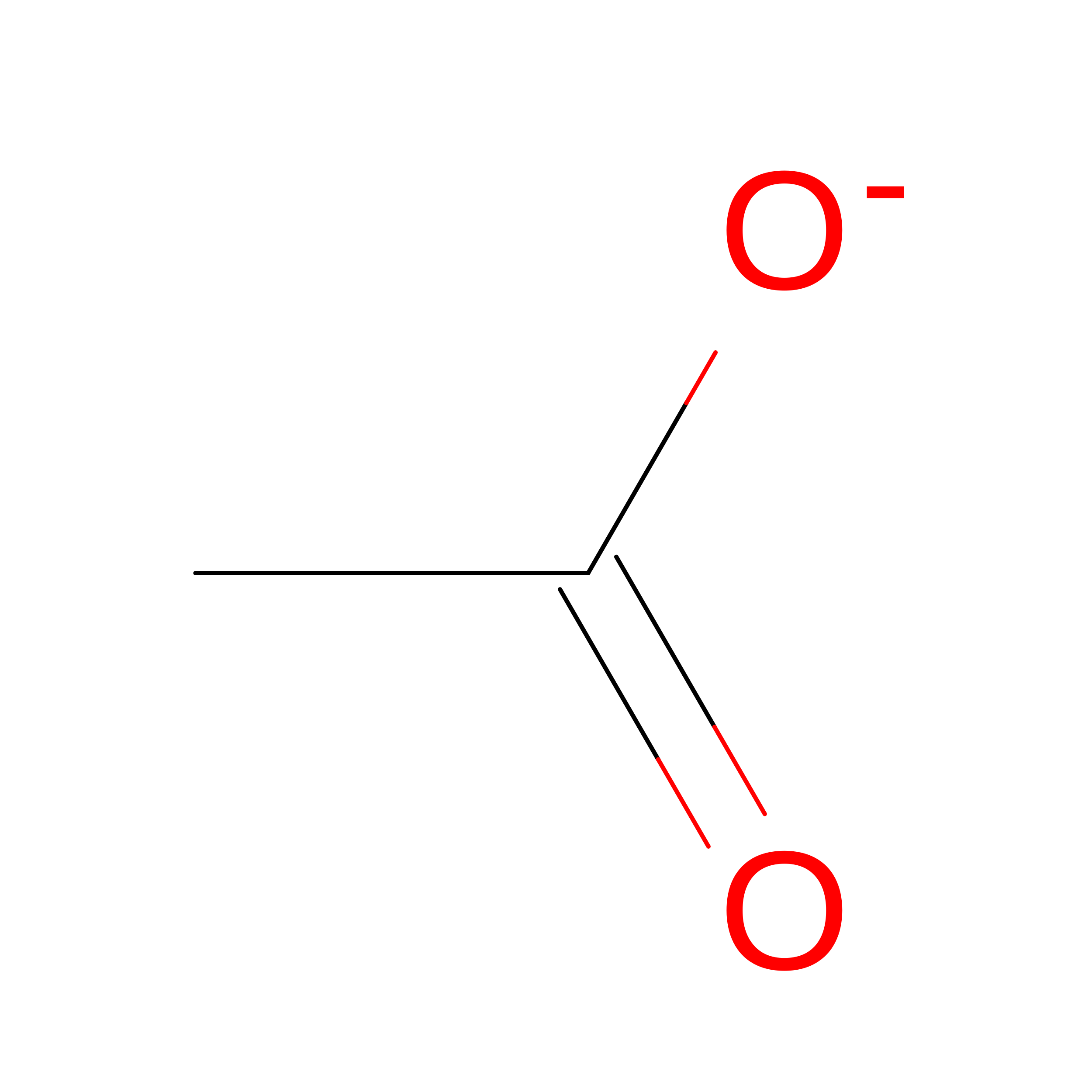
Structure of Dehydroascrobate Reductase from Pennisetum Americanum in complex with two non-native ligands, Acetate in the G-site and Glycerol in the H-site


Experimental Data Snapshot

  • Method: X-RAY DIFFRACTION
  • Resolution: 2.51 Å
  • R-Value Free: 
    0.241 (Depositor), 0.242 (DCC) 
  • R-Value Work: 
    0.196 (Depositor), 0.194 (DCC) 
  • R-Value Observed: 
    0.198 (Depositor) 

wwPDB Validation 3D Report Full Report

Validation slider image for 5EVO

This is version 1.2 of the entry. See complete history

Literature

Non-native ligands define the active site of Pennisetum glaucum (L.) R. Br dehydroascorbate reductase.

Krishna Das, B.Kumar, A.Maindola, P.Mahanty, S.Jain, S.K.Reddy, M.K.Arockiasamy, A.

(2016) Biochem Biophys Res Commun 473: 1152-1157

  • DOI: https://doi.org/10.1016/j.bbrc.2016.04.031
  • Primary Citation Related Structures: 
    5EVO, 5IQY

  • PubMed Abstract: 

    Dehydroascorbate reductase (DHAR), a member of the glutathione-S-transferase (GST) family, reduces dehydroascorbate (DHA) to ascorbate (AsA; Vitamin-C) in a glutathione (GSH)-dependent manner and in doing so, replenishes the critical AsA pool of the cell. To understand the enzyme mechanism in detail, we determined the crystal structure of a plant DHAR from Pennisetum glaucum (PgDHAR) using Iodide-Single Anomalous Dispersion (SAD) and Molecular replacement methods, in two different space groups. Here, we show PgDHAR in complex with two non-native ligands, viz. an acetate bound at the G-site, which resembles the γ-carboxyl moiety of GSH, and a glycerol at the H-site, which shares the backbone of AsA. We also show that, in the absence of bound native substrates, these non-native ligands help define the critical 'hook points' in the DHAR enzyme active site. Further, our data suggest that these non-native ligands can act as the logical bootstrapping points for iterative design of inhibitors/analogs for DHARs.


  • Organizational Affiliation
    • Membrane Protein Biology Group, ICGEB, Aruna Asaf Ali Marg, New Delhi, Delhi 110067, India; Department of Biotechnology, Jamia Hamdard University, New Delhi, Delhi, 110062, India.

Macromolecule Content 

  • Total Structure Weight: 23.88 kDa 
  • Atom Count: 1,705 
  • Modeled Residue Count: 213 
  • Deposited Residue Count: 216 
  • Unique protein chains: 1

Macromolecules

Find similar proteins by:|  3D Structure
Entity ID: 1
MoleculeChains  Sequence LengthOrganismDetailsImage
Dehydroascorbate reductase216Cenchrus americanusMutation(s): 0 
EC: 1.8.5.1
UniProt
Find proteins for U5XYA0 (Cenchrus americanus)
Explore U5XYA0 
Go to UniProtKB:  U5XYA0
Entity Groups
Sequence Clusters30% Identity50% Identity70% Identity90% Identity95% Identity100% Identity
UniProt GroupU5XYA0
Sequence Annotations
Expand
Reference Sequence

Experimental Data & Validation

Experimental Data

  • Method: X-RAY DIFFRACTION
  • Resolution: 2.51 Å
  • R-Value Free:  0.241 (Depositor), 0.242 (DCC) 
  • R-Value Work:  0.196 (Depositor), 0.194 (DCC) 
  • R-Value Observed: 0.198 (Depositor) 
Space Group: P 43 2 2
Unit Cell:
Length ( Å )Angle ( ˚ )
a = 69.494α = 90
b = 69.494β = 90
c = 111.557γ = 90
Software Package:
Software NamePurpose
BUSTERrefinement
HKL-2000data reduction
HKL-2000data scaling
BALBESphasing

Structure Validation

View Full Validation Report


Entry History 

Deposition Data

Revision History  (Full details and data files)

  • Version 1.0: 2016-05-04
    Type: Initial release
  • Version 1.1: 2017-10-04
    Changes: Data collection, Database references, Derived calculations
  • Version 1.2: 2024-03-20
    Changes: Data collection, Database references