5I4Z | pdb_00005i4z

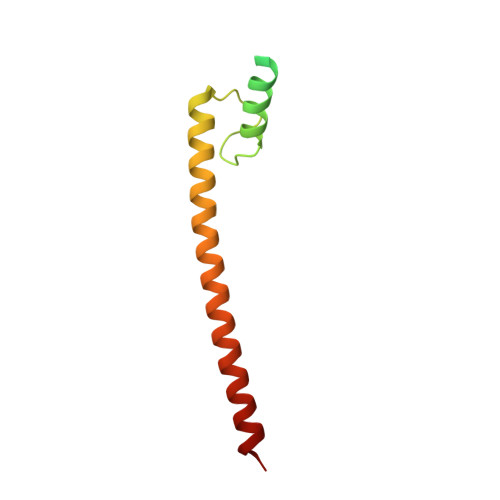
Structure of apo OmoMYC


Experimental Data Snapshot

  • Method: X-RAY DIFFRACTION
  • Resolution: 1.95 Å
  • R-Value Free: 
    0.194 (Depositor), 0.195 (DCC) 
  • R-Value Work: 
    0.173 (Depositor), 0.180 (DCC) 
  • R-Value Observed: 
    0.174 (Depositor) 

Starting Model: experimental
View more details

wwPDB Validation 3D Report Full Report

Validation slider image for 5I4Z

This is version 1.3 of the entry. See complete history

Literature

OmoMYC blunts promoter invasion by oncogenic MYC to inhibit gene expression characteristic of MYC-dependent tumors.

Jung, L.A.Gebhardt, A.Koelmel, W.Ade, C.P.Walz, S.Kuper, J.von Eyss, B.Letschert, S.Redel, C.d'Artista, L.Biankin, A.Zender, L.Sauer, M.Wolf, E.Evan, G.Kisker, C.Eilers, M.

(2017) Oncogene 36: 1911-1924

  • DOI: https://doi.org/10.1038/onc.2016.354
  • Primary Citation Related Structures: 
    5I4Z, 5I50

  • PubMed Abstract: 

    MYC genes have both essential roles during normal development and exert oncogenic functions during tumorigenesis. Expression of a dominant-negative allele of MYC, termed OmoMYC, can induce rapid tumor regression in mouse models with little toxicity for normal tissues. How OmoMYC discriminates between physiological and oncogenic functions of MYC is unclear. We have solved the crystal structure of OmoMYC and show that it forms a stable homodimer and as such recognizes DNA in the same manner as the MYC/MAX heterodimer. OmoMYC attenuates both MYC-dependent activation and repression by competing with MYC/MAX for binding to chromatin, effectively lowering MYC/MAX occupancy at its cognate binding sites. OmoMYC causes the largest decreases in promoter occupancy and changes in expression on genes that are invaded by oncogenic MYC levels. A signature of OmoMYC-regulated genes defines subgroups with high MYC levels in multiple tumor entities and identifies novel targets for the eradication of MYC-driven tumors.


  • Organizational Affiliation
    • Theodor Boveri Institute, Biocenter, University of Würzburg, Würzburg, Germany.

Macromolecule Content 

  • Total Structure Weight: 28.53 kDa 
  • Atom Count: 1,390 
  • Modeled Residue Count: 148 
  • Deposited Residue Count: 236 
  • Unique protein chains: 1

Macromolecules

Find similar proteins by:|  3D Structure
Entity ID: 1
MoleculeChains  Sequence LengthOrganismDetailsImage
Myc proto-oncogene protein
A, B
118Homo sapiensMutation(s): 4 
Gene Names: MYCBHLHE39
UniProt & NIH Common Fund Data Resources
Find proteins for P01106 (Homo sapiens)
Explore P01106 
Go to UniProtKB:  P01106
PHAROS:  P01106
GTEx:  ENSG00000136997 
Entity Groups
Sequence Clusters30% Identity50% Identity70% Identity90% Identity95% Identity100% Identity
UniProt GroupP01106
Sequence Annotations
Expand
Reference Sequence

Small Molecules

Ligands 3 Unique
IDChains Name / Formula / InChI Key2D Diagram3D Interactions
GOL

Query on GOL


Download:Ideal Coordinates CCD File
C [auth A],
D [auth A],
G [auth B]
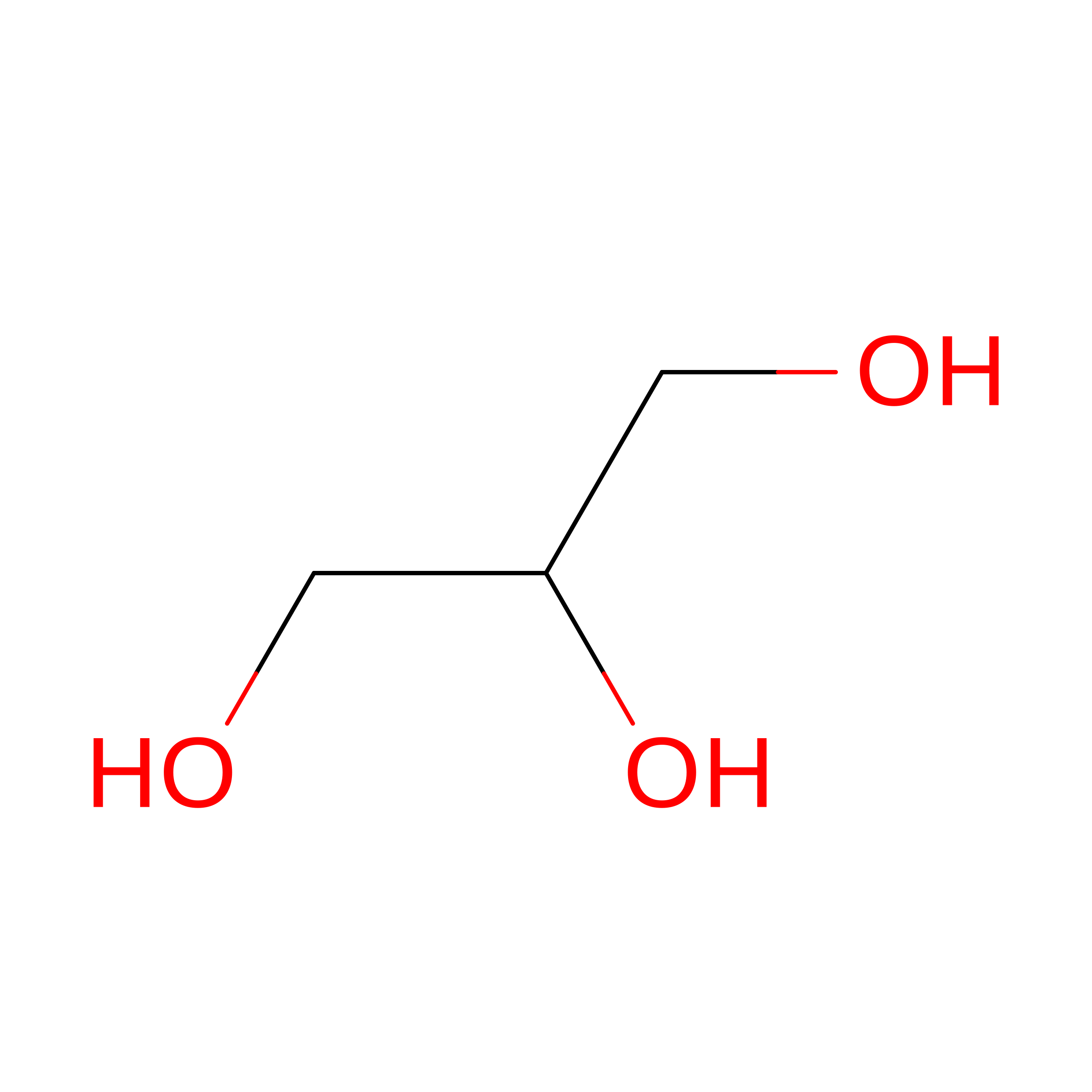
GLYCEROL
C3 H8 O3
PEDCQBHIVMGVHV-UHFFFAOYSA-N
K

Query on K


Download:Ideal Coordinates CCD File
I [auth B],
J [auth B]
POTASSIUM ION
K
NPYPAHLBTDXSSS-UHFFFAOYSA-N
CL

Query on CL


Download:Ideal Coordinates CCD File
E [auth A],
F [auth A],
H [auth B]
CHLORIDE ION
Cl
VEXZGXHMUGYJMC-UHFFFAOYSA-M

Experimental Data & Validation

Experimental Data

  • Method: X-RAY DIFFRACTION
  • Resolution: 1.95 Å
  • R-Value Free:  0.194 (Depositor), 0.195 (DCC) 
  • R-Value Work:  0.173 (Depositor), 0.180 (DCC) 
  • R-Value Observed: 0.174 (Depositor) 
Space Group: P 41 2 2
Unit Cell:
Length ( Å )Angle ( ˚ )
a = 65.7α = 90
b = 65.7β = 90
c = 149.5γ = 90
Software Package:
Software NamePurpose
XDSdata reduction
XDSdata scaling
PHASERphasing
PHENIXrefinement

Structure Validation

View Full Validation Report


Entry History 

& Funding Information

Deposition Data


Funding OrganizationLocationGrant Number
German Research FoundationGermany2341

Revision History  (Full details and data files)

  • Version 1.0: 2016-10-26
    Type: Initial release
  • Version 1.1: 2017-04-19
    Changes: Database references
  • Version 1.2: 2024-01-10
    Changes: Author supporting evidence, Data collection, Database references, Derived calculations, Refinement description
  • Version 1.3: 2024-11-20
    Changes: Structure summary