5HJ3 | pdb_00005hj3

Crystal structure of host-primed Ebola virus GP, GPcl.


Experimental Data Snapshot

  • Method: X-RAY DIFFRACTION
  • Resolution: 3.30 Å
  • R-Value Free: 
    0.258 (Depositor), 0.267 (DCC) 
  • R-Value Work: 
    0.227 (Depositor), 0.239 (DCC) 
  • R-Value Observed: 
    0.228 (Depositor) 

wwPDB Validation 3D Report Full Report

Validation slider image for 5HJ3

This is version 2.1 of the entry. See complete history

Literature

Host-Primed Ebola Virus GP Exposes a Hydrophobic NPC1 Receptor-Binding Pocket, Revealing a Target for Broadly Neutralizing Antibodies.

Bornholdt, Z.A.Ndungo, E.Fusco, M.L.Bale, S.Flyak, A.I.Crowe, J.E.Chandran, K.Saphire, E.O.

(2016) mBio 7: e02154-e02115

  • DOI: https://doi.org/10.1128/mBio.02154-15
  • Primary Citation Related Structures: 
    5HJ3

  • PubMed Abstract: 

    The filovirus surface glycoprotein (GP) mediates viral entry into host cells. Following viral internalization into endosomes, GP is cleaved by host cysteine proteases to expose a receptor-binding site (RBS) that is otherwise hidden from immune surveillance. Here, we present the crystal structure of proteolytically cleaved Ebola virus GP to a resolution of 3.3 Å. We use this structure in conjunction with functional analysis of a large panel of pseudotyped viruses bearing mutant GP proteins to map the Ebola virus GP endosomal RBS at molecular resolution. Our studies indicate that binding of GP to its endosomal receptor Niemann-Pick C1 occurs in two distinct stages: the initial electrostatic interactions are followed by specific interactions with a hydrophobic trough that is exposed on the endosomally cleaved GP1 subunit. Finally, we demonstrate that monoclonal antibodies targeting the filovirus RBS neutralize all known filovirus GPs, making this conserved pocket a promising target for the development of panfilovirus therapeutics. Ebola virus uses its glycoprotein (GP) to enter new host cells. During entry, GP must be cleaved by human enzymes in order for receptor binding to occur. Here, we provide the crystal structure of the cleaved form of Ebola virus GP. We demonstrate that cleavage exposes a site at the top of GP and that this site binds the critical domain C of the receptor, termed Niemann-Pick C1 (NPC1). We perform mutagenesis to find parts of the site essential for binding NPC1 and map distinct roles for an upper, charged crest and lower, hydrophobic trough in cleaved GP. We find that this 3-dimensional site is conserved across the filovirus family and that antibody directed against this site is able to bind cleaved GP from every filovirus tested and neutralize viruses bearing those GPs.


  • Organizational Affiliation
    • Department of Immunology and Microbial Science, The Scripps Research Institute, La Jolla, California, USA.

Macromolecule Content 

  • Total Structure Weight: 336.37 kDa 
  • Atom Count: 20,876 
  • Modeled Residue Count: 2,680 
  • Deposited Residue Count: 3,032 
  • Unique protein chains: 4

Macromolecules

Find similar proteins by:|  3D Structure
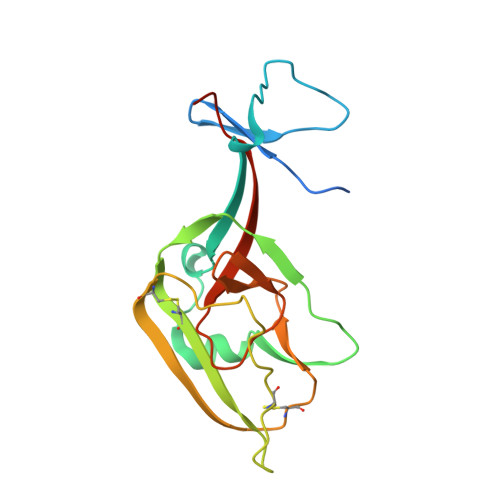
Entity ID: 1
MoleculeChains  Sequence LengthOrganismDetailsImage
Envelope glycoproteinA [auth C],
E [auth G],
I [auth K],
M [auth O]
179Orthoebolavirus sp.Mutation(s): 0 
Gene Names: GP
UniProt
Find proteins for Q05320 (Zaire ebolavirus (strain Mayinga-76))
Explore Q05320 
Go to UniProtKB:  Q05320
Entity Groups
Sequence Clusters30% Identity50% Identity70% Identity90% Identity95% Identity100% Identity
UniProt GroupQ05320
Sequence Annotations
Expand
Reference Sequence
Find similar proteins by:|  3D Structure
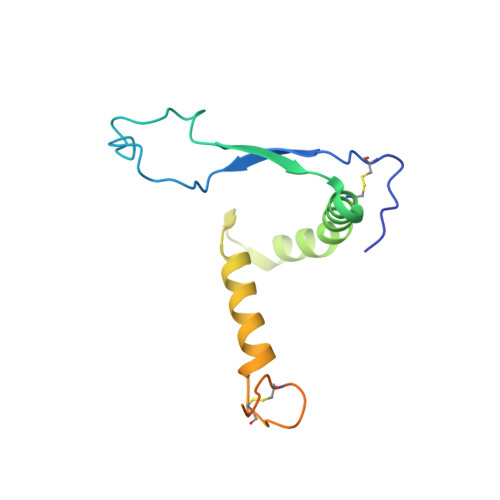
Entity ID: 2
MoleculeChains  Sequence LengthOrganismDetailsImage
Envelope glycoproteinB [auth D],
F [auth H],
J [auth L],
N [auth P]
136Ebola virus - Zaire (1995)Mutation(s): 0 
Gene Names: GP
UniProt
Find proteins for P87666 (Zaire ebolavirus (strain Kikwit-95))
Explore P87666 
Go to UniProtKB:  P87666
Entity Groups
Sequence Clusters30% Identity50% Identity70% Identity90% Identity95% Identity100% Identity
UniProt GroupP87666
Glycosylation
Glycosylation Sites: 1
Sequence Annotations
Expand
Reference Sequence
Find similar proteins by:|  3D Structure
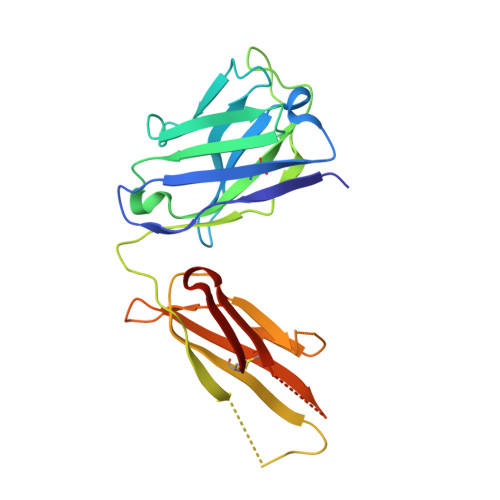
Entity ID: 3
MoleculeChains  Sequence LengthOrganismDetailsImage
KZ52 Antibody FragmentC [auth E],
G [auth I],
K [auth M],
O [auth A]
226Homo sapiensMutation(s): 0 
Find similar proteins by:|  3D Structure
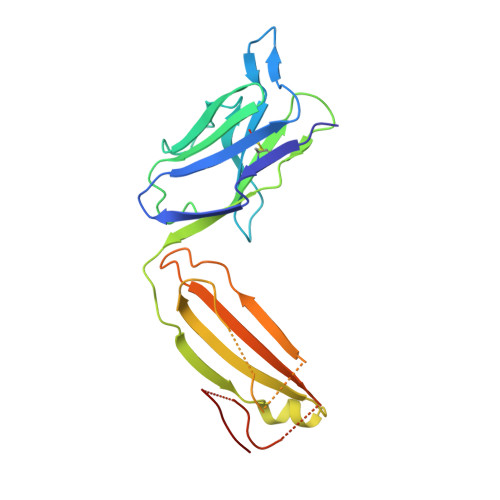
Entity ID: 4
MoleculeChains  Sequence LengthOrganismDetailsImage
KZ52 Antibody FragmentD [auth F],
H [auth J],
L [auth N],
P [auth B]
217Homo sapiensMutation(s): 0 

Oligosaccharides

Help  
Entity ID: 5
MoleculeChains Length2D Diagram GlycosylationD Interactions
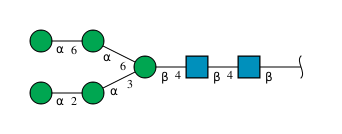
alpha-D-mannopyranose-(1-2)-alpha-D-mannopyranose-(1-3)-[alpha-D-mannopyranose-(1-6)-alpha-D-mannopyranose-(1-6)]beta-D-mannopyranose-(1-4)-2-acetamido-2-deoxy-beta-D-glucopyranose-(1-4)-2-acetamido-2-deoxy-beta-D-glucopyranose
Q, R, S, T
7N-Glycosylation
Glycosylation Resources
GlyTouCan: G23799GS
GlyCosmos: G23799GS
GlyGen: G23799GS

Experimental Data & Validation

Experimental Data

  • Method: X-RAY DIFFRACTION
  • Resolution: 3.30 Å
  • R-Value Free:  0.258 (Depositor), 0.267 (DCC) 
  • R-Value Work:  0.227 (Depositor), 0.239 (DCC) 
  • R-Value Observed: 0.228 (Depositor) 
Space Group: H 3
Unit Cell:
Length ( Å )Angle ( ˚ )
a = 193.103α = 90
b = 193.103β = 90
c = 350.32γ = 120
Software Package:
Software NamePurpose
PHENIXrefinement
d*TREKdata scaling
PHASERphasing
PDB_EXTRACTdata extraction
d*TREKdata reduction

Structure Validation

View Full Validation Report


Entry History 

Deposition Data

Revision History  (Full details and data files)

  • Version 1.0: 2016-03-09
    Type: Initial release
  • Version 1.1: 2016-05-04
    Changes: Database references
  • Version 2.0: 2020-07-29
    Type: Remediation
    Reason: Carbohydrate remediation
    Changes: Atomic model, Data collection, Derived calculations, Structure summary
  • Version 2.1: 2024-10-30
    Changes: Data collection, Database references, Derived calculations, Structure summary