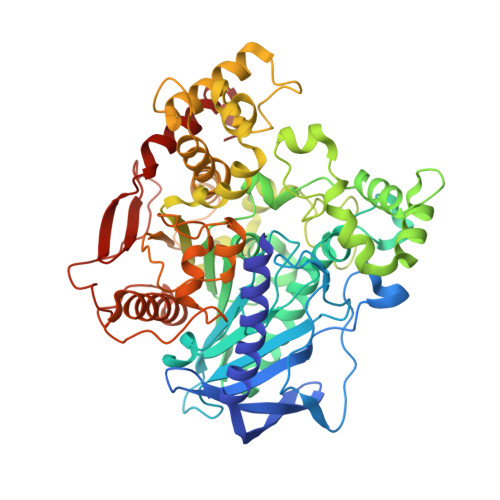
5C8V | pdb_00005c8v

Lucilia cuprina alpha esterase 7: Gly137Asp


Experimental Data Snapshot

  • Method: X-RAY DIFFRACTION
  • Resolution: 2.01 Å
  • R-Value Free: 
    0.245 (Depositor), 0.245 (DCC) 
  • R-Value Work: 
    0.185 (Depositor), 0.192 (DCC) 
  • R-Value Observed: 
    0.188 (Depositor) 

Starting Model: experimental
View more details

wwPDB Validation 3D Report Full Report

Validation slider image for 5C8V

This is version 1.2 of the entry. See complete history

Literature

Conformational Disorganization within the Active Site of a Recently Evolved Organophosphate Hydrolase Limits Its Catalytic Efficiency.

Mabbitt, P.D.Correy, G.J.Meirelles, T.Fraser, N.J.Coote, M.L.Jackson, C.J.

(2016) Biochemistry 55: 1408-1417

  • DOI: https://doi.org/10.1021/acs.biochem.5b01322
  • Primary Citation Related Structures: 
    5C8V

  • PubMed Abstract: 

    The evolution of new enzymatic activity is rarely observed outside of the laboratory. In the agricultural pest Lucilia cuprina, a naturally occurring mutation (Gly137Asp) in α-esterase 7 (LcαE7) results in acquisition of organophosphate hydrolase activity and confers resistance to organophosphate insecticides. Here, we present an X-ray crystal structure of LcαE7:Gly137Asp that, along with kinetic data, suggests that Asp137 acts as a general base in the new catalytic mechanism. Unexpectedly, the conformation of Asp137 observed in the crystal structure obstructs the active site and is not catalytically productive. Molecular dynamics simulations reveal that alternative, catalytically competent conformers of Asp137 are sampled on the nanosecond time scale, although these states are less populated. Thus, although the mutation introduces the new reactive group responsible for organophosphate detoxification, the catalytic efficiency appears to be limited by conformational disorganization: the frequent sampling of low-energy nonproductive states. This result is consistent with a model of molecular evolution in which initial function-changing mutations can result in enzymes that display only a fraction of their catalytic potential due to conformational disorganization.


  • Organizational Affiliation
    • Research School of Chemistry, Australian National University , Acton 2601, Canberra, Australia.

Macromolecule Content 

  • Total Structure Weight: 65.49 kDa 
  • Atom Count: 4,795 
  • Modeled Residue Count: 566 
  • Deposited Residue Count: 570 
  • Unique protein chains: 1

Macromolecules

Find similar proteins by:|  3D Structure
Entity ID: 1
MoleculeChains  Sequence LengthOrganismDetailsImage
Carboxylic ester hydrolase570Lucilia cuprinaMutation(s): 8 
Gene Names: LcaE7
EC: 3.1.1
UniProt
Find proteins for Q25252 (Lucilia cuprina)
Explore Q25252 
Go to UniProtKB:  Q25252
Entity Groups
Sequence Clusters30% Identity50% Identity70% Identity90% Identity95% Identity100% Identity
UniProt GroupQ25252
Sequence Annotations
Expand
Reference Sequence

Experimental Data & Validation

Experimental Data

  • Method: X-RAY DIFFRACTION
  • Resolution: 2.01 Å
  • R-Value Free:  0.245 (Depositor), 0.245 (DCC) 
  • R-Value Work:  0.185 (Depositor), 0.192 (DCC) 
  • R-Value Observed: 0.188 (Depositor) 
Space Group: C 2 2 21
Unit Cell:
Length ( Å )Angle ( ˚ )
a = 49.674α = 90
b = 102.583β = 90
c = 225.476γ = 90
Software Package:
Software NamePurpose
REFMACrefinement
XDSdata reduction
XSCALEdata scaling
Aimlessdata scaling

Structure Validation

View Full Validation Report


Entry History 

Deposition Data

Revision History  (Full details and data files)

  • Version 1.0: 2016-03-09
    Type: Initial release
  • Version 1.1: 2016-03-16
    Changes: Database references
  • Version 1.2: 2023-09-27
    Changes: Data collection, Database references, Derived calculations, Refinement description