Download Mendeley
Active-Site Plasticity Is Essential to Carbapenem Hydrolysis by OXA-58 Class D beta-Lactamase of Acinetobacter baumannii.
Pratap, S., Katiki, M., Gill, P., Kumar, P., Golemi-Kotra, D.(2015) Antimicrob Agents Chemother 60: 75-86
- PubMed: 26459904 Search on PubMedSearch on PubMed Central
- DOI: https://doi.org/10.1128/AAC.01393-15
- Primary Citation Related Structures:
4Y0O, 4Y0T, 4Y0U - PubMed Abstract:
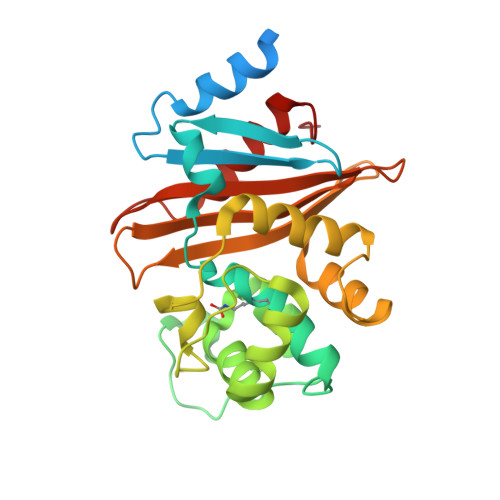
Carbapenem-hydrolyzing class D β-lactamases (CHDLs) are a subgroup of class D β-lactamases, which are enzymes that hydrolyze β-lactams. They have attracted interest due to the emergence of multidrug-resistant Acinetobacter baumannii, which is not responsive to treatment with carbapenems, the usual antibiotics of choice for this bacterium. Unlike other class D β-lactamases, these enzymes efficiently hydrolyze carbapenem antibiotics. To explore the structural requirements for the catalysis of carbapenems by these enzymes, we determined the crystal structure of the OXA-58 CHDL of A. baumannii following acylation of its active-site serine by a 6α-hydroxymethyl penicillin derivative that is a structural mimetic for a carbapenem. In addition, several point mutation variants of the active site of OXA-58, as identified by the crystal structure analysis, were characterized kinetically. These combined studies confirm the mechanistic relevance of a hydrophobic bridge formed over the active site. This structural feature is suggested to stabilize the hydrolysis-productive acyl-enzyme species formed from the carbapenem substrates of this enzyme. Furthermore, our structural studies provide strong evidence that the hydroxyethyl group of carbapenems samples different orientations in the active sites of CHDLs, and the optimum orientation for catalysis depends on the topology of the active site allowing proper closure of the active site. We propose that CHDLs use the plasticity of the active site to drive the mechanism of carbapenem hydrolysis toward efficiency.
- Department of Biotechnology, Indian Institute of Technology Roorkee, Roorkee, Uttarakhand, India.
Organizational Affiliation: