4XTB | pdb_00004xtb

Crystal structure of the N-terminal domain of the human mitochondrial calcium uniporter


Experimental Data Snapshot

  • Method: X-RAY DIFFRACTION
  • Resolution: 1.50 Å
  • R-Value Free: 
    0.176 (Depositor), 0.185 (DCC) 
  • R-Value Work: 
    0.140 (Depositor) 
  • R-Value Observed: 
    0.142 (Depositor) 

Starting Model: experimental
View more details

wwPDB Validation 3D Report Full Report

Validation slider image for 4XTB

This is version 1.3 of the entry. See complete history

Literature

Structure and function of the N-terminal domain of the human mitochondrial calcium uniporter.

Lee, Y.Min, C.K.Kim, T.G.Song, H.K.Lim, Y.Kim, D.Shin, K.Kang, M.Kang, J.Y.Youn, H.S.Lee, J.G.An, J.Y.Park, K.R.Lim, J.J.Kim, J.H.Kim, J.H.Park, Z.Y.Kim, Y.S.Wang, J.Kim, D.H.Eom, S.H.

(2015) EMBO Rep 16: 1318-1333

  • DOI: https://doi.org/10.15252/embr.201540436
  • Primary Citation Related Structures: 
    4XSJ, 4XTB, 5BZ6

  • PubMed Abstract: 

    The mitochondrial calcium uniporter (MCU) is responsible for mitochondrial calcium uptake and homeostasis. It is also a target for the regulation of cellular anti-/pro-apoptosis and necrosis by several oncogenes and tumour suppressors. Herein, we report the crystal structure of the MCU N-terminal domain (NTD) at a resolution of 1.50 Å in a novel fold and the S92A MCU mutant at 2.75 Å resolution; the residue S92 is a predicted CaMKII phosphorylation site. The assembly of the mitochondrial calcium uniporter complex (uniplex) and the interaction with the MCU regulators such as the mitochondrial calcium uptake-1 and mitochondrial calcium uptake-2 proteins (MICU1 and MICU2) are not affected by the deletion of MCU NTD. However, the expression of the S92A mutant or a NTD deletion mutant failed to restore mitochondrial Ca(2+) uptake in a stable MCU knockdown HeLa cell line and exerted dominant-negative effects in the wild-type MCU-expressing cell line. These results suggest that the NTD of MCU is essential for the modulation of MCU function, although it does not affect the uniplex formation.


  • Organizational Affiliation
    • School of Life Sciences, Gwangju Institute of Science and Technology (GIST), Gwangju, Korea Steitz Center for Structural Biology, Gwangju Institute of Science and Technology (GIST), Gwangju, Korea.

Macromolecule Content 

  • Total Structure Weight: 14.28 kDa 
  • Atom Count: 1,030 
  • Modeled Residue Count: 109 
  • Deposited Residue Count: 123 
  • Unique protein chains: 1

Macromolecules

Find similar proteins by:|  3D Structure
Entity ID: 1
MoleculeChains  Sequence LengthOrganismDetailsImage
Calcium uniporter protein, mitochondrial123Homo sapiensMutation(s): 0 
Gene Names: MCUC10orf42CCDC109A
UniProt & NIH Common Fund Data Resources
Find proteins for Q8NE86 (Homo sapiens)
Explore Q8NE86 
Go to UniProtKB:  Q8NE86
PHAROS:  Q8NE86
GTEx:  ENSG00000156026 
Entity Groups
Sequence Clusters30% Identity50% Identity70% Identity90% Identity95% Identity100% Identity
UniProt GroupQ8NE86
Sequence Annotations
Expand
Reference Sequence

Small Molecules

Ligands 1 Unique
IDChains Name / Formula / InChI Key2D Diagram3D Interactions
PG4

Query on PG4


Download:Ideal Coordinates CCD File
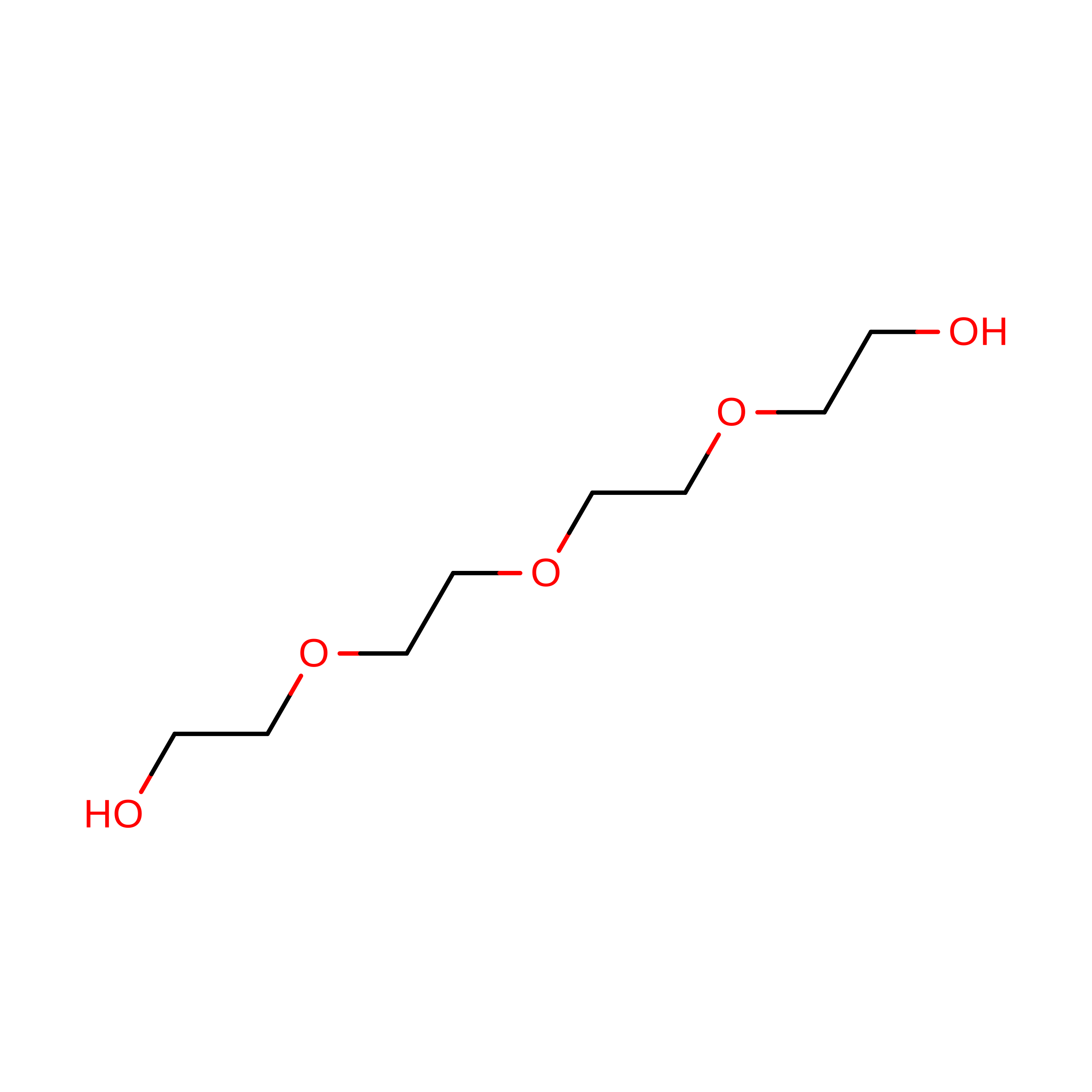
B [auth A]TETRAETHYLENE GLYCOL
C8 H18 O5
UWHCKJMYHZGTIT-UHFFFAOYSA-N

Experimental Data & Validation

Experimental Data

  • Method: X-RAY DIFFRACTION
  • Resolution: 1.50 Å
  • R-Value Free:  0.176 (Depositor), 0.185 (DCC) 
  • R-Value Work:  0.140 (Depositor) 
  • R-Value Observed: 0.142 (Depositor) 
Space Group: P 65
Unit Cell:
Length ( Å )Angle ( ˚ )
a = 55.463α = 90
b = 55.463β = 90
c = 68.929γ = 120
Software Package:
Software NamePurpose
REFMACrefinement
HKL-2000data processing
Cootmodel building

Structure Validation

View Full Validation Report


Entry History 

Revision History  (Full details and data files)

  • Version 1.0: 2015-09-16
    Type: Initial release
  • Version 1.1: 2015-09-23
    Changes: Other
  • Version 1.2: 2015-10-14
    Changes: Database references
  • Version 1.3: 2023-11-08
    Changes: Data collection, Database references, Derived calculations, Refinement description