4XL4 | pdb_00004xl4

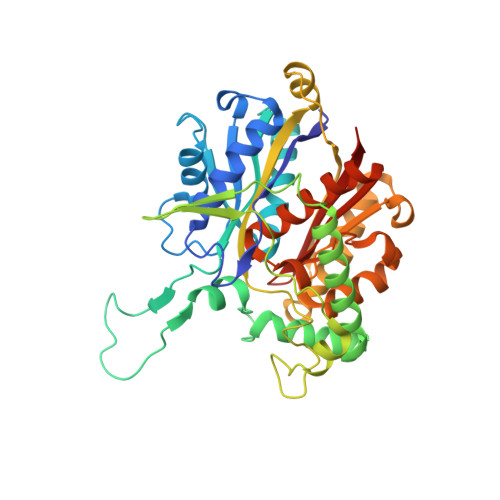
Crystal structure of thiolase from Clostridium acetobutylicum in complex with CoA


Experimental Data Snapshot

  • Method: X-RAY DIFFRACTION
  • Resolution: 1.90 Å
  • R-Value Free: 
    0.183 (Depositor), 0.188 (DCC) 
  • R-Value Work: 
    0.142 (Depositor), 0.154 (DCC) 
  • R-Value Observed: 
    0.144 (Depositor) 

Starting Model: experimental
View more details

wwPDB Validation 3D Report Full Report

Validation slider image for 4XL4

Ligand Structure Quality Assessment 


This is version 1.2 of the entry. See complete history

Literature

Redox-switch regulatory mechanism of thiolase from Clostridium acetobutylicum

Kim, S.Jang, Y.S.Ha, S.C.Ahn, J.W.Kim, E.J.Hong Lim, J.Cho, C.Shin Ryu, Y.Kuk Lee, S.Lee, S.Y.Kim, K.J.

(2015) Nat Commun 6: 8410-8410

  • DOI: https://doi.org/10.1038/ncomms9410
  • Primary Citation Related Structures: 
    4WYR, 4WYS, 4XL2, 4XL3, 4XL4

  • PubMed Abstract: 

    Thiolase is the first enzyme catalysing the condensation of two acetyl-coenzyme A (CoA) molecules to form acetoacetyl-CoA in a dedicated pathway towards the biosynthesis of n-butanol, an important solvent and biofuel. Here we elucidate the crystal structure of Clostridium acetobutylicum thiolase (CaTHL) in its reduced/oxidized states. CaTHL, unlike those from other aerobic bacteria such as Escherichia coli and Zoogloea ramegera, is regulated by the redox-switch modulation through reversible disulfide bond formation between two catalytic cysteine residues, Cys88 and Cys378. When CaTHL is overexpressed in wild-type C. acetobutylicum, butanol production is reduced due to the disturbance of acidogenic to solventogenic shift. The CaTHL(V77Q/N153Y/A286K) mutant, which is not able to form disulfide bonds, exhibits higher activity than wild-type CaTHL, and enhances butanol production upon overexpression. On the basis of these results, we suggest that CaTHL functions as a key enzyme in the regulation of the main metabolism of C. acetobutylicum through a redox-switch regulatory mechanism.


  • Organizational Affiliation
    • School of Life Sciences, KNU Creative BioResearch Group, Kyungpook National University, Daegu 702-701, Korea.

Macromolecule Content 

  • Total Structure Weight: 86.87 kDa 
  • Atom Count: 6,611 
  • Modeled Residue Count: 784 
  • Deposited Residue Count: 800 
  • Unique protein chains: 1

Macromolecules

Find similar proteins by:|  3D Structure
Entity ID: 1
MoleculeChains  Sequence LengthOrganismDetailsImage
Acetyl-CoA acetyltransferase
A, B
400Clostridium acetobutylicum EA 2018Mutation(s): 1 
Gene Names: CEA_G2880
EC: 2.3.1.9
UniProt
Find proteins for A0A0R4I970 (Clostridium acetobutylicum (strain EA 2018))
Explore A0A0R4I970 
Go to UniProtKB:  A0A0R4I970
Entity Groups
Sequence Clusters30% Identity50% Identity70% Identity90% Identity95% Identity100% Identity
UniProt GroupA0A0R4I970
Sequence Annotations
Expand
Reference Sequence

Small Molecules

Ligands 2 Unique
IDChains Name / Formula / InChI Key2D Diagram3D Interactions
COA

Query on COA


Download:Ideal Coordinates CCD File
C [auth A],
I [auth B]
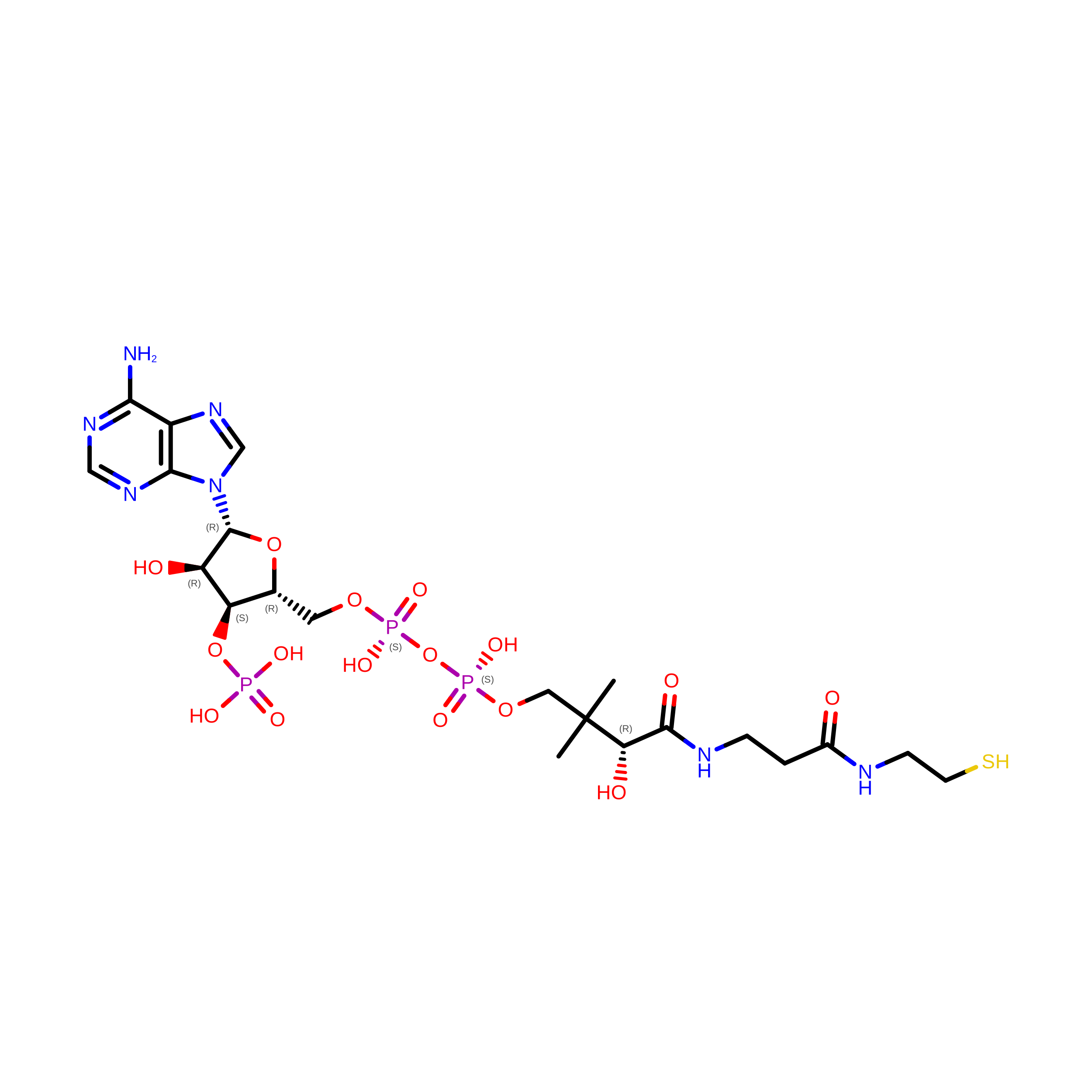
COENZYME A
C21 H36 N7 O16 P3 S
RGJOEKWQDUBAIZ-IBOSZNHHSA-N
GOL

Query on GOL


Download:Ideal Coordinates CCD File
D [auth A]
E [auth A]
F [auth A]
G [auth A]
H [auth A]
D [auth A],
E [auth A],
F [auth A],
G [auth A],
H [auth A],
J [auth B],
K [auth B]
GLYCEROL
C3 H8 O3
PEDCQBHIVMGVHV-UHFFFAOYSA-N

Experimental Data & Validation

Experimental Data

  • Method: X-RAY DIFFRACTION
  • Resolution: 1.90 Å
  • R-Value Free:  0.183 (Depositor), 0.188 (DCC) 
  • R-Value Work:  0.142 (Depositor), 0.154 (DCC) 
  • R-Value Observed: 0.144 (Depositor) 
Space Group: P 21 21 2
Unit Cell:
Length ( Å )Angle ( ˚ )
a = 204.307α = 90
b = 54.171β = 90
c = 73.112γ = 90
Software Package:
Software NamePurpose
REFMACrefinement
PDB_EXTRACTdata extraction
HKL-2000data reduction
HKL-2000data scaling
MOLREPphasing

Structure Validation

View Full Validation Report


Ligand Structure Quality Assessment 


Entry History 

Deposition Data

Revision History  (Full details and data files)

  • Version 1.0: 2015-10-07
    Type: Initial release
  • Version 1.1: 2015-10-14
    Changes: Derived calculations
  • Version 1.2: 2023-11-08
    Changes: Data collection, Database references, Derived calculations, Refinement description