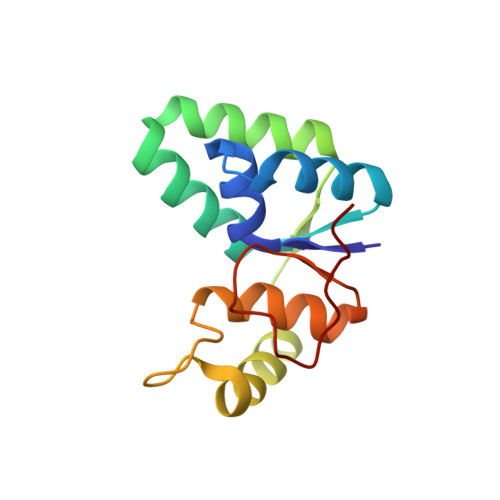
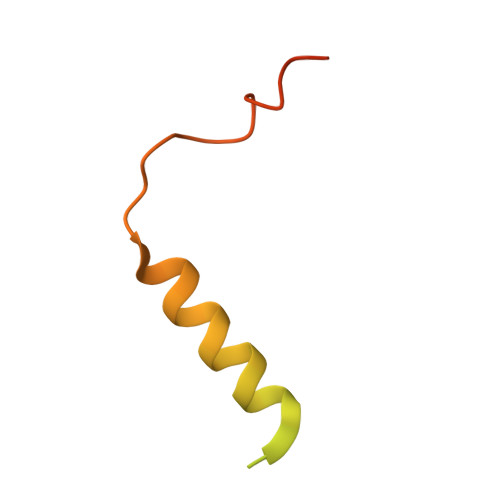
4XGQ | pdb_00004xgq

Crystal structure of addiction module from Mycobacterial species


Experimental Data Snapshot

  • Method: X-RAY DIFFRACTION
  • Resolution: 2.70 Å
  • R-Value Free: 
    0.238 (Depositor), 0.239 (DCC) 
  • R-Value Work: 
    0.206 (Depositor), 0.207 (DCC) 
  • R-Value Observed: 
    0.207 (Depositor) 

wwPDB Validation 3D Report Full Report

Validation slider image for 4XGQ

This is version 1.2 of the entry. See complete history

Literature

Structural and functional studies of the Mycobacterium tuberculosis VapBC30 toxin-antitoxin system: implications for the design of novel antimicrobial peptides

Lee, I.-G.Lee, S.J.Chae, S.Lee, K.Y.Kim, J.H.Lee, B.-J.

(2015) Nucleic Acids Res 43: 7624-7637

  • DOI: https://doi.org/10.1093/nar/gkv689
  • Primary Citation Related Structures: 
    4XGQ, 4XGR

  • PubMed Abstract: 

    Toxin-antitoxin (TA) systems play important roles in bacterial physiology, such as multidrug tolerance, biofilm formation, and arrest of cellular growth under stress conditions. To develop novel antimicrobial agents against tuberculosis, we focused on VapBC systems, which encompass more than half of TA systems in Mycobacterium tuberculosis. Here, we report that theMycobacterium tuberculosis VapC30 toxin regulates cellular growth through both magnesium and manganese ion-dependent ribonuclease activity and is inhibited by the cognate VapB30 antitoxin. We also determined the 2.7-Å resolution crystal structure of the M. tuberculosis VapBC30 complex, which revealed a novel process of inactivation of the VapC30 toxin via swapped blocking by the VapB30 antitoxin. Our study on M. tuberculosis VapBC30 leads us to design two kinds of VapB30 and VapC30-based novel peptides which successfully disrupt the toxin-antitoxin complex and thus activate the ribonuclease activity of the VapC30 toxin. Our discovery herein possibly paves the way to treat tuberculosis for next generation.


  • Organizational Affiliation
    • Research Institute of Pharmaceutical Sciences, College of Pharmacy, Seoul National University, Seoul 151-742, Korea.

Macromolecule Content 

  • Total Structure Weight: 94.29 kDa 
  • Atom Count: 5,050 
  • Modeled Residue Count: 648 
  • Deposited Residue Count: 864 
  • Unique protein chains: 2

Macromolecules

Find similar proteins by:|  3D Structure
Entity ID: 1
MoleculeChains  Sequence LengthOrganismDetailsImage
Ribonuclease VapC30A,
C [auth E],
E [auth C],
G
132Mycobacterium tuberculosis H37RvMutation(s): 0 
Gene Names: vapC30Rv0624MTCY20H10.05
EC: 3.1
UniProt
Find proteins for P9WF77 (Mycobacterium tuberculosis (strain ATCC 25618 / H37Rv))
Explore P9WF77 
Go to UniProtKB:  P9WF77
Entity Groups
Sequence Clusters30% Identity50% Identity70% Identity90% Identity95% Identity100% Identity
UniProt GroupP9WF77
Sequence Annotations
Expand
Reference Sequence
Find similar proteins by:|  3D Structure
Entity ID: 2
MoleculeChains  Sequence LengthOrganismDetailsImage
Antitoxin VapB30B,
D [auth F],
F [auth D],
H
84Mycobacterium tuberculosis H37RvMutation(s): 0 
Gene Names: vapB30Rv0623
UniProt
Find proteins for P9WJ35 (Mycobacterium tuberculosis (strain ATCC 25618 / H37Rv))
Explore P9WJ35 
Go to UniProtKB:  P9WJ35
Entity Groups
Sequence Clusters30% Identity50% Identity70% Identity90% Identity95% Identity100% Identity
UniProt GroupP9WJ35
Sequence Annotations
Expand
Reference Sequence

Experimental Data & Validation

Experimental Data

  • Method: X-RAY DIFFRACTION
  • Resolution: 2.70 Å
  • R-Value Free:  0.238 (Depositor), 0.239 (DCC) 
  • R-Value Work:  0.206 (Depositor), 0.207 (DCC) 
  • R-Value Observed: 0.207 (Depositor) 
Space Group: P 31 2 1
Unit Cell:
Length ( Å )Angle ( ˚ )
a = 96.381α = 90
b = 96.381β = 90
c = 232.788γ = 120
Software Package:
Software NamePurpose
REFMACrefinement
HKL-2000data reduction
HKL-2000data scaling
MOLREPphasing

Structure Validation

View Full Validation Report


Entry History 

Deposition Data

Revision History  (Full details and data files)

  • Version 1.0: 2015-08-12
    Type: Initial release
  • Version 1.1: 2015-09-16
    Changes: Database references
  • Version 1.2: 2024-03-20
    Changes: Data collection, Database references, Derived calculations